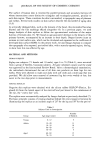
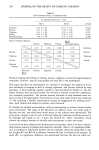
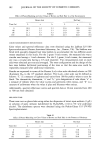
158' JOURNAL OF THE SOCIETY OF COSMETIC CHEMISTS Table II Facial Irritation Study 2: Complexion Bars Accumulated mean sum -+ S.D. Bar C Bar D p-Value Erythema 5.07 - 4.43 12.13 -+ 8.35 Dryness 1.67 - 1.88 3.20 - 2.96 Tightness 2.33 -+ 1.84 4.20 _ 3.45 Itching 0.93 - 1.28 3.40 - 3.79 Burning/stinging 1.40 - 1.60 4.33 - 1.08 0.023 O.O25 0.037 0.026 0.008 Pearson correlation coefficients.' Bar D Dryness Tightness Itching Burning/ stinging -0.17 -0.13 0.21 0.25 Dryness Tightness Itching Burning/stinging 0.67 0.60 0.48 0.70 0.79 0.80 0.72 0.63 •"••. 0.86 0.86 0.26 0.40 • -. 0.85 0.12 -0.02 -0.27 • Erythema Dryness Tightness Itching Bar C Erythema Dryness Tightness Itching Products evoking the feelings of itching, dryness, tightness, and/or burning/stinging in consumers, however, may be unacceptable and may fail in the marketplace. This paper describes the development of a method to investigate the subjective irrita- tion attributes of stinging as well as itching, tightness, and dryness induced by soap materials. A facial washing regimen, similar to that described by Frosch (7), was fol- lowed. Subjects were not pre-screened, but selected at random to provide a representa- tive consumer population. Ten percent aqueous solutions of soap materials were uti- lized, as this is the approximate concentration of soap used under normal use conditions (7). By including a skinfeel questionnaire during an exaggerated-use washing proce- dure, both clinical and subjective irritancy were evaluated. To develop the skinfeel questionnaire, subjects participating in various clinical studies were interviewed. The types of feel perceived on subjects' faces, the words used to describe this feel, and what those words meant to the subjects were determined. The seven-point category scale for each of the four subjective irritation attributes proved to be thorough and simple to use. A space was allotted for "other" discomfort, which allowed the subjects freedom to describe their perceptions in their own terms. A review of the data indicates that between pairs of soap bars, there is no strict relation- ship between induced erythema and subjective irritation. That is, if a significant differ- ence in erythema is determined between the test materials, there may (study #2) or may not (studies # 1 and #4) be a difference between the bars in self-perceived irritancy. In study #3, no significant difference was determined between the bars for either ery-

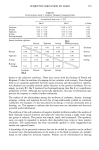
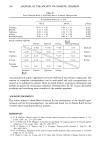
SUBJECTIVE IRRITATION BY SOAPS 159 Table III Facial Irritation Study 3: Synthetic Detergent Complexion Bars Accumulated mean sum + S.D. Bar E Bar F p-Value Erythema 12.41 + 9.10 11.92 + 8.75 Dryness 5.21 + 5.74 5.71 + 5.77 Tightness 5.43 + 5.18 6.36 + 6.01 Itching 2.43 + 4.09 3.21 + 5.62 Burning/stinging 3.36 + 4.78 4.71 + 6.35 0.23 0.50 0.22 0.55 0.06 Pearson correlation coefficients.' Bar F Dryness Tightness Itching Burning/ stinging Dryness Tightness Itching • 0.31 0.43 0.41 0.08 - • 0.86 0.12 0.86 • 0.27 0.76 0.84 0.11 0.73 0.87 0.86 O.92 O.9O Burning/stinging 0.44 O.83 0.91 0.93 Erythema Dryness Tightness Itching Bar E Erythema Dryness Tightness Itching thema or the subjective attributes. These data concur with the findings of Frosch and Kligman (2) that the attribute of stinging did not correlate with irritancy. Even though there is no consistent agreement between visual irritation and that perceived, informa- tion obtained can certainly provide useful direction to the product developer. For ex- ample, in study #3, Bar F produced less burning/stinging than Bar E at a significance probability of 0.06. Although not statistically significant, this type of information may provide the impetus to conduct further evaluations. The analysis of the relationships among the attributes of erythema, dryness, burning/ stinging, itching, and tightness for each bar of soap additionally yielded no consistent correlation. For example, if a bar was perceived as drying, it was not necessarily seen as burning, etc. This appears to indicate that the terms were not redundant and that each provided useful information. The addition of this self-evaluation of negative skinfeel attributes enabled the analysis of both clinically induced irritation and subjective irritation during a single study using one group of subjects. The process was simple, rapid, and economical. The question- naire can easily be expanded to include other discomfort-type terms or more positive attributes. The questionnaire has been successfully applied to other exaggerated-use studies not reported herein. A knowledge of the perceived irritation that can be evoked by a product can be utilized in several ways. Recommendations can be made as to the likely acceptance of a product based on the subjective irritation response. Product can be reformulated by altering
Purchased for the exclusive use of nofirst nolast (unknown)
From: SCC Media Library & Resource Center (library.scconline.org)