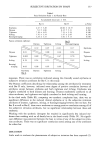
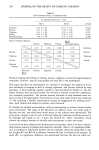
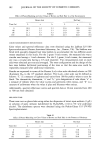
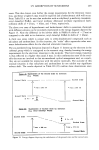
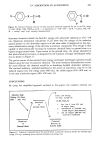
SUBJECTIVE IRRITATION BY SOAPS 159 Table III Facial Irritation Study 3: Synthetic Detergent Complexion Bars Accumulated mean sum + S.D. Bar E Bar F p-Value Erythema 12.41 + 9.10 11.92 + 8.75 Dryness 5.21 + 5.74 5.71 + 5.77 Tightness 5.43 + 5.18 6.36 + 6.01 Itching 2.43 + 4.09 3.21 + 5.62 Burning/stinging 3.36 + 4.78 4.71 + 6.35 0.23 0.50 0.22 0.55 0.06 Pearson correlation coefficients.' Bar F Dryness Tightness Itching Burning/ stinging Dryness Tightness Itching • 0.31 0.43 0.41 0.08 - • 0.86 0.12 0.86 • 0.27 0.76 0.84 0.11 0.73 0.87 0.86 O.92 O.9O Burning/stinging 0.44 O.83 0.91 0.93 Erythema Dryness Tightness Itching Bar E Erythema Dryness Tightness Itching thema or the subjective attributes. These data concur with the findings of Frosch and Kligman (2) that the attribute of stinging did not correlate with irritancy. Even though there is no consistent agreement between visual irritation and that perceived, informa- tion obtained can certainly provide useful direction to the product developer. For ex- ample, in study #3, Bar F produced less burning/stinging than Bar E at a significance probability of 0.06. Although not statistically significant, this type of information may provide the impetus to conduct further evaluations. The analysis of the relationships among the attributes of erythema, dryness, burning/ stinging, itching, and tightness for each bar of soap additionally yielded no consistent correlation. For example, if a bar was perceived as drying, it was not necessarily seen as burning, etc. This appears to indicate that the terms were not redundant and that each provided useful information. The addition of this self-evaluation of negative skinfeel attributes enabled the analysis of both clinically induced irritation and subjective irritation during a single study using one group of subjects. The process was simple, rapid, and economical. The question- naire can easily be expanded to include other discomfort-type terms or more positive attributes. The questionnaire has been successfully applied to other exaggerated-use studies not reported herein. A knowledge of the perceived irritation that can be evoked by a product can be utilized in several ways. Recommendations can be made as to the likely acceptance of a product based on the subjective irritation response. Product can be reformulated by altering

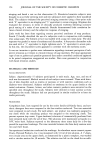
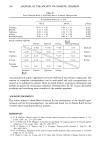
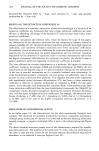
160 JOURNAL OF THE SOCIETY OF COSMETIC CHEMISTS Table IV Facial Irritation Study 4: All-Family Bar vs. Synthetic Detergent Bar Accumulated mean sum 4-_ S.D. Bar G Bar H p-Value Erythema 10.07 4-_ 7.66 4.93 -+- 5.74 Dryness 2.33 -+- 2.85 1.27 4-_ 1.83 Tightness 2.00 4-_ 2.00 2.20 4-_ 2.76 Itching 0.93 4-_ 1.28 0.27 4-_ 0.80 Burning/stinging 0.80 _+_ 1.15 0.80 _ 1.78 0.001 0.090 0.980 0.080 0.630 Pearson correlation coefficients.' Bar H Dryness Tightness Itching Burning/ stinging Dryness Tightness Itching Burning/stinging 0.002 -0.40 -0.06 0.35 0.03 0.19 0.50 • -0.19 -0.11 -0.03 -0.16 0.29 0.25 • -0.02 0.34 -0.03 0.34 0.61 0.19 0.28 Erythema Dryness Tightness Itching Bar G Erythema Dryness Tightness Itching concentrations of suspect ingredients or by the addition of anti-irritant compounds. The amount of complaint correspondence can be anticipated and such correspondence an- swered in an informative manner. More in-depth product acceptance information may perhaps be gained by monitoring complaint correspondence for the various discomfort attributes and correlating these numbers to the panelist responses. ACKNOWLEDGEMENTS The author wishes to thank Maria Giovanni for her development of the skinfeel ques- tionnaire and for her encouragement. An additional thank you to Donna Busch for her valuable input regarding statistical analyses. REFERENCES (1) P. B. Koehler, Clinical aspects of safety testing cosmetic-products in the nineteen-eighties, J. Soc. Cosmet. Chem., 31, 213-218 (1980). (2) P. J. Frosch and A.M. Kligman, A method for appraising the stinging capacity of topically applied substances, J. Soc. Cosmet. Chem., 28, 197-209 (1977). (3) M. A. Brandt, E. Z. Skinner, and J. A. Coleman, Texture profile method, J. Food Sci., 28, 404-409 (1963). (4) N. O. Schwartz, Adaptation of the sensory texture profile method to skin care products, J. of Texture Studies, 6, 33-42 (1975). (5) S. Nacht, J. Close, D. Yeung, and E. H. Gans, Skin friction coefficient: Changes induced by skin
Purchased for the exclusive use of nofirst nolast (unknown)
From: SCC Media Library & Resource Center (library.scconline.org)