164 JOURNAL OF THE SOCIETY OF COSMETIC CHEMISTS links in influencing the mechanical properties of the material could be misleading. This possibility arises since not all crosslinks need be effective in influencing the mechanical properties of a polymer. For example, if crosslinks were found at moderately high con- centration in localized areas of the collagen matrix while they were essentially absent in other areas, the material would likely behave as though it were uncrosslinked in me- chanical experiments while appearing to be crosslinked from a chemical point of view. Thus, the topological positioning of crosslinks as well as their overall concentration are important factors in determining the contributions which crosslinks make to mechan- ical properties of a collagenous material. We have studied methods based on rubber elasticity theory (20) which may be used to assess the number of effective crosslinks in collagenous materials. This theory states that for an isotropic elastic material, the elongation of a stressed sample can be related to the degree of crosslinking. Since rat tail tendon is neither isotropic nor elastic due to its partially crystalline character, we destroyed the crystallinity by denaturation (21) and plasticized (22) the denatured tendon to make it elastic at room temperature. Rubber elasticity theory is based on thermodynamic arguments, and therefore all analyzable data must be time-independent. This paper discusses some surprising results we found when trying to use rubber elasticity theory to characterize rat tail tendon collagen. EXPERIMENTAL Samples of almost pure collagen were obtained from the tails of male white Wistar rats (Mission Labs, Rosemead, CA). The rats ranged in ages from 2 months to over 2 years. Upon removal from the distal end, the samples, which were approximately 10 cm long and . 15 mm in diameter, were washed in excess distilled water and allowed to air dry for 3 hours. They were stored under dry nitrogen and calcium sulfate desiccant at 4øC until use. Storage times did not exceed 3 months. Since our experimental plan involved using rubber elasticity theory, the samples had to behave in a way describable by this equation of state. As mentioned above, natural rat tail tendon, being highly crystalline, is not consistent with this model thus the crys- talline nature of the tendon was eliminated by denaturation. Prior to denaturation, samples selected for uniformity of dimensions and straightness were soaked for 1 hour in distilled water. Samples were then denatured at 70øC for 30 seconds, also in distilled water. This particular set of denaturation conditions was chosen since complete denaturation was necessary and yet the possible effects of hydrol- ysis and excessive swelling by water had to be avoided. In preliminary experiments (21) we observed that these were the mildest conditions which resulted in a totally amor- phous sample as evidenced by visual and X-ray examinations. These samples were then dried overnight in a desiccator. The glass transition temperature of pure collagen is in excess of 200øC, and rather than attempt mechanical experiments above this high temperature where the material would be elastic and presumably obey rubber elasticity theory, it was decided to depress the glass transition temperature through plasticization (22). This is a well-known technique in which the bulk polymer is diluted or swollen with a low molecular weight solvent. The denatured tendons were swollen in glycerol for 24 hours at 60øC. In previous work (23), glycerol proved to be a liquid capable of swelling tendons sufficiently to obtain an

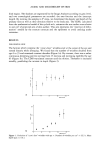
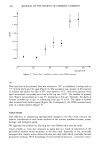
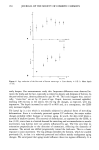
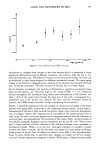
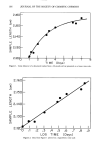
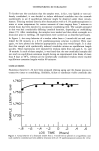
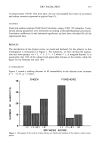
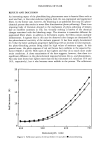
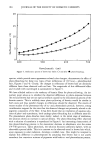
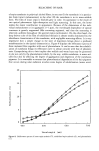
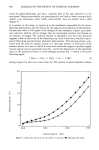
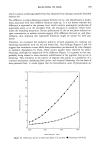
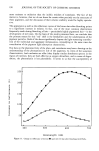
CROSSLINKING IN COLLAGEN 165 elastomer at room temperature furthermore, it has a low enough vapor pressure to eliminate measurable swelling agent loss under our experimental conditions. After swelling, surface glycerol was removed by resting the sample on a piece of filter paper in a desiccator for 1 day. The actual experiment measured sample creep in which the strain under constant stress was recorded. A 2.5-cm straight portion of sample with the most uniform shape was cut from the total tendon and weighed. This piece would be weighed again after the mechanical experiment to check for glycerol loss. For all the mechanical testing re- ported, no change in weight of the swollen sample was detected. Black ink marks of negligible weight which were used as reference points were then made near each end of the sample, which was held in an adjustable screw clamp and hung inside a dry box in preparation for measurement. The dry box was equipped with an internal heater and blower, and dry nitrogen purged the box. With ordinary insulation installed around the box, temperature stability was + 2øC during the course of the experiment. Although various experimental temperatures were used in our thermoelastic studies (21), the ex- periments reported here were all carried out at 40 ø -+ 2øC. All lengths were measured with a cathetometer (-+ .005 cm) placed outside the dry box. Each sample was allowed to equilibrate at the experimental temperature for 30 minutes before appropriate weights were suspended from it. The weight ranged from 0. 1241 gram to 0.4216 gram. Lengths were recorded during stressing. RESULTS AND DISCUSSION The results of a tensile creep experiment carried out at 40øC on a tendon of a 26- month-old rat prepared according to the procedure described above are shown in Figure 1. Here the sample length between bench marks is plotted versus time after the appli- cation of the load. As might be expected, the sample length increases as a function of time and appears to be approaching an equilibrium value at longer times. It is tempting to extrapolate this behavior to an equilibrium extension and use this extrapolated value for analysis via rubber elasticity theory. However, in the study of physical properties of polymers it is well known that such results are often misleading. Since polymer mole- cules are very long, contributions from short-range as well as long-range molecular motions influence observed behavior. Furthermore, short-range molecular motions occur rapidly while longer-range molecular motions may be much slower. Because polymer molecules are so long, these various time scales of relaxation are grossly dif- ferent. In order to accurately access both long-range and short-range relaxation in the same figure, it is always necessary to plot system response as a function of the logarithm of time if any conclusions concerning approaches to equilibrium behavior are to be drawn from experimental data. In view of this fact, the data in Figure 1 have been replotted as length versus log time in Figure 2. Here it is clear that no approach to equilibrium behavior is observed even on an extended time scale involving creep for several days. Thus, any attempt to analyze such data via an equilibrium theory is un- founded. More importantly, however, these observations indicate that the tendon studied, rather than being extensively crosslinked, was so lightly crosslinked that slow relaxation was observed. This tendon was taken from an old rat in which substantial crosslinking would be expected (1). Similar behavior was observed with tendons from animals ranging in age from 2 months to 26 months.
Purchased for the exclusive use of nofirst nolast (unknown)
From: SCC Media Library & Resource Center (library.scconline.org)