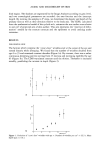
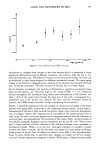
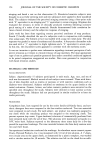
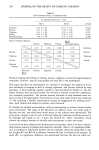
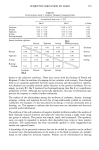
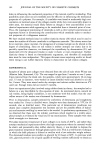
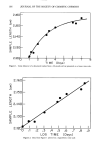
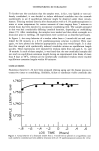
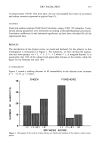
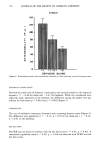
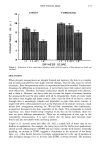
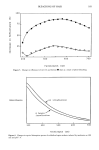
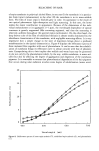
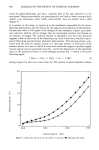
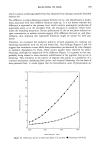
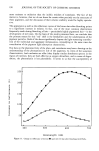
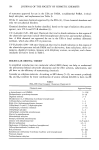
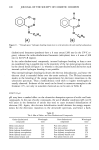
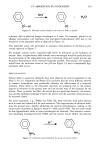
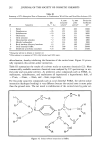
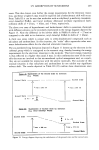
DRY FACIAL SKIN 175 i,i u z u z o u IS 10 CHEEK FOREHEAD 1 (1-2) 2 1 (1-2) 2 •iRYNESS SCORE Figure 3. Evaluation of skin conductance (arbitrary units) with the severity of skin dryness on cheek and forehead. DISCUSSION •/hile physical measurements are straight forward and rigorous, the skin is so complex and so easily perturbed by even slight external changes, that the data must be viewed cautiously. Easy interpretations which fit expectations should be avoided. Conductance illustrates the difficulties in interpretation. A wetter horny layer will conduct electricity more effectively. Therefore, decreased conductance should be associated with dryness, and it often is. However, one has to take into account the degree of intimacy between the sensing probe and the skin surface with all its irregularities. Scales of course make the surface even rougher and lessen contact. Also, since the flow of an electric current through skin is exceedingly complex and dependent in more than water content, it might well reflect other parameters such as the thickness of the stratum corneum, casual sebum level, nonapparent sweating, etc. •/e did find, nonetheless, that conductance, as expected, decreased in dry skin, especially on the cheek. This corresponds to clinical experience, too. Since women rarely complain of dry skin on the forehead, these two sites are quite different anatomically. There are no ambiguities of this type in the extensibility measurements. It is quite evident that the horny layer becomes more brittle and less stretchable with increasing dryness. Cooper et al. recently noted this effect (9). Still, a simple lack of water may be too shallow an explanation. For example, the horny layer could be thicker and qualitatively altered as well. Measurement of TE•/L did not closely correlate with dryness. Generally speaking, an increase in TE•/L suggests a disturbance in the structure of the horny layer, e.g., when barrier function is strongly compromised as in the case of psoriasis or after detergent damage (10, 11). In these cases TE•/L is always elevated. The tendency

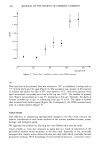
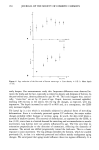
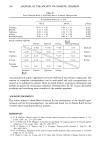
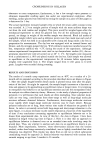
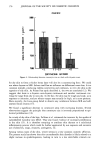
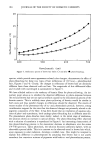
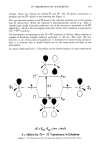
176 JOURNAL OF THE SOCIETY OF COSMETIC CHEMISTS CHEEK n- W n- W W 0 9gg 659 8BB 759 ?BB 1 (1-2) I]RYNESS SCORE Figure 4. Relationship between corneocyte size on cheek with dryness scores. for dry skin to form a thicker horny layer will also be a counteracting force. We could not relate dryness to SER. Sebum itself has no influence on diffusional water loss. It is a common mistake, producing endless controversy and confusion, to view dry skin as the opposite of oily skin. As Pierard has aptly described it, the two are unrelated (12). We suggest that there is a dryness-non-dryness continuum and another continuum cov- ering the range from oily to non-oily. In the face, the skin may be rough and scaly, as in response to irritation, and yet sebum output may actually be high, as in acne patients. More recently, the Iowa group failed to observe any correlation between SER and self- assessed facial dryness (13). We found a significant decrease in corneocyte areas with increasing dryness. Several observations suggest the principle that corneocyte size is inversely proportional to epi- dermal proliferation (14). In a study of dry skin of the legs, Fullmer et al. estimated the turnover by the uptake of radiolabelled tymidine into DNA. They also found evidence of increased proliferation in dry skin (15). It is therefore tempting to attribute skin dryness to a subclinical inflammatory process which could be further aggravated by sun exposure and excessive use of abrasives, soaps, cleansers, astringents, etc. Among various types of dry skin, winter xerosis is a very common cosmetic affliction. The present study has shown that this uncomfortable skin disorder is likely related to a slight increase in epidermopoiesis, leading in turn to a less stretchable stratum cor-
Purchased for the exclusive use of nofirst nolast (unknown)
From: SCC Media Library & Resource Center (library.scconline.org)