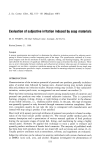
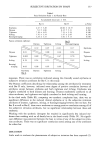
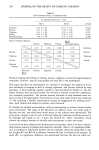
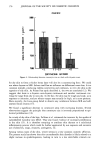
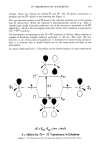
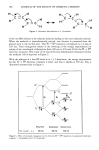
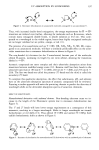
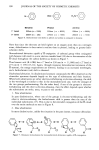
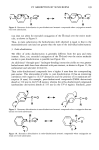
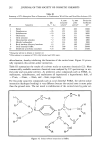
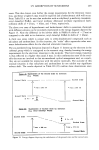
UV ABSORPTION BY SUNSCREENS 203 vents. This then lowers even further the energy requirements for the electronic transi- tion, and hence a higher X max would be expected and a bathochromic shift will occur. From Table III it can be seen that molecules such as ethylhexyl p-methoxy cinnamate, octyl dimethyl PABA, and butyl methoxy dibenzoyl methane experienced bath- ochromic shifts of q-23nm, q- 16nm, and q- 9nm, respectively. The above two cases of hypsochromic and bathochromic shifts in sunscreen chemicals with different solvents can be pictorially represented in the energy diagram depicted by Figure 15. Note the difference in the solvent shifts in PABA (X shifts of -27nm) as compared to the shift in its derivative, octyl dimethyl PABA (• shifts of q- 16nm). A third case exists which is unique only to ortho-disubstituted compounds such as salicylates and anthranilates. In this situation, the "ortho" effect supercedes other reso- nance delocalization effects for the observed ultraviolet transitions. The six-membered ring formation depicted in Figure 11 loosens up the electrons in the carbonyl group which is conjugated to the aromatic ring, thereby lowering the energy requirements for the electronic transition in the molecule. This lower energy transition is thus reflected in a higher than usual • max. In this conformation most of the avail- able electrons are involved in this six-membered cyclical arrangement and, as a result, they are not available for interaction with the solvent molecules. The outcome of this unusual situation is that salicylates and anthranilates do not exhibit any significant solvent shift. The results depicted in Table III (22) confirm these observations since Ca.•.•z.•._.• Slablllzallon o! Ihe Ground State by Solvatlon (e.g. PABA) Excited State .................. • max . 293 nm Ground State .. /• • = - 27 '.... Excited State • ma[ ß 266 nm -. ß - Ground State CaseJ• Slablllzallon of Exclled State by Solvallon (e.g. Oclyl Dimethyl PABA) Excited State Ground State ee ** ß Excited State •max ß 300 nm T Amax = 316 nm Ground •ale . ß .. ee eee* e. ee ee .e Figure 15. Energy diagram depicting the stabilization of the ground state and the excited state.

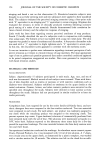
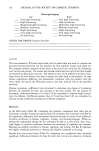
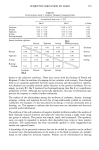
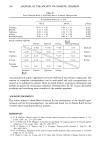
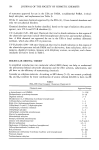
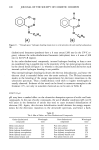
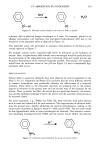
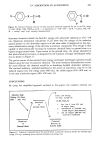
204 JOURNAL OF THE SOCIETY OF COSMETIC CHEMISTS homomenthyl salicylate shifts by -2nm, octyl salicylate by -2nm, and menthyl anthranilate by + 2nm only. EFFECTS ON THE EXTINCTION COEFFICIENT (E) The effectiveness of a sunscreen chemical at a particular wavelength is a function of its extinction coefficient (e). Chemicals that have a high extinction coefficient are more efficient in absorbing the energy of the harmful UV radiation than those with a lower extinction coefficient. Symmetry, calculations and selection rules, which are beyond the scope of this paper, can characterize all the electronic transitions for any compound as symmetry allowed or symmetry forbidden (23,24). Symmetry allowed transitions generally have high extinction coefficients, and symmetry forbidden transitions have lower extinction coefficients. Nevertheless, trends in extinction coefficients for sunscreen chemicals can be arrived at qualitatively, by studying both the spatial requirements and the electronic transition responsible for the observed UV spectrum. Since it has been demonstrated earlier that the degree of resonance delocalization in a molecule can predict the relative }, max, a similar qualitative prediction regarding its extinction coefficient is possible. The more efficient the electron alelocalization in a molecule, the higher its extinction coefficient. Compare, for example, PABA and menthyl anthranilate. In PABA, the two substituents on the benzene ring are in a para relationship whereas the two substituents in the case of menthyl anthranilate are in a sterically hindered ortho relationship. In ortho-disubstituted aromatic compounds, the two groups are sufficiently close to one another to cause a deviation from planarity. This slightest deviation from coplanarity will significantly reduce resonance delocalization (25), and hence a lower extinction coefficient is observed in menthyl anthranilate as compared to PABA. For the same reason, octyl salicylate and homomenthyl salicylate (both ortho-disubstituted) have lower extinction coefficients than the para-disubstituted compounds. See Table III for comparative results. Increased conjugation, allowing for increased resonance delocaliza- tion, will also result in higher extinction coefficients. For example, the extinction coef- ficient of ethylene is 15,000, that of 1,3 butadiene is 21,000, that of 1,3,5-hexatriene is 35,000, and in the case of the highly conjugated molecule, B-carotene, it is 152,000. MECHANISM OF SUNSCPdSENING ACTION In an earlier paper (3), the characteristics for the ideal sunscreening chemical were outlined. The chemicals are generally disubstituted aromatic compounds possessing a carbonyl group (either part of a ketone or an ester) and an electron-releasing substituent (usually nitrogen- or oxygen-containing) ortho or para to the carbonyl group (see Figure 16). The above chemical structures possess most of the characteristics required for suitable sunscreen protection. The presence of the substituent Y, with a lone pair of electrons in the ortho or para position, allows for the necessary electron alelocalization required for absorbance at the observed }, max (see Figures 8 and 10).
Purchased for the exclusive use of nofirst nolast (unknown)
From: SCC Media Library & Resource Center (library.scconline.org)