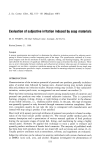
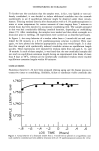
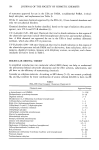
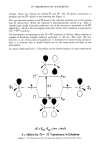
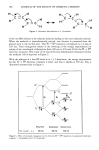
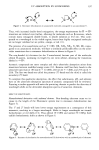
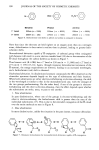
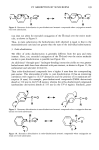
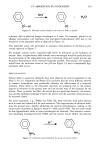
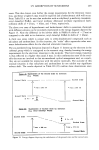
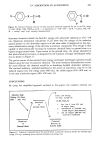
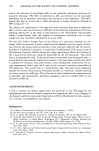
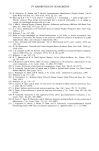
UV ABSORPTION BY SUNSCREENS 201 OH- Figure 12. Phenolate anions formed by the action of alkali on phenol. HzO ochromic shift is observed (longer wavelength or h. max). For example, phenol in an alkaline environment will experience this anticipated bathochromic shift due to the formation of the phenolate anion as depicted in Figure 12. This phenolate anion will participate in resonance delocalization of electrons as pre- viously depicted in Figure 5. For aromatic amines, acidic conditions (pH below 4) will assist in the formation of cations. Here, a hypsochromic shift towards lower wavelength would be predicted since the protonation of the unbounded lone pair of electrons with acid would prevent any resonance delocalization of the electrons originally possible. Thus aniline, for example, would form the anilinium cation at low pH (see Figure 13) and a considerable hyp- sochromic shift occurs. EFFECT OF SOLVENT Solvent shifts in sunscreen chemicals have been observed by several researchers in the field (3, 19-21). Riegelman and Penna (22) concluded that the use of different solvents in cosmetic formulations may profoundly influence the effectiveness of a sunscreen chemical. These shifts in the ultraviolet spectrum are primarily due to the relative degrees of solvation of the ground state and the excited state of the chemical by the solvent. Thus, to predict the effect the solvent has on a particular chemical, the interac- tion (mostly hydrogen bonding) between the solvent and the sunscreen chemical has to be reviewed closely. For polar sunscreens, e.g., PABA (see Table III), their solvation with polar solvents such as water and ethanol will be quite extensive. This large amount of solvation stabi- lizes the ground state, thereby inhibiting the electron delocalization, leading to the excited state illustrated in Figure 8, where Y = NH 2 and R- OH. The net result would be that hypsochromic shifts to lower wavelengths are observed. This extensive interac- tion (hydrogen bonding) between PABA and the solvent would inhibit this electron NH: NHz Figure 13. Anilinium cation formed by the action of acid on aniline.

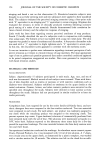
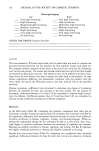
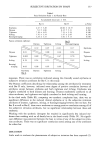
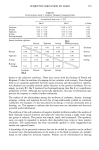
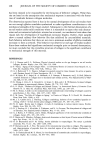
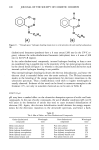
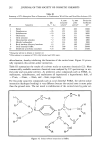
202 JOURNAL OF THE SOCIETY OF COSMETIC CHEMISTS Table III Summary of UV Absorption Data of Sunscreens in Combination With Polar and Non-Polar Solvents (22) # Sunscreen h• max h 2 max Extinction Ah non-polar polar Coefficient (•'2 -- k•.) solvent • solvent u (e) u 1 PABA - 27 293 266 13600 2 Dioxybenzone - 26 352 326 9400 3 Sulisobenzone - 10 334 324 8600 4 Oxybenzone - 8 329 321 9300 5 Octyl salicylate - 2 308 306 4900 6 Homomenthyl salicylate - 2 310 308 4800 7 Menthyl anthranilate q- 2 334 336 5600 8 Butyl methoxy dibenzoyl methane q- 9 351 360 31000 9 Octyl dimethyl PABA q- 16 300 316 28400 10 Ethylhexyl p-methoxy cinnamate + 23 289 312 24200 Non-polar solvent is hexane or mineral oil. Polar solvent is a mixture of 70% ethyl alcohol and 30% water. delocalization, thereby inhibiting the formation of the excited state. Figure 14 pictor- ially represents this solvent-solute interaction. Table III summarizes the results of a solvent study on sunscreen chemicals (22). Most commercially available sunscreen chemicals were analyzed by UV spectroscopy in sev- eral polar and non-polar solvents. As predicted, polar compounds such as PABA, di- oxybenzone, sulisobenzone, and oxybenzone all experienced a hypsochromic shift, of - 27nm, - 26nm, - 10nm, and - 8nm, respectively. For less polar sunscreen compounds such as octyl dimethyl PABA, the solvent-solute interaction (hydrogen bonding) is very different because the excited state is more polar than the ground state. The net result is stabilization of the excited state by polar sol- Figure 14. Solute-solvent interaction in PABA.
Purchased for the exclusive use of nofirst nolast (unknown)
From: SCC Media Library & Resource Center (library.scconline.org)