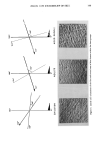
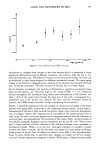
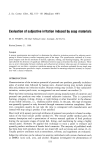
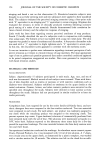
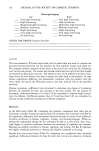
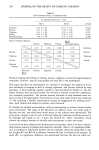
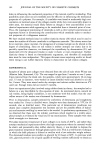
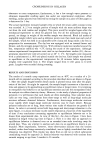
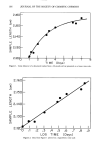
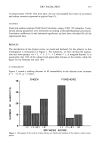
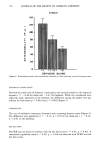
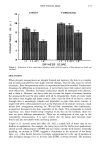
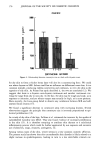
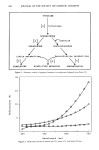
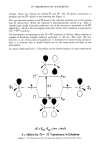
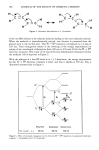
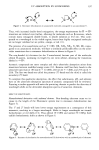
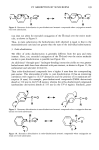
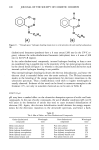
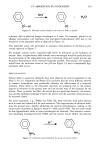
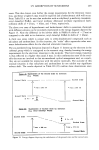
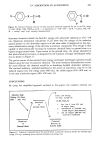
UV ABSORPTION BY SUNSCREENS 199 Figure 8. Resonance delocalization in para-disubstituted aromatic compounds where conjugation extends over both substituents. tion does not allow for extended conjugation of the H-cloud over the entire mole- cule, as shown in Figure 9. Thus, in meta substitution the bathochromic shift observed is equal to that in the monosubstituted case (and not greater than the sum of the individual substituents). 3. Ortho disubstitution The effect of ortho disubstitution is generally different from the para and meta isomers. Here, too, extended conjugation of the H-cloud over the entire molecule similar to para disubstitution is possible (see Figure t0). An additional "through space" hydrogen-bonding interaction yields an even greater bathochromic shift than those observed with para isomers, as shown in Figure 1 t, for anthranilate and salicylate derivatives. Thus ortho-disubstituted compounds have a higher K max than the corresponding para isomer. This relationship of ortho vs. para disubstitution (3) has an interesting correlation with regard to its UV absorption and the position of its maximum ab- sorption (K max). For example, para-disubstituted compounds (PABA derivatives) absorb at 3 t0 nm (in the UV-B region), whereas the ortho-disubstituted compounds (anthranilate derivatives) absorb at 335 nm (in the UV-A region). Similarly, para- Figure 9. Resonance delocalization in meta-disubstituted aromatic compounds where conjugation does not extend over both substituents. Figure 10. Resonance delocalization in ortho-disubstituted aromatic compounds where conjugation ex- tends over both substituents.

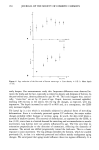
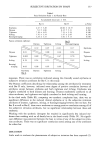
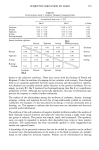
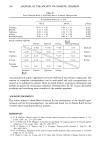
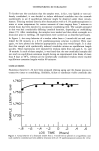
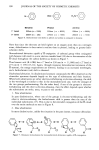
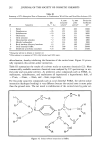
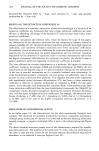
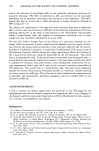
200 JOURNAL OF THE SOCIETY OF COSMETIC CHEMISTS H H . "-7---'% I I O• O•CloH1 Call17 (^) Figure 11. "Through space" hydrogen bonding interaction in octyl salicylate (A) and menthyl anthranilate (B). disubstituted benzoates (parabens) have a X max around 260 nm (in the UV-C re- gion), whereas the ortho-disubstituted benzoates (salicylates) have a X max of 308 nm (in the UV-B region). In the ortho-disubstituted compounds, internal hydrogen bonding to form a new six-membered ring is possible due to the proximity of the two polar groups (as shown by the dotted bonds in Figure 11), whereas in the para-disubstituted derivatives such internal cyclical hydrogen bonding is not possible. This internal hydrogen bonding facilitates the electron delocalization, and hence the electron cloud is extended futher over the entire molecule. The H-cloud extension results in the lowering of the energy requirements for electronic transitions in the ultraviolet spectrum. Thus a bathochromic (red) shift to higher wavelengths is usually observed. Evidence of this trend can be found in numerous examples in the literature (17), not only in sunscreen chemicals as can be seen in Table II. EFFECT OF pH pH may have a marked effect on the ultraviolet absorption spectra of acidic and basic compounds. In the case of acidic compounds, the use of alkaline conditions (pH over 9) will assist in the formation of anions that tend to cause increased delocalization of electrons (18). Again, this electron delocalization would decrease the energy require- ments for the electronic transition in the ultraviolet spectrum, and hence a bath- Table II The X Max of Ortho- and Para-Disubstituted Compounds Ortho-disubstituted compounds Wavelength Para-disubstituted Wavelength (nm) compounds (nm) Ortho nitro phenol Ortho nitro aniline Ortho hydroxy benzaldehyde Ortho hydroxy acetophenone Ortho hydroxy benzoic acid Ortho amino benzoic acid 351 Para nitro phenol 317 412 Para nitro aniline 381 325 Para hydroxy benzaldehyde 282 329 Para hydroxy acetophenone 276 301 Para hydroxy benzoic acid 251 327 Para amino benzoic acid 284
Purchased for the exclusive use of nofirst nolast (unknown)
From: SCC Media Library & Resource Center (library.scconline.org)