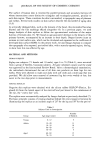
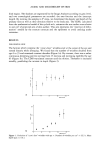
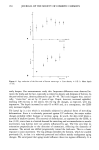
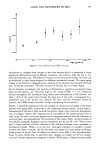
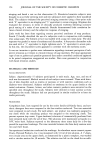
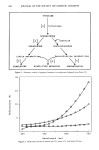
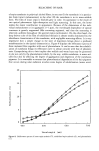
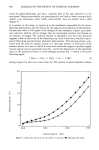
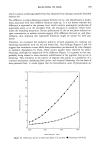
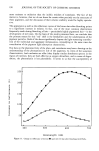
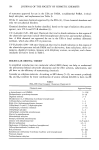
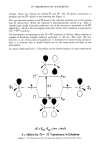
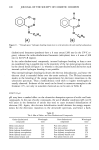
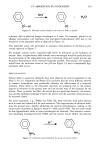
J. Soc. Cosmet. Chem., 82, 179-191 (May/June 1987) Chemical- and photo-bleachino of brown and red hair LESZEK J. WOLFRAM and LINDA ALBRECHT, Clairol Research Laboratories, Stamford, CT 06922. Received December 19, 1986. Presented at the Annual Meeting of the Society of Cosmetic Chemists, New York, December 4-5, 1986. Synopsis The color of mammalian hairs is mainly due to the presence of melanin pigments that are introduced into the keratinized cytoplasmic protein during the process of fiber formation. The melanins fall into two chemically distinct classes: eumelanin, derived from enzyme oxidation of DOPA, and pheomelanin, formed from 5-S-cysteinyl DOPA. The eumelanin is found in black and brown hair while pheomelanin is the red hair colorant. The changes in hair color that are attendant upon bleaching of hair with hydrogen peroxide or upon exposure to sunlight have been followed using reflectance measurements. Our data suggest that pheomel- anin is more resistant than eumelanin to chemical or photo-degradation, a finding supported by a parallel series of in vitro experiments with the isolated pigments. We have also observed shifts in the hue of bleached tresses and have proposed an explanation of these in terms of changes in physical and spectral characteristics of the melanin pigment. INTRODUCTION The color of hair is derived mainly from the secretory products of melanocytes. These products consist of a range of melanin pigments having different structures and compo- sitions. Presumably, by varying the chemical nature of the pigment, its quantity, and its mode of distribution within the hair, a wide range of colors can be produced. The pigmentary colors are under genetic control which, in laboratory rodents and domestic animals, is now well understood (1). Although there is still a paucity of parallel infor- mation with regard to the inheritance of hair color, the variations in hair color are seen primarily as biochemical differences. Indeed, there is substantial evidence (2) sug- gesting that all pigments are biogenetically related, arising from a common metabolic pathway in which dopaquinone is the key intermediate. A link between the two most important and chemically distinct classes of melanin--eumelanin (black pigment) and pheomelanin (red pigment), accounting for the possibility of intermeshing of pigmen- tary pathways--has been suggested by Prota (2). A graphic representation of the cur- rently held view in this field is given in Figure 1. In terms of hair color, such inter- meshing could possibly account for the warm tones frequently seen in brown hair. Figure 2, which shows spectral reflectance curves of black (Oriental), brown, and red hair, illustrates this point. The brown hair displays spectral characteristics which appear intermediate to the fully eumelanic (black) and fully pheomelanic (red) fibers. 179

180 JOURNAL OF THE SOCIETY OF COSMETIC CHEMISTS ,, TYROSINE O] tyrosinase DOPAQUINONE DOPACHROME / indole metabolites EUMELANINS ••ys te ine CYSTEINYLDOPAS benzothiazine metabolites MIXED-TYPE MELAN INS PHEOMELANINS Figure 1. Schematic outline of pigment formation in melanocytes [adapted from Prota (2)]. 20 15 10 i i I I I 400 500 600 Wavelength (nm) Figure 2. Reflectance spectra of natural red (A), brown (O), and black ({U) hair. ! 700
Purchased for the exclusive use of nofirst nolast (unknown)
From: SCC Media Library & Resource Center (library.scconline.org)