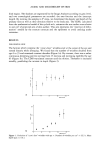
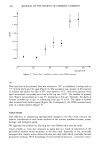
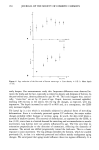
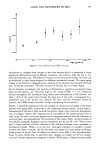
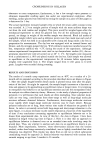
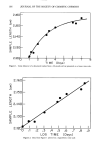
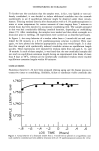
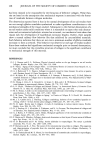
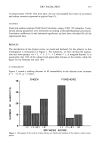
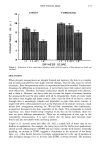
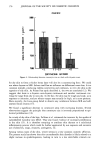
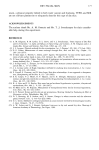
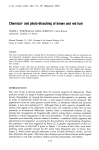
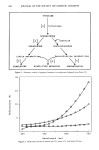
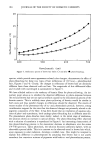
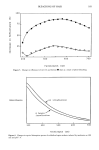
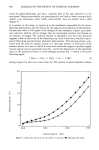
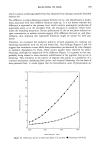
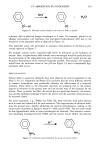
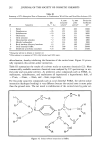
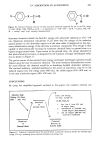
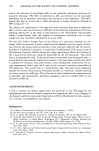
AGING AND MICRORELIEF OF SKIN 147 bital region. The shadows are segmented by the Image Analyzer according to grey level, and two stereological parameters are recorded: the area fraction and the intercept length. By rotating the samples in 9 ø steps, we determined the density and depth of the primary lines as well as their direction relative to the body axis. The CDSS, calculated from the mathematical model of the cycloid arch, estimates the true surface area relative to one cm 2 of projected area of skin surface. This area represents the "reservoir of defor- mation" needed by the stratum corneum and the epidermis to avoid cracking under extension. RESULTS PERI-ORBITAL SKIN The furrows which comprise the "crow's-foot" wrinkles start at the corner of the eye and extend linearly while diverging. We found that the number of wrinkles doubled from age 6 to 35 and remained constant therafter (Figure la). By contrast, there was a rather continuous deepening pattern starting from 25 microns and increasing eightfold by age 65 (Figure lb). The CDSS was almost constant until the thirties. Thereafter it increased steadily, paralleling the increase in depth (Figure 2). VlO a. a o age (years) + b o , elo • ,. •1o 40 eo =ge (yea•s) Figure 1. Evolution of "crow's foot" wrinkles with age. a. Number of wrinkles per cm 2 + S.E.b. Mean depth (I-tm + S.E.).

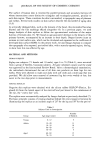
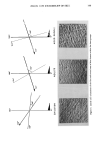
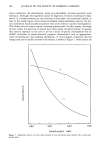
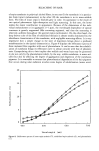
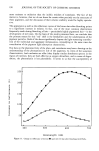
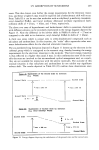
148 JOURNAL OF THE SOCIETY OF COSMETIC CHEMISTS 1.50 I .40. 1.30 I .20 1 1.00- 0 20 40 60 80 age (years) Figure 2. "Crow's foot" wrinkles: evolution of the CDSS with age. LEG The main axis of the primary lines was oriented at 125 ø in childhood, turning back to 73 ø in both adults and the aged (Figure 3). The secondary axis, present in fifty percent of children and adults, was first at 95 ø, then shifted to 151 ø. Only thirty percent of the aged maintained a secondary axis close to the leg axis (165ø). The number of primary lines (Figure 4a) increased up to age 35, plateauing at this age. Similarly, the depth of furrows increased up to age 35, plateauing from age 35 to 65. The depth of furrows then increased with further aging (Figure 4b). Consequently, the CDSS increased mod- estly in a similar fashion (Figure 5). DISCUSSION One difficulty in interpreting age-associated changes in the skin relief concerns the relative contribution of each factor involved in the process: mechanical stress, actinic damage, and biological aging. We approach the problem by selecting two very different skin sites for study. Linear wrinkles as "crows j%t" originate in aging skin as a result of contraction of the peri-orbital muscles which terminate in the skin itself. Especially in lax, actinically damaged skin, muscle action throws the skin into deep folds which eventually become permanent etchings. With the passage of time and loss of elasticity, "crows feet" neces-
Purchased for the exclusive use of nofirst nolast (unknown)
From: SCC Media Library & Resource Center (library.scconline.org)