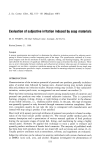
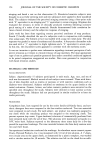
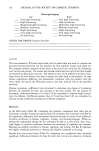
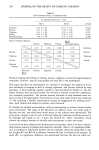
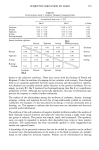
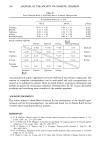
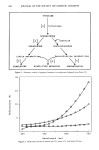
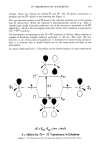
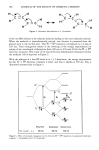
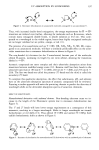
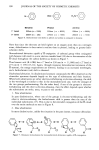
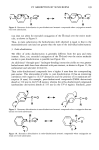
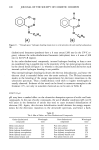
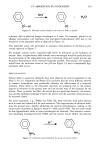
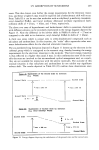
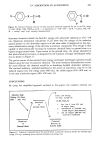
UV ABSORPTION BY SUNSCREENS 205 C--OR R y Figure 16. General chemical structure of most sunscreen chemicals approved for use in the US, where Y=OH, OCH 3, NH2, N(CH3)2 and X = no substituent or -CH=CH - and R = C6H4Y, OH, OR' (R' = methyl, amyl, octyl, menthyl, homomenthyl). Sunscreen chemicals absorb the harmful, energy-rich ultraviolet radiation at 250-350 nm. Quantum mechanical calculations (5,23) show that the energy of the radiation quanta present in this ultraviolet region is of the same order of magnitude as the reso- nance delocalization energy of the electrons in aromatic compounds. This energy is thus capable of photochemically exciting the sunscreen chemical from its ground state to a higher energy-excited state. Upon return to the ground state, the energy absorbed in this photochemical excitation is dissipated by the emission of longer wavelength radia- tion as shown in Figure 17. The precise nature of this emitted lower energy and longer wavelength radiation would depend upon the type of sunscreen chemical. The more resonance delocalization occurs, the more efficient the chemical would be in absorbing harmful ultraviolet radiation. The emitted radiation, rendered harmless by the action of sunscreens, may be in the infrared region (very low energy above 800 nm), the visible region (450-800 nm), or in the near ultraviolet region (380-450 nm). (3). CONCLUSIONS By using the simplified approach outlined in this paper, the cosmetic chemist can Absorbs High Energy UV Rays (250 - 350 nm) / Chemical In Ground State Chemical In Excited State /•'-•Emlts Low Energy UV Rays (Longer N) /In the F•rm of: • 1. Ver'• Low E (over 800 nm) \• IR Region (Heat) 2. Intermediate E (450-800 nm) Visible Region (Flourescence) 3. Low UV Region (380-450 rim) .•/ (CIs/Trans Isomerlsm) Chemical Returns to Ground State Figure 17. Schematic representation of the process where a sunscreen chemical absorbs the harmful high- energy UV rays, rendering them relatively harmless low-energy rays.

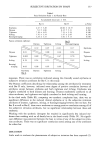
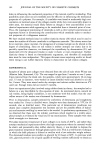
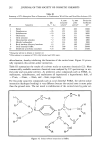
206 JOURNAL OF THE SOCIETY OF COSMETIC CHEMISTS predict the direction of wavelength shifts in the ultraviolet absorption spectrum for sunscreen chemicals. The effect of substituents, pH, and solvents on the ultraviolet absorbance can be estimated, providing some assistance to the formulator. This infor- mation may also be of some use to those attempting to design alternative methods of SPF testing (26-31). The addition of substituents in the para and ortho positions may have a substantial effect on the }t max and extinction coeffficient of the sunscreen formulations. Electron- releasing substituents in the ortho or para position to the chromophore will generally exhibit a bathochromic shift. pH changes in formulations containing acidic or basic compounds may contribute significantly to }t max shifts. The role that solvent changes have on the efficacy of a sunscreen chemical was dis- cussed. Here the situation is more complicated and depends upon the degree of solva- tion between the ground state/excited state of the sunscreen molecule and the solvent. In general, if solvation is extensive, it would lead to stabilization of the ground state of the sunscreen chemical, thereby raising the energy requirements (hence the lowering of the }t max) for the electronic transition responsible for the UV absorption. This would lead to a hypsochromic shift. If the excited state is more polar than the ground state, it would allow for the sunscreen chemical to resonate to the more polar excited state which is stabilized by solvation with polar solvents. Such stabilizations would lower the en- ergy requirements (hence raise the }t max) in the electronic transition responsible for UV absorption. This would lead to a bathochromic shift. Deviation from coplanarity reduces the electron delocalization (resonance) possible in a molecule, thereby resulting in a lower extinction coefficient. This is the case in ortho-disubstituted compounds such as salicylates and anthranilates. Increased conjugation also has a marked effect on the extinction coefficient. ACKNOWLEDGEMENTS I wish to express my deepest appreciation and gratitude to Lisa Paloympis for the experimental work and her helpful comments and suggestions, and to my colleagues of the Research and Instrumentation Departments at Felton Worldwide for their construc- tive criticism, encouragement, and support. REFERENCES (1) P. Robins, The need and the challenge, The Skin Cancer Foundation, 1 (1985). (2) The Skin Cancer Foundation, Box 561, New York, N.Y. 10156. (3) N. A. Shaath, The chemistry of sunscreens, Cosmetics and Toiletries, 101, 55-70 (March 1986). (4) "Sunscreen Drug Products for Over the Counter Human Drugs: Proposed Safety, Effective and La- beling Conditions," in Federal Register, Washington, D.C., Department of Health, Education and Welfare, Food and Drug Administration, 43(166): 38206-38269 (August 25, 1978). (5) H. H. Jaffe and M. Orchin, Theory and Application of Ultraviolet Spectroscopy (John Wiley and Sons, New York, 1964). (6) J. R. Dyer, Applications of Absorption Spectroscopy of Organic Compounds (Prentice-Hall, Inc., Englewood Cliffs, New Jersey, 1965). (7) E. Stern and T. Timmons, Electronic Absorption Spectroscopy in Organic Chemistry (St. Martin's Press, New York, 1971).
Purchased for the exclusive use of nofirst nolast (unknown)
From: SCC Media Library & Resource Center (library.scconline.org)