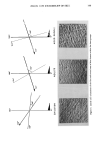
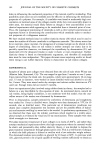
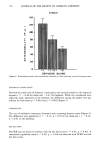
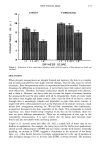
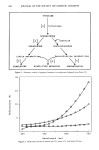
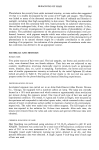
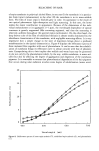
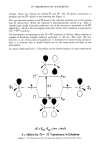
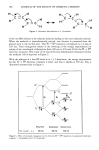
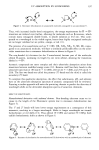
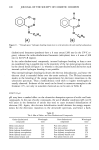
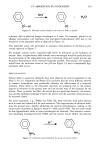
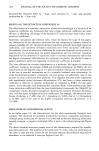
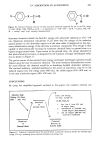
UV ABSORPTION BY SUNSCREENS 197 \ / Figure 4. Resonance delocalization in unsaturated molecules conjugated to an auxochrome Y. Thus, with increased double-bond conjugation, the energy requirements for H -- H* transition are reduced even further, allowing for molecules such as lB-carotene, which contain many conjugated double bonds, to absorb radiation at 452 nm. This corre- sponds to a wavelength in the visible region hence these highly conjugated molecules are no longer colorless but are yellow, orange, or red (11). The presence of an auxochrome such as Y = OH, OR, NH2, NR2, X, SH, SR, conju- gated to an unsaturated molecule, will have a similarily predictable effect on the ultra- violet transitions due to resonance delocalization as shown in Figure 4. The non-bonded (n) electrons (on the Y-auxochrome) become part of the molecular orbital H-system, increasing its length by one extra orbital, allowing for transitions labeled n--) H*. Aromatic compounds are more complex and their ultraviolet absorption arises from transitions between modified energy states (12). Benzene itself has three bands in the ultraviolet spectrum at 184 nm (½ = 47,000), 202 nm (½ = 7,400), and 255 nm (½ = 230). The first two bands are called the primary (1 ø) bands and the third is called the secondary (2 ø ) band. To complete this qualitative description, the effect that substituents, pH, and solvents have on the ultraviolet absorption spectrum of aromatic compounds will be reviewed. Pursuing a similar approach will assist the practicing chemist to predict the direction of wavelength shifts in the ultraviolet absorption spectra of sunscreen chemicals. EFFECT OF SUBSTITUENTS Monosubstituted derivatives with unshared electrons. Non-bonding electrons cause an in- crease in the length of the H-aromatic system due to resonance delocalization (see Figure 5). The 1 ø and 2 ø bands will have lower energy requirements as a consequence of this resonance, resulting in a longer wavelength. Shifts to longer wavelength are termed bathochromic or red shifts (13). Thus phenol (Y=OH) and aniline (Y=NHi) both exhibit bathochromic shifts as shown in Figure 6. Figure 5. Resonance delocalization for monosubstituted (Y) derivatives with an unshared pair of electrons.

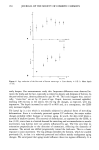
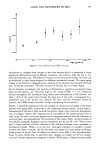
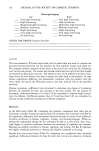
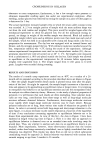
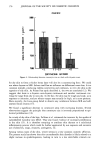
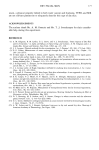
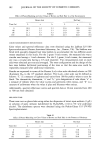
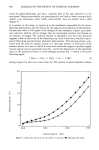
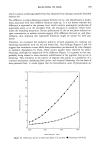
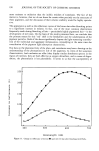
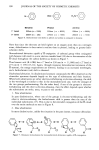
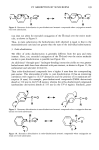
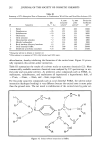
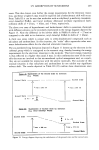
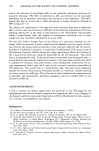
198 JOURNAL OF THE SOCIETY OF COSMETIC CHEMISTS Benzene Phenol An III ne 1 ø band: 202nm (½--7400) 210nm ( ½ = 8200) 230nm ( ½ = 8600) 2 ø band: 255nm (•: = 230) 270nm ( ½ = 1450) 280nm ( ½ = 1430) Figure 6. Bathochromic (red) shifts in phenol and aniline as compared to benzene. Note that since the electrons are held tighter on an oxygen atom than on a nitrogen atom, delocalization is thus easier in aniline than in phenol, leading to greater bath- ochromic shifts. Monosubstituted derivatives capable of H-conjugation. A carbonyl group when conjugated with benzene will result in a new electron transfer band (14) due to the extension of the H-cloud throughout the carbon skeleton as shown in Figure 7. Thus benzoic acid (R= OH) has a 1 ø band at 230 nm (½ = 11,600) and a 2 ø band at 273 nm (½ = 970) (15,16). Again, through resonance delocalization (extension of the H-system), the energy requirements are lowered, leading to an increased wavelength, and a bathochromic (red) shift is observed. Disubstituted derivatives. In disubstituted aromatic compounds the effect observed on the ultraviolet spectrum depends largely on the type of substituents and their location. When both substituents are either electron-withdrawing or electron-releasing, the shift in the wavelength is similar to that in the monosubstituted case, with the stronger of the two groups predominating. On the other hand, if one of the groups is electron- withdrawing and the other is electron-releasing, then the effect depends upon whether the substituents are ortho, meta, or para to one another. 1. Para disubstitution In para disubstitution, where one of the groups is electron-withdrawing and the other is electron-releasing, the bathochromic shift is greater than the sum of the individual substituents (17). This is due to the extended conjugation of the H-cloud over the entire molecule as seen in Figure 8. 2. Meta disubstitution In meta disubstitution, unlike the situation in the para isomer, resonance delocaliza- ?-% (•C--O C:O R R Figure 7. Resonance delocalization for monosubstituted derivatives capable of II-conjugation.
Purchased for the exclusive use of nofirst nolast (unknown)
From: SCC Media Library & Resource Center (library.scconline.org)