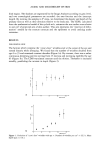
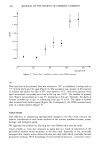
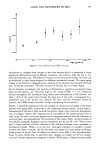
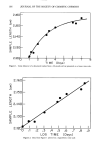
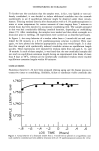
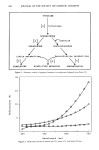
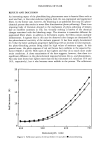
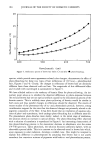
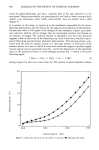
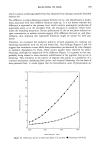
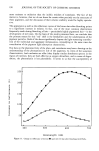
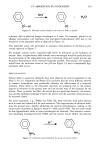
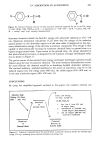
CROSSLINKING IN COLLAGEN 167 To further test the conclusion that the samples were, in fact, very lightly or non-uni- formly crosslinked, it was decided to induce additional crosslinks into the network synthetically to see if equilibrium behavior might be observed under these circum- stances. Treating tendons directly after denaturation with a 0.1% parabenzoquinone in water at room temperature for various amounts of time ranging from 5 minutes to several hours has been reported to incorporate crosslinking (24). The samples prepared in this way had considerably differing crosslink densities, depending on crosslinking times (21). After crosslinking, the samples were washed and then dried overnight in a desiccator prior to swelling. All experiments were carried out as described previously. In Figure 3, the creep behavior of a tendon taken from a 3-month-old rat and cross- linked for 60 minutes in a 0.1% parabenzoquinone solution is plotted. Here once again, we have plotted the behavior appropriately as log time versus length. It is clear that this sample with synthetically induced crosslinks attains an equilibrium length quickly. These experiments were repeated for tendons taken from rats ages 6, 12, and 18 months. In each of these samples, it was found that the non-crosslinked samples did not reach an equilibrium extension length during an experimental time frame of more than 8 days at 40øC, whereas all the synthetically crosslinked tendons tested reached equilibrium extension lengths within 60 minutes. CONCLUSIONS Numerous theories (1-8) have been proposed relating aging and the disease process in connective tissue to crosslinking. Similarly, failure to synthesize viable crosslinks also 1.750 -- 1,740- 1.730-- -,8 -.6 -,4 -,2 0 ,2 ,4 ,6 LOG TIME (Hours) Figure 3. Creep behavior of a denatured tendon from a 3-month-old rat plotted on a logarithmic time scale synthetic crosslinks have been added by treatment with a 0.1% parabenzoquinone solution for 1.0 hr.

168 JOURNAL OF THE SOCIETY OF COSMETIC CHEMISTS has been claimed to be responsible for the formation of defective collagen. These theo- ries are based on the assumption that mechanical response is associated with the forma- tion of crosslinks between collagen molecules. The observation reported here is that in the normal development of rat tail tendon there are not enough efj•ctive crosslinks synthesized to make significant contributions to the mechanical strengths of the tissues studied. Subsequent to the thermal denaturation of a rat tail tendon under mild conditions where it is reasonable to expect that only denatur- ation and not extensive hydrolytic scission has occurred, our mechanical tests show that tissues lack the development of equilibrium extension lengths. Rather, these samples show a normal rubbery flow behavior like that exhibited by uncrosslinked materials. Such behavior indicates that there are not even a minimum number of effictive crosslinks necessary to form a network. This behavior was observed at each age of tendon studied. Since these tendons had significant mechanical strengths prior to thermal denaturation, we must conclude that the crystalline structure of collagen is the significant contributor to mechanical strength of this material. REFERENCES (1) J. J. Butzow and G. L. Eichhorn, Physical chemical studies on the age changes in rat tail tendon collagen, Biochim. Biophys. Acta, 154, 208-219, 1968. (2) F. Verzar, "Aging of the Collagen Fiber," in International Review of Connective Tissue Research, D. A. Hall, Ed. (Academic Press, New York, 1964), p. 244. (3) A. J. Bailey and V. C. Duance, Collagen in acquired connective tissue diseases: An active or passive role? European Journal of Clinical Investigation, 10, 1- 3, 1980. (4) P. H. Byers, R. C. Siegel, K. A. Holbrook, A. S. Narayan, P. Bornstein, and J. G. Hall, Defective crosslink formation in collagen due to decreased lysyl oxidase activity, New England Journal of Medi- cine, 303, 61-65, 1980. (5) K. Chang, J. Uitto, E. A. Rowold, G. A. Grant, C. Kilo, and J. R. Williamson, Increased collagen cross-linkages in experimental diabetes, Diabetes, 29, 778-781, 1980. (6) L. E. Glynn, "Diseases of Collagen and Related Tissues," in International Review of Connective Tissue Research, D. A. Hall, Ed. (Academic Press, New York, 1964), pp. 238-244. (7) M. E. Nimni, A defect in the intramolecular and intermolecular cross-linking of collagen caused by penicillamine, J. Bio. Chem., 243, 1457-1467, 1968. (8) F. M. Sinex, "The Role of Collagen in Aging," in Treatise on Collagen, B. S. Gould, Ed. (Academic Press, New York, 1968), p. 439. (9) M. J. C. Crabbe and J. J. Harding, Collagen crosslinking: Isolation of two crosslinked peptides in- volving 2-CB (3-5) from bovine scleral collagen, FEBS Letters, 97, 189-192, 1979. (10) N. D. Light, Bovine type I collagen. A study of crosslinking in various mature tissues, Blochim. Biophys. Acta, 581, 96-105, 1979. (11) D. J. Prockop, K. I. Kivirikko, L. Tuderman, and N. A. Guzman, The biosynthesis ofcollagen and its disorders, New England Journal of Medicine, 301, 77-83, 1979. (12) A. J. Bailey, S. P. Robins, and G. Balian, Biological significance of the intermolecular crosslinks of collagen, Nature, 251, 105- 109, 1974. (13) F. Bartos and L. Miroslav, Collagen, elastin and desmosines in three layers of bovine aortas of different ages, Exp. Geront., 14, 21-26, 1979. (14) O. O. Blumenfeld and P. M. Gallop, Amino aldehydes in tropocollagen: The nature a probable cross-link. Proc. N.A.S., 56, 1260-1268, 1966. (15) P. Bornstein and K. A. Piez, The nature of the intramolecular cross-links in collagen. The separation and characterization of peptides from the cross-link region of rat skin collagen, Biochemistry, 5, 3460-3472, 1966. (16) A.D. Deshmukh and M. E. Nimni, In vitro formation of intramolecular crosslinks in tropocollagen, Blochem. Biophys. Res. Commun., 35, 845-853, 1969.
Purchased for the exclusive use of nofirst nolast (unknown)
From: SCC Media Library & Resource Center (library.scconline.org)