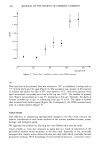
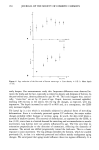
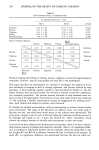
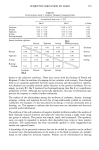
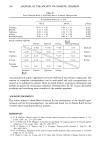
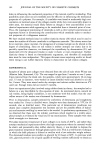
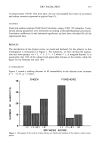
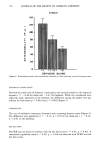
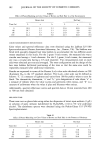
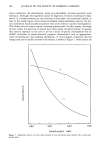
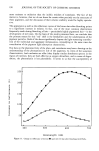
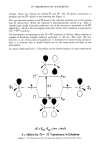
176 JOURNAL OF THE SOCIETY OF COSMETIC CHEMISTS CHEEK n- W n- W W 0 9gg 659 8BB 759 ?BB 1 (1-2) I]RYNESS SCORE Figure 4. Relationship between corneocyte size on cheek with dryness scores. for dry skin to form a thicker horny layer will also be a counteracting force. We could not relate dryness to SER. Sebum itself has no influence on diffusional water loss. It is a common mistake, producing endless controversy and confusion, to view dry skin as the opposite of oily skin. As Pierard has aptly described it, the two are unrelated (12). We suggest that there is a dryness-non-dryness continuum and another continuum cov- ering the range from oily to non-oily. In the face, the skin may be rough and scaly, as in response to irritation, and yet sebum output may actually be high, as in acne patients. More recently, the Iowa group failed to observe any correlation between SER and self- assessed facial dryness (13). We found a significant decrease in corneocyte areas with increasing dryness. Several observations suggest the principle that corneocyte size is inversely proportional to epi- dermal proliferation (14). In a study of dry skin of the legs, Fullmer et al. estimated the turnover by the uptake of radiolabelled tymidine into DNA. They also found evidence of increased proliferation in dry skin (15). It is therefore tempting to attribute skin dryness to a subclinical inflammatory process which could be further aggravated by sun exposure and excessive use of abrasives, soaps, cleansers, astringents, etc. Among various types of dry skin, winter xerosis is a very common cosmetic affliction. The present study has shown that this uncomfortable skin disorder is likely related to a slight increase in epidermopoiesis, leading in turn to a less stretchable stratum cor-

DRY FACIAL SKIN 177 neum, a physical property linked to both water content and thickness. TEWL and SER are not relevant parameters to adequately describe this type of dry skin. ACKNOWLEDGEMENTS The authors thank Ms. A. M. Francois and Mr. T. J. Stoudemayer for their consider- able help during this experiment. REFERENCES (lO) (11) (12) (13) (14) (15) (1) A.M. Kligman, R. M. Lavker, G. L. Grove, and T. J. Stoudemayer, "Some Aspects of Dry Skin and Its Treatment," in Safety and Efficacy of Topical Drugs and Cosmetics, A. M. Kligman and J. J. Leyden Eds. (Grune and Stratton, New York, 1982), pp. 221-238. (2) J. L. Leveque, Physical methods for skin investigation, Int. J. Dermatol., 22, 368-375 (July 1983). (3) G. E. Nilson, Measurement of water exchange through skin, &led. and Bid. Eng. Cornput., 15, 209-218 (1977). (4) D. Saint Leger, C. Berrebi, C. Duboz, and P. Agache, The Lipometre: An easy tool for rapid quanti- tation of skin surface lipids in man, Arch. Dermatol. Res., 265, 79-89 (1979). (5) D. Saint Leger and E. Cohen, Practical study of qualitative and quantitative sebum excretion on the human forehead, Brit. J. Dermatol., 113, 551-557 (1985). (6) J. de Rigal and J. L. Leveque, In vivo measurement of the stratum comeurn elasticity, Bioengineering and the Skin, 1, 13-23 (1985). (7) J. L. Leveque and J. de Rigal, Impedance methods for studying skin moisturization, J. Soc. Cosmet. Chem., 34, 419-428 (1983). (8) P. Corcuff, F. Chatenay, and D. Saint Leger, Hair-skin relationships: A new approach to desquama- tion, Bioengineeering and the Skin, 6, 133-139 (1985). (9) E. R. Cooper, P.J. Missel, D. P. Harmon, and G. B. Albright, Mechanical properties of dry, normal, and glycerol-treated skin as measured by the gas-bearing electrodynamameter, J. Soc. Cosmet. Chem., 36, 335-348 (1985). K. A. Grice and F. R. Bettley, Skin water loss and accidental hypothermia in psoriasis, ichtyosis and erythroderma, Brit. Med. J., 4, 195-198 (1967). H. Baker and A.M. Kligman, Measurement of transepidermal water loss by electrical hygrometry, Arch. Derm., 96, 441-452 (1967). G. E. PieraM, Xerosis and dry skin are not synonymous, Meeting: Methods for Evaluating the Effects of Moisturizers on Skin, Philadelphia, May 1985. D. T. Downing, M. E. Stewart, and J. S. Strauss, Changes in sebum secretion and the sebaceous gland, Dermatol. Clin., 4, 419-423 (July 1986). G. L. Grove, Exfoliative cytological procedures as a non-intrusive method for dermato!ogical studies, J. Invest. Dermatol., 73, 67-74 (1979). A. W. Fulmer and G. J. Kramer, Epidermal turn-over in dry and normal dry skin. Meeting of American Academy of Dermatology, Las Vegas, 1986.
Purchased for the exclusive use of nofirst nolast (unknown)
From: SCC Media Library & Resource Center (library.scconline.org)