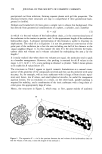
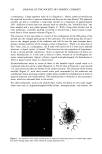
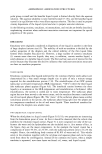
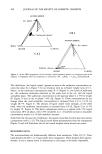
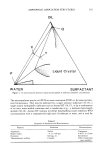
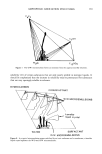
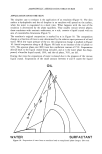
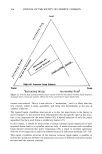
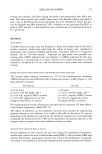
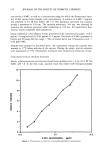
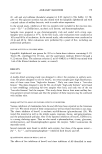
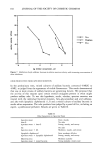
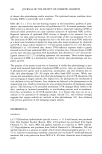
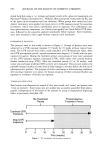
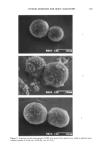
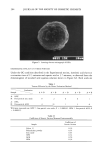
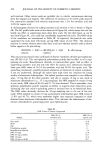
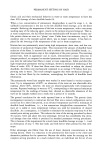
AMPHIPHILIC ASSOCIATION STRUCTURES 165 APPLICATION ONTO THE SKIN The simplest case to evaluate is the application of an emulsion (Figure 5). The skin surface is hydrophobic and the oil droplets in an emulsion will spread on the surface, while the water is evaporated in a short time. What happens with the rest of the emulsion is determined by the phase equilibria. They usually contain several phases those emulsions with nonionic surfactants, as a rule, contain a liquid crystal with an area of considerable dimensions (Figure 5). The emulsion's original composition is marked by ot in Figure 10. The composition change as a function of time is now determined by the relative vapor pressure of oil and water. With low vapor pressure of the oil, the composition change is marked in Figure 10. Initial evaporation along or-lB (Figure 10) leads to an increase of the oil phase to 52%. The aqueous phase one (48%) now has a surfactant content of 15%. Evaporation after {3 leads to the liquid crystal being included, and at •/the water phase has disap- peared a lamellar liquid crystal, 30%, and the oil phase, 70%, are left. During that time the evaporation of water is slowed due to the presence of the viscous liquid crystal. Evaporation of the small amount between •/ and $ causes the liquid OIL WATER SURFACTANT Figure 10. Evaporation of water from an emulsion leads to complicated phase changes. (See text).

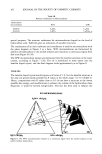
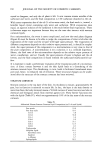
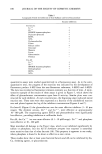
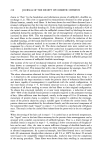
166 JOURNAL OF THE SOCIETY OF COSMETIC CHEMISTS crystal to disappear, and only the oil phase is left. It now contains inverse micelies of the surfactant and water, and the final composition is 14% surfactant dissolved in the oil. With some evaporation also of the oil (« oil-to-water ratio), the final result is, instead, a lameliar liquid crystal containing only water and surfactant. With evaporation rates equal, an aqueous solution of the surfactant is the result before final evaporation. These in-between stages are important because they are the ones that interact with stratum corneum lipids. For a microemulsion, the event is more complicated, and now the total phase diagram (Figure 8) must be known to be able to judge the compositions of what is left after the evaporation of the water and the oil part with high vapor pressure. The evaporation of different components depends on their relative vapor pressure and, it should be empha- sized, the vapor pressure of the components in a microemulsion is very close to that of the pure components. A microemulsion is not a solution it is a colloidal dispersion. Hence, the final state of the microemulsion depends on the relative vapor pressure of water, cosurfactant, and oil. Usually the vapor pressure of water is highest and the oil lowest, and the final composition is found towards the surfactant/cosurfactant/oil sur- face. It is essential to make a preliminary evaluation of the evaporation path of a microemul- sion. A direct contact between it and the skin lipids leads to a disordering of the stratum corneum layer. The disordering, in turn, leads to facilitated transdermal trans- port and, hence, to enhanced risk of irritation. These structural changes can be under- stood after the structure of the stratum corneum has been reviewed. STRATUM CORNEUM Stratum corneum is the top layer of the skin. Its thickness is minute, approximately 30 [•m, but its function is essential to retain life. In fact, the layer is the main barrier to water loss from the body (removal means a 50-fold increase of water loss rate) and also to chemical and biological attack from external agents (22). These barrier functions rest with the lipids (Table IV), which are approximately 10% of the dry mass of the stratum corneum. Table IV Abdominal Human Stratum Corneum Lipid Composition (wt% of total liDds) Free steroIs 14.0 Free fatty acids 19.3 C14:0 3.8 C16:0 36.8 C16:1 3.6 C18:0 9.9 C18:1 33.1 C18:2 12.5 C20:0 0.3 Triglycerides 25.2 Nonpolar lipids 16.3 Sterol/wax esters 6.1 Squalene 6.5 n-Alkanes 3.7 Sphingolipids 18.1
Purchased for the exclusive use of nofirst nolast (unknown)
From: SCC Media Library & Resource Center (library.scconline.org)