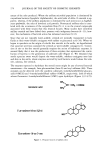
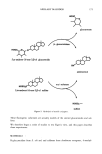
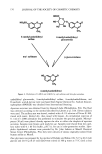
184 JOURNAL OF THE SOCIETY OF COSMETIC CHEMISTS DISCUSSION It has long been recognized that axillary odor arises from the interaction of bacteria with apocrine sweat. A class of volatile free steroids has been associated with axillary odor and with a particular bacterial population--the lipophilic diphtheroids. We suspected that the enzymes responsible for this process would be those capable of releasing free volatile steroid from odorless steroid conjugates present in sterile apocrine secretion. We showed that a mixed culture of axillary bacteria produces a beta-glucuronidase capable of cleaving asteroid glucuronide. From our preliminary screening tests, we showed that another class of hydrolytic enzyme, aryl sulfatase, was also present in axil- lary strains. We have shown that a beta-glucuronidase and an aryl sulfatase, both of bacterial origin, will cleave odorless compounds in sterile secretion to produce distinct axillary odor. Thus, hydrolytic enzymes are implicated in the release of odor. We have also shown that a lipophilic diphtheroid secretes both of the enzymes necessary to produce steroid malodor from sterile axillary secretion. We have shown that the generation of odor, from the addition of beta-glucuronidase or aryl sulfatase or lipophilic diphtheroid to apocrine secretion, may be prevented by the inclusion of the enzyme inhibitor Zn + + and somewhat reduced by glucarolactone (which inhibits only the beta-glucuronidase but not aryl sulfatase). This further sub- stantiates the role of these bacterial enzymes in axillary odor. REFERENCES (1) (2) (3) (4) (5) (6) (7) (8) (9) (10) (11) (12) (13) E. Eigen, A new mechanism of axillary malodor [Letter], J. Soc. Cosmet. Chem., 41, 147 (1990). J. S. Strauss and A. M. Kligman, The bacteria responsible for axillary odor. I., J. Invest. Dermatol., 27, 67-71 (1956). N. Shehadeh and A.M. Kligman, The bacteria responsible for axillary odor. II., J. Invest. Dermatol., 41, 3 (1963). J. N. Labows, K. J. McGinley, and A.M. Kligman, Perspectives on axillary odor, J. $oc. Cosmet. Chem., 34, 193-202 (1982). P. J. H. Jackman and W. C. Noble, Normal axillary skin microflora in various populations, Clin. Exp. Dermatol., 8, 259-268 (1983). J. J. Leyden, K. J. McGinley, E. Holzle, J. N. Labows, and A. M. Kligman, The microbiology of the human axilla and its relationship to axillary odor, J. Invest. Dermatol., 77, 413-416 (1981). R. R. Marples and A.M. Kligman, In-vivo methods for appraising anti-bacterial agents, TGA Cosmet. J., 1, 26-33 (1969). B. W. L. Brooksbank, R. Brown, and J.-A. Gustafsson, The detection of 5 alpha-androst-16-en-3 alpha ol in human male axillary sweat, Experientia, 30, 864-865 (1964). A. Nixon, A. I. Mallet, and D. B. Gower, Simultaneous quantification of five odorous steroids (16-androstenes) in the axillary hair of men, J. Steroid Blochem., 29, 505-510 (1988). S. Bird and D. B. Gower, Axillary 5-alpha-androst-16-en-3-one, cholesterol, and squalene in men: Preliminary evidence for 5-alpha-androst-16-en-3-one being a product of bacterial action, J. Steroid Blochem., 17, 517-522 (1982). J. N. Labows, G. Preti, E. Holzle, J. J. Leyden, and A. M. Kligman, Steroid analysis of human apocrine secretion, Steroids, 34, 249-258 (1979). W. C. Noble, Microbiology of Human Skin. (Lloyd-Duke Medical Books, London, 1981) pp. 92-106. A. Nixon, A. I. Mallet, P. J. H. Jackman, and D. B. Gower, Testosterone metabolism by isolated human axillary corynebacterium ssp.: A gas-chromatographic mass-spectrometric study, J. Steroid Blochem., 27, 1-6 (1986).

AXILLARY MALODOR 18 5 (14) (15) (16) (17) (18) (19) (20) (21) (22) (23) (24) (25) (26) (27) (28) (29) (30) (31) (32) R. Hobkirk, Steroid sulfotransferases and steroid sulfate sulfatases: Characteristics and biological roles, Can. J. Biochem., 63, 1127-1144 (1985). P. M. Sokolove, M. A. Wilcox, R. G. Thurman, and F. C. Kauffman, Stimulation of hepatic micro- somal beta-glucuronidase by calcium, Biochem. Biophys. Res. Commun., 121, 987-993 (1984). R. W. Trepeta and S.C. Edberg, Methylumbelliferyl-beta-D-glucuronide-based medium for rapid isolation and identification of Escherichia coli, J. Clinical Microbiol., 19, 172-174 (1984). J. V. Dubsky and A. Rabas, The formation of salts with glycine, Spisy Vydavane Prirodoveckedou Fakultou Masarykovy Univ. No. 115, 12-6 [Chem. Abs. 24, 4722 (1931)]. M. L. Doyle, P. A. Katzman, and E. A. Doisy, Production and properties of bacterial beta-glucuron- idase, J. Biol. Chem., 217, 921-930 (1955). V. Graef, E. Furuya, and O. Nishikaze, Hydrolysis of steroid glucuronides with beta-glucuronidase preparations from bovine liver, Helix pomatia, and E. coli, Clin. Chem., 23, 532-535 (1977). U. G. Ahlborg, E. Manzor, and T. Thunberg, Inhibitions of beta-glucuronidase by chlorinated hy- droquinones and benzoquinones, Arch. Toxicol., 37, 81-87 (1977). J. Kushari and M. Mukherjea, Studies on beta-glucuronidase of the developing human placenta, Gynecol. Obstet. Invest., 11, 119-127 (1980). J. E. Christner, S. Nand, and N. S. Mhatre, The reversible inhibition of beta-glucuronidase by organic peroxides, Biochem. Biophys. Res. Commun., 38, 1098-1104 (1970). T. Niwa, T. Tsuruoka, S. Inoue, Y. Naito, T. Koeda, and T. Niida, A potent new beta-glucuroni- dase inhibitor of D-glucaro-delta-lactam derived from nojirimycin,J. Blochem. (Tokyo), 72, 207-211 (1972). T. Okhubo and S. Sano, Mechanism of the action of beta-glucuronidase inhibitor upon apocrine sweat and sebacious glands and its dermatological application. Acta Dermatovener. (Stockholm), 53, 85-93 (1974). L. H. Chen and L. V. Packerr, Influence of alpha-tocopherol on the inhibition of beta-glucuronidase by peroxidized linoleic acid, Am. J. Clin. Nut., 24, 1232-1237 (1971). E. R. Schwartz and L. Adamy, Effect of ascorbic acid on aryl sulfatase activities and sulfated proteo- glycan metabolism in chondrocyte cultures, J. Clin. Invest., 60, 96-106 (1977). E. R. Schwartz, Effects of vitamins C and E on sulfated proteoglycan metabolism and sulfatase and phosphatase activities in organ cultures of human cartilage, Calcified Tissue International, 28, 201-208 (1979). A. L. Fluharry, R. L. Stevens, R. T. Miller, S. S. Shapiro, and H. Kihara, Ascorbic acid-2-sulfate sulfohydrolase activity of human arylsulfatase A, Biochim. Biophys. Acta, 429, 508-516 (1976). L. R. Fowler and D. H. Rammler, Sulfur metabolism of Aerobacter aerogenes. II. The purification and some properties of a sulfatase, Biochemistry, 3, 230-237 (1964). K. S. Dodgson, B. Spencer, and K. Williams, Examples of anti-competitive inhibition, Nature, 177, 432-433 (1956). D. Robinson, J. N. Smith, B. Spencer, and R. T. Williams, Studies in detoxification. 43. Aryl sulfatase activity of takadiastase towards some phenolic ethereal sulfates, Blochem. J•, 51, 202-208 (1952). A. B. Roy, Sulfatase of ox liver. XIII. Action of carbonyl reagents on sulfatase A, Biochim. Biophys. Acta, 198, 76-81 (1970).
Purchased for the exclusive use of nofirst nolast (unknown)
From: SCC Media Library & Resource Center (library.scconline.org)