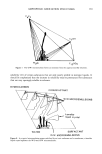
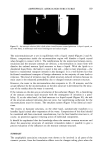
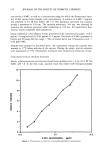
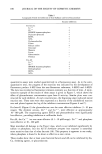
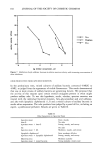
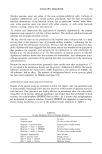
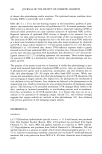
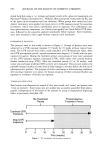
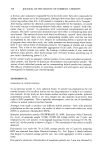
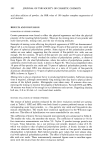
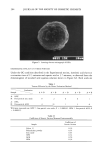
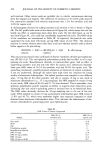
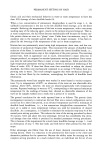
182 JOURNAL OF THE SOCIETY OF COSMETIC CHEMISTS lOO 80 60 20 Cu++ Phosphate log Inhibitor concentration, uM Figure 7. Inhibition of aryl sulfatase: decrease in relative reaction velocity with increasing concentration of three inhibitors. ODOR PRODUCTION FROM APOCRINE SECRETION In the preliminary tests, mixed cultures of axillary bacteria converted 4-MUG to 4-MU, as judged from the appearance of visible fluorescence. This result demonstrated that one or more strains of axillary bacteria are generating beta-G. We proposed that the activity of this enzyme upon certain steroid conjugates present in sweat might produce axillary odor. To test this hypothesis, sterile, odorless, apocrine secretion was treated with the individual bacterial enzymes, beta-glucuronidase and aryl sulfatase, and also with lipophilic diphtheroid (1,3) and a mixed culture of axillary bacteria in sterile saline suspension. The odor produced was judged by a panel of five, including an expert, a professional perfumer. Results are given in Table II. Table II Odor Generation in Apocrine Sweat Apocrine sweat beta-G Apocrine sweat + beta-G AS Apocrine sweat + AS Lipophilic diphtheroid Apocrine sweat q- lipophilic diphtheroid Mixed bacteria Apocrine sweat q- mixed bacteria Faint, musky No odor Strong, musky, and sweaty No odor Moderate, musky, and sweaty Faint moderate off-odor Strong, musky, and sweaty Moderate malodor Strong malodor, sweaty note

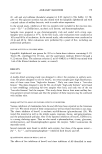
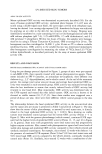
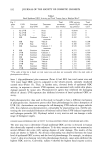
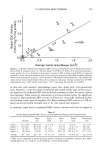
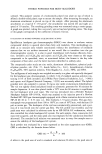
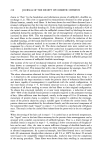
AXILLARY MALODOR 183 Neither apocrine sweat nor either of the pure enzymes exhibited odor. Cultures of lipophilic diphtheroid, and a mixed axillary population, had the faint-to-moderate malodor characteristic of any bacterial culture, but no particular "sweaty" odor. How- ever, when apocrine sweat was mixed with either enzyme, or with either bacterial culture, a strong, sweaty odor was produced. To confirm and characterize the implication of lipophilic diphtheroids, the enzyme substrates were exposed to cell-free culture medium. The medium exhibited both aryl sulfatase and beta-glucuronidase activity. The fact that the odor can be produced by the enzymes alone indicates that it is their activity that is the essential cause of steroidal axillary malodor, confirming the hy- pothesis from the preliminary tests above. The fact that the odor is produced by lipo- philic diphtheroids alone suggests that this strain may be one member of the population that produces the enzymes, and accounts for its implication in odor production by Leyden et al. (6) and Jackman et al. (5). The presence of enzyme activity in cell-free diphtheroid medium shows that the enzymes are extracellular. Any subsequent intra- cellular enzymatic conversions of the steroids that may occur seem not to be essential to odor production. Because the sterile secretion alone generated a faint musky odor after incubation at 37 ø C, we tested it for indigenous beta-G and AS activity: Addition of 4-MUG, the beta-G substrate, produced the characteristic 4-MU fluorescence, but addition of 4-MUS, the AS substrate, had no effect. The presence of endogenous beta-G in the apocrine gland has been noted separately by Ohkubo and Sano (24). INHIBITION OF ODOR FROM APOCRINE SECRETION Results of the second study are presented in Table III. Again, odor was generated only in those samples containing either apocrine secretion with enzymes or apocrine secretion with bacteria. Zinc glycinate was highly effective in preventing odor the odor-inhib- iting effect of the lactone, although significant, was weaker than that of ZnGLY in both systems the polyphosphate (SPORIX) had no effect. (It is known that polyphosphates are hydrolyzed in aqueous solution. Possibly SPORIX was degraded to inactive frag- ments during incubation it is one of the weakest beta-G inhibitors in Table I.) Table III In Vitro Deodorant Action of Enzyme Inhibitors Enzymes Apocrine sweat Enzymes + apocrine sweat Enzymes + sweat + ZnGLY Enzymes q- sweat q- SPORIX Enzymes + sweat + lactone Lipophilic diphrheroids LDs q- apocrine sweat LDs + sweat + ZnGLY LDs + sweat + lacrone No odor No odor to faint off-odor Faint/moderate musky-sweaty No odor Faint/moderate musky-sweaty No odor to faint musky-sweaty Faint off-odor Strong, sweaty Faint stale musky Moderate sweaty
Purchased for the exclusive use of nofirst nolast (unknown)
From: SCC Media Library & Resource Center (library.scconline.org)