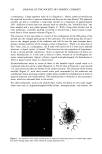
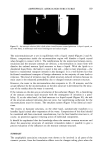
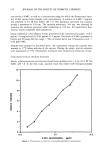
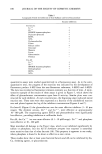
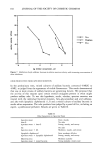
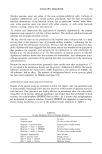
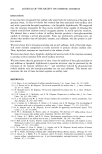
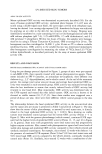
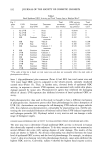
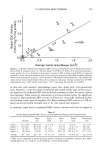
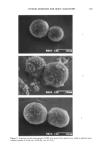
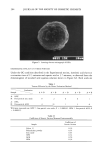
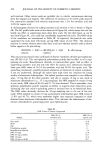
202 JOURNAL OF THE SOCIETY OF COSMETIC CHEMISTS acid after addition of powder. An OSR value of 100 implies complete suppression of acid malodor. RESULTS AND DISCUSSION FORMATION OF HYBRID POWDERS Certain parameters were found to affect the physical appearance and thus the physical property of the resulting hybrid powder. These are the mixing ratio of core powder and outer layer powder, mixing time, and the size of mixing mediums. Examples of mixing ratios affecting the physical appearance of HPZ are demonstrated. Figure 4A is a microscopic profile of HPZ using 10 parts of fine-particle zinc oxide and 90 parts of spherical polyethylene powder. Some regions of the polyethylene powder surface are seen naked, suggesting that the amount of fine-particle zinc oxide was not enough. On the contrary, 50 parts of fine-particle zinc oxide and 50 parts of spherical polyethylene powder would overload the surface of polyethylene powder, as observed from Figure 4B. An ideal hybridization, where the surface of polyethylene powder is uniformly covered with zinc oxide, is shown in Figure 4C. This was accomplished when 30 parts of fine-particle zinc oxide and 70 parts of spherical polyethylene powder were hybridized. An ideal HPA was obtained also at a ratio of 30 parts of fine-particle aluminum chlorohydrate to 70 parts of spherical polyethylene powder. A micrograph of HPA is shown in Figure 5. Mixing time is also an important factor in producing hybrid powders. Sufficient mixing time is required, although unnecessarily long mixing time may lead to physical deteri- oration of the hybrid powder. Micrographs were taken every 10 minutes after com- mencing the mixing to monitor the progress of hybridization. For both HPZ and HPA, 30 minutes was found to be enough in our laboratory scale system. Regarding alumina ball size, 0.8 to 30 mm i.d. was found most suitable. TEXTURE EVALUATION OF HYBRID POWDERS The texture of hybrid powders evaluated by the direct evaluation method are summa- rized in Table I. HPZ and HPA were both found to possess preferred texture to their corresponding outer layer powders, i.e., fine-particle zinc oxide and fine-particle alu- minum chlorohydrate. The results show statistical significance by the Wilcoxon sign- rank test. The effect of hybridization was more remarkable for zinc oxide. The coefficients of kinetic friction measured instrumentally are summarized in Table II. The smaller the value, the smoother the texture. The coefficient of variation (cv %) for five consecutive measurements was below 5%. Nylon 12 powder (average particle size 6.6 I•m, Toray Industries, Inc.), our previous core powder, showed a value of 0.39, which was similar to that of spherical polyethylene powder. A drastic decrease in the values are observed when either fine-particle zinc oxide or fine-particle aluminum chlorohydrate is hybridized. Both hybrid powders gave values that were almost iden- tical with spherical polyethylene powder. The effect of hybridization was more remark- able with zinc oxide. These instrumentally measured figures were in excellent agree- ment with the results from the direct evaluation method.

HYBRID POWDERS FOR BODY MALODORS 203 9923 15K !Cute. Figure 4. Scanning electron micrographs of HPZ with ratios of fine-particle zinc oxide to spherical poly- ethylene powder of 10:90 (A), 50:50 (B), and 30:70 (C).
Purchased for the exclusive use of nofirst nolast (unknown)
From: SCC Media Library & Resource Center (library.scconline.org)