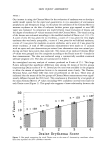
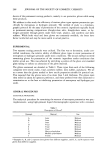
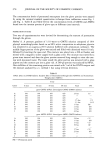
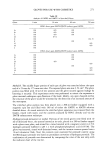
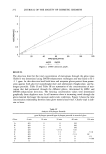
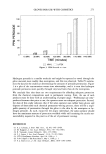
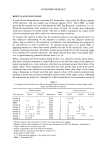
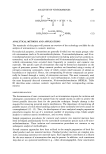
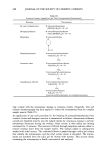
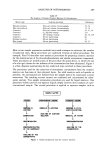
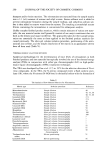
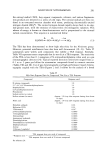
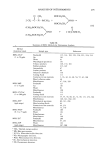
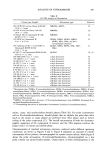
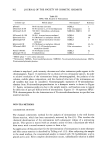
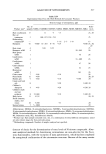
SUNSCREEN EFFICACY 279 RESULTS AND DISCUSSION A total of nine formulations, including 8% homosalate, were tested for efficacy against UVB radiation, and one sample was evaluated against UVA. Their SPFs, as either stated by the manufacturer or as determined by Hill Top Research, varied from 3 to 36. Wash-off experiments were conducted on seven of these. In several cases additional trials were conducted to clarify results. The data in Table I summarize the results of the clinical and guinea pig trials under the various testing conditions. To evaluate the validity of these data by statistical analysis is not appropriate since it is the subjective relationship of one response to another, and not assigned numerical values, that is critical to the evaluation. In addition, this methodology was designed to be cost-effective as well as predictive. To increase group sizes or to spend effort in applying statistics to these data would prohibit the use of the method as a fast, inex- pensive screening procedure. Therefore, group sizes intended for actual screening usage were employed for method validation the trends derived from these were highly effec- tive in approximating protection factors from 3 to 36. When combining data from single animals within a set, subjective trends, which gener- ally show erythema responses at treated skin sites to be less than those of the respective paired untreated sites, were indicative of protection estimates greater than those of the target values. Those responses at treated sites that were greater than those of the paired untreated sites were indicative of protection estimates lower than those of the target values. Responses at treated sites that were equal to those of the paired untreated sites resulted in protection estimates essentially equal to those of the target values. Although all evaluations are subjective, through the relative quantitative and qualitative nature of Table I A Comparison of Sun Protection Factors (Human) and Sun Protection Estimates (Guinea Pigs) Under Static and Wash-Off Conditions Human clinical Guinea pig tests Target c Test material Trial I a Trial IIb Irradiation value Trial I Trial II Trial III Sample A UVA 3 •3 (•3) d Sample B 3.4 3.3 UVB 3 3 3 HMS 4.3,4.1 UVB 4 4 (A) Sample D 5.5 5.0 UVB 5 5 5 Sample E 8.7 (6.7) d 10.6 (4.9) UVB 8 8 •8 (A) Sample F 9.9 (9.1) 8.7 UVB 8 8 8 (•8) Sample G 15.4 14.5 UVB 15 15 • 15 Sample H 17.1 (16.1) 20.2 UVB 15 15 415 (•15) Sample I 25.7 (18.9) UVB 15 15 (15) (15) Sample J 36 f (36) f UVB 36 36 (•36) (A) e (15) Human Human Target values for use in guinea pig trials. Values in parenthesis are from wash-off evaluation. Target value for guinea pig Trial III was reduced to 6. Value based on label claim. A = No protection apparent at the target level tested. HMS = homosalate 8%. clinical values presented for Trial I were provided by the supplier. clinical values presented for Trial II were determined by Hill Top Research, Incorporated.

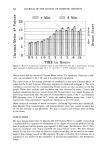
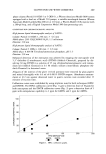
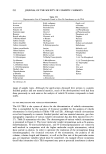
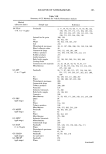
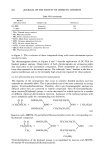
280 JOURNAL OF THE SOCIETY OF COSMETIC CHEMISTS the data at each skin site it is possible to visualize not only the success or failure of a material as a sun protector but also the general margin by which this result has oc- curred. With one exception, the guinea pig trials were successful in confirming the clinical "sun protection factors" of the nine materials tested under static conditions. Sample H, which was shown by the clinical trial to have a protection factor range of 17.1-20.2, was shown by the guinea pig to have a protection estimate of no greater than 15. Although this was not a confirmation of the human SPF value, it was an acceptable approximation of the formulation's potential. In addition, when trials were repeated using the same test material, the results were comparable. Guinea pig wash-off data for a second material, Sample E, using a target value of 8, showed no protection under these conditions (Trial II). Since the initial clinical SPF finding was 6.7, a second trial for wash-off in the guinea pig was conducted using a more realistic target value of 6 (Trial III). This trial again showed no protective capa- bility by this material at this value, suggesting that if this material was substantive in water, its screening ability, after wash, should be characterized by a lower SPF. A clinical reevaluation (Trial II) resulted in a lower SPF (4.9) under wash-off conditions. Although no follow-up animal testing was carried out, these clinical data confirmed the trend predicted by the guinea pig. For purposes of evaluating the data obtained in the guinea pig, we did not choose to adopt the system as described in the OTC monograph (14). In the human, an SPF is calculated by determining the quotient of MED (treated) + MED (untreated) and depends upon the subjective evaluation of the opposing test sites. With the guinea pig, we evaluate and compare the parallel sites only. By doing this we feel that the results will be conservative and will not overestimate the efficacy of the test material. Although experience is limited with UVA protection and wash-off, it is also apparent that the guinea pig is useful for these evaluations. In all instances the data would have been supportive for further evaluation in the human. CONCLUSIONS It is clear that the guinea pig will yield well-defined, reproducible responses to both ultraviolet B irradiation and to ultraviolet A irradiation if the animals are properly sensitized. The procedure is inexpensive and readily manipulated in a laboratory envi- ronment. Because of these characteristics, it serves as an excellent predictive model to indicate or confirm sunprotection estimates in new or reformulated preparations under both static and wash-off conditions where the cost of clinical testing may preclude such investigations in humans. It shows promise as a substitute for the human testing of UVA sunscreens where the use of psoralen compounds is required. In addition, an animal model of this nature used to show protection correlation between formulations comprised of similar raw materials can provide data without other preclinical safety data, thus circumventing the need for larger batteries of toxicological assays required for "new formulations."
Purchased for the exclusive use of nofirst nolast (unknown)
From: SCC Media Library & Resource Center (library.scconline.org)