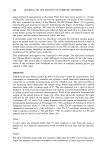
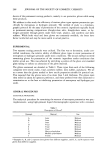
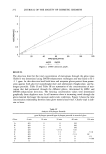
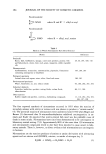
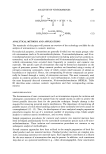
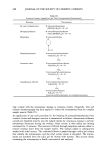
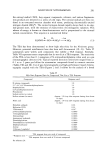
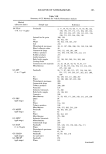
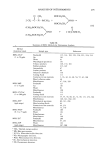
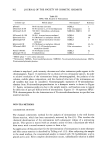
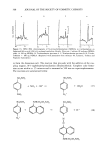
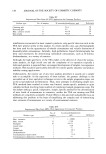
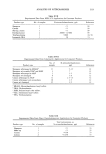
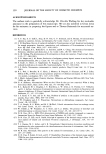
288 JOURNAL OF THE SOCIETY OF COSMETIC CHEMISTS Table III Common Cosmetic Ingredients and Their Corresponding Nitrosamine(s) Precursor Nitrosamines Di- and triethanolamine Diisopropanolamine Morpholine Dimethylstearamine Lauramine oxide Stearalkonium chloride N-nitrosodiethanolamine (HOH2CCH2)2N - N = O N-nitrosodiisopropanolamine (CH3CHOHCH2)2N - N = O N-nitrosomorpholine O () N I N=O N-nitrosomethylstearylamine CH3(CH2)i7N - N = O I CH 3 N-nitrosomethyldodecylamine CH3(CH2)• •N - N = O I CH 3 N-nitrosomethyltetradecylamine CH3(CH2)•3N - N = O CH 3 N-nitrosobenzylmethylamine C6HsCH2N - N = O I CH3 N-nitrosodimethylamine (CHj)2N - N = O N-nitrosomethylstearylamine (see dimethylstearamine) may co-elute with the nitr0samine, leading to erroneous results). Frequently, silica gel column chromatography has been applied to isolate the nitrosamines from the complex sample matrix (Table IV). An application of one such procedure (1) for isolating N-nitrosodiethanolamine from cosmetic lotion and shampoo matrices is summarized as follows: Ammonium sulfamate crystals are dissolved directly into the sample matrix by continuous mixing to prevent nitrosamine formation during the workup. Ethyl acetate is then added and mixing continued for 15 minutes. This mixture is filtered through anhydrous sodium sulfate to remove residual water from the sample matrix. The sodium sulfate is subsequently washed with ethyl acetate. The combined tiltrate is passed through a silica gel column that adsorbs the nitrosamines, and the ethyl acetate eluent is discarded. The nitrosa- mines are desorbed from the silica gel by elution with acetone. This acetone eluent containing the nitrosamines is finally concentrated and analyzed.

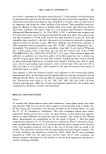
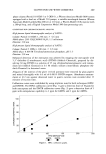
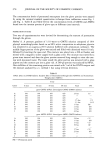
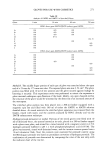
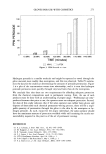
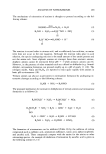
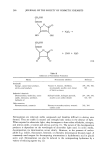
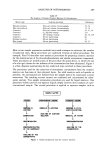
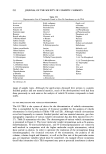
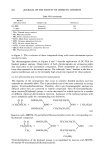
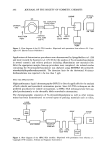
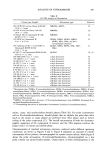
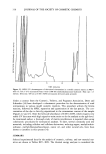
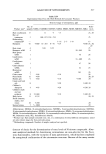
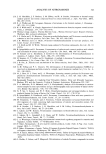
ANALYSIS OF NITROSAMINES 289 Table IV The Analysis of Finished Product Matrices for Nitrosamines Matrix type Isolation procedure References Shampoo products Silica gel column chromatography 19, 29 Hair-care products Silica gel column chromatography 25, 26 Cosmetics Silica gel column chromatography 42, 43, 95 Cosmetics C•8 Sep-Pak cleanup 275 Cosmetics Ion-exchange cleanup 28, 30, 105 Cosmetics Solvent partitioning 66 Shampoo products Solvent partitioning 32 Skin creams Solvent partitioning 29, 32 More recent sample preparation methods have made attempts to minimize the number of analytical steps. Many procedures are condensed versions of earlier procedures. For example, Fine (16) describes trace analytical procedures for preparing cosmetic matrices for the determination of N-nitrosodiethanolamine and similar nitrosamine compounds. These procedures are modifications of the procedure discussed above, in which the use of a silica gel column for the isolation of the nitrosamines has been eliminated. Figure 1 is a flow diagram summarizing the key analytical steps involved in these procedures. The procedures used for the extraction of nitrosamine contaminants from the cosmetic matrices are functions of their physical forms. For solid matrices such as lipsticks or powders, the nitrosamines are isolated from the sample matrix by consecutive acetone extractions. The resulting acetone extracts are combined and concentrated for subse- quent analysis. Two sample preparation procedures are used for liquid matrices. One procedure widely used for non-aqueous liquids simply involves direct analysis of a pre- concentrated sample. The second procedure is applied to aqueous samples such as Figure 1. Sample preparation steps for cosmetic matrices.
Purchased for the exclusive use of nofirst nolast (unknown)
From: SCC Media Library & Resource Center (library.scconline.org)