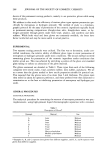
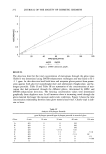
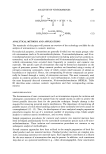
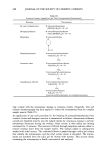
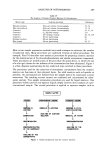
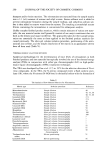
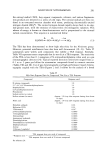
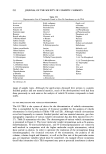
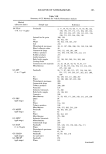
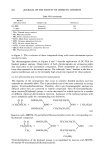
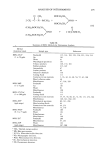
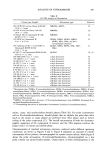
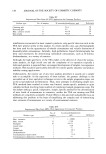
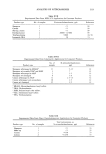
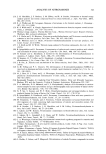
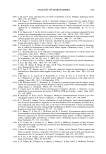
ANALYSIS OF NITROSAMINES 319 Table XVII Experimental Data From HPLC-UV Applications for Consumer Products Product type No. of samples N-nitrosodiethanolamine, ppb References Shampoos 1 1 99 Creams 1 1 99 Shaving creams 1 1 99 Diethanolamine 2 20000- 127000 99 Triethanolamine 3 •800 10, 99 Lauramide DEA 1 50 74 Table XVIII Experimental Data From Colorimetric Applications for Consumer Products No. of N-nitrosodiethanolamine, Product type samples ppb References Shampoos w/bronopol & MEALS a 11 Shampoos w/cocamide DEA b and SLES c 3 Shampoos w/bronopol & ALS d 3 Shampoos w/o bronopol 6 Creams w/bronopol & TEA e 12 Creams w/bronopol and antioxidants 10 Creams w/o bronopol 25 5-22 32 7 32 2.5 32 3.9 32 2.5-15 32 2.5 32 2.5 32 MEALS, Monoethanolamine lauryl sulfate. DEA, Diethanolamine. SLES, Sodium lauryl ether sulfate. ALS, Ammonium lauryl sulfate. TEA, Triethanolamine. Table XlX Experimental Data From Direct Chemiluminescence Applications for Consumer Products Product type No. of samples Total nitrosamines, as N-nitrosodiethanolamine, ppb References Shampoos Make-up Creams Lotions 1 1 •350 •1240 33 33 33 33

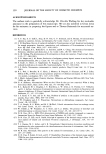
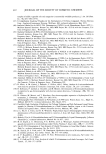
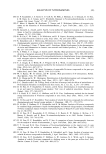
320 JOURNAL OF THE SOCIETY OF COSMETIC CHEMISTS ACKNOWLEDGMENTS The authors wish to gratefully acknowledge Dr. Priscilla Walling for her invaluable assistance in the preparation of this manuscript. We are also indebted to Glenn Lewis for his assistance in preparing the figures and to Theresa Raimonde for secretarial ser- vices. REFERENCES (1) T. Y. Fan, E. U. Golf, L. Song, D. H. Fine, G. P. Arsenault, and K. Bieman, N-nitrosodiethan- olamine in cosmetics, lotions, and shampoos, Fed. Cosmet. Toxicol., 15, 423-430 (1977). (2) J. H. Hotchkiss, Review of analytical methods for N-nitrosamines in food: Analytical methodology for sample preparation, detection, quantitation, and confirmation of N-nitrosamines in foods, J. Assoc. Off. Anal. Chem., 64(5), 1037-1050 (1981). (3) M. L. Douglass, B. L. Kabacoff, G. A. Anderson, and M. C. Cheng, The chemistry of nitrosamine formation, inhibition and destruction, J. Soc. Cosmet. Chem., 29, 581-606 (1978). (4) G. M. Telling, The determination of N-nitrosamines in foods and cosmetics, Trends in Anal. Chem., 1(12), 277-280 (1982). (5) P. N. Magee and J. M. Barnes, Production of malignant primary hepatic tumors in rats by feeding dimethylnitrosamine, Brit. J. Cancer, 10, 114-122 (1956). (6) F. Ender, G. Havre, A. Ndgebostad, N. Koppang, R. Madsen, and L. Ceh, Sterility in mink induced by deficiency of vitamin B6, Naturwissenschaften, 51, 637-638 (1964). (7) S.S. Hecht, Nitrosamine contaminants in cosmetic products, Drug & Cosmet. Ind., 36-37 (June 1981). (8) B. L. Pool, S. Brendler, R. G. Klein, J. Monarca, R. Pasquini, P. Schmezer, and W. J. Zeller, Effects of SO2 or NOx on toxic and genotoxic properties of chemical carcinogens. II. Short term in vivo studies, Carcinogenesis, 9(7), 1247-1252 (1988). (9) J. March, Advanced Organic Chemistry: Reactions, Mechanisms and Structure (McGraw Hill, New York, 1968), pp. 484-486. (10) G. A. Anderson, Nitrosamines: What are they? How do they get into cosmetics? What is being done about them?, House. & Pers. Prod. Ind., 94-104 (May 1978). (11) B. L. Kabacoff, M. L. Douglass, I. E. Rosenberg, L. W. Levan, J. K. Punwar, S. F. Vielhuber, and R. J. Lechner, Formation of nitrosamines in nonionic and anionic emulsions in the presence and absence of inhibitors, N-Nitroso Compounds: Occurrence International Agency for Research on Cancer Science Publication, 57, 347-352 (1984). (12) I. S. Krull, T. Y. Fan, and D. H. Fine, Problem of artifacts in the analysis of N-nitroso com- pounds, Anal. Chem., 50(6), 698-701 (1978). (13) J. W. Pensabene and A. E. Wasserman, Nitrosamines in dishwashing compounds, Fed. Cosmet. Toxicol., 18, 329 (1980). (14) T. A. Gough, K. S. Webb, and M. F. McPhail, Volatile nitrosamines from ion-exchange resins, Fed. Cosmet. Toxicol., 15, 437-440 (1977). (15) W. Fiddler, J. W. Pensabene, R. C. Doerr, and C. J. Dooley, The presence of dimethyl- and diethylnitrosamine in deionized water, Fed. Cosmet. Toxicol., 15, 441-443 (1977). (16) D. H. Fine, III.2.a. HPLC-TEA determination of NDELA and similar compounds in cosmetics, International Agency for Research on Cancer Science Publication, 45, 3309-3317 (1983). (17) D. H. Fine, D. Lieb, and F. Rufeh, Principle of operation of the thermal energy analyzer for the trace analysis of volatile and nonvolatile N-nitroso compounds, J. Chromatogr., 107, 351-357 (1975). (18) T. J. Hansen, M. C. Archer, and S. R. Tannenbaum, Characterization of pyrolysis conditions and interferences by other compounds in the chemiluminescence detection of nitrosamines, Anal. Chem., 51(9), 1526-1528 (1979). (19) M. R. Sine, Nitromusk: False positive in the analysis for nitrosamines, J. Soc. Cosmet. Chem., 37, 267-277 (1986). (20) D. H. Fine, F. Rufeh, D. Lieb, and D. P. Rounbehler, Description of the thermal energy analyzer (TEA) for trace determination of volatile and nonvolatile N-nitroso compounds, Anal. Chem., 47(7), 1188-1191 (1975).
Purchased for the exclusive use of nofirst nolast (unknown)
From: SCC Media Library & Resource Center (library.scconline.org)