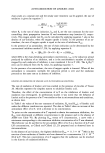
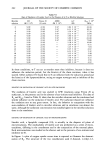
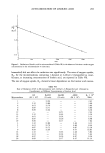
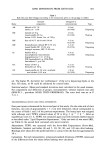
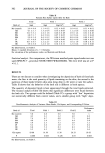
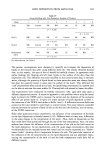
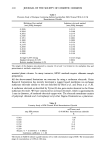
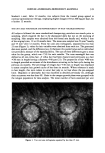
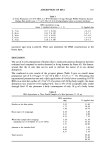
AUTO-OXIDATION OF LINOLEIC ACID 295 Table IX Rate of Oxidation of Linoleic Acid in Presence and in Absence of Inhibitor in Microemulsions With 2-Ethyl-1,3-Hexanediol and 1-Butanol as Cosurfactants and Propylenglycol/Water Mixture as External Phase LH ButOH HexOH Tween 20 AIBN ot-T Rp X 109 Rin h X 109 Microemulsion (M X 102) (% w/w) (% w/w) (% w/w) (M X 10 3) (M X 10 4) (M/s) (M/s) 23 9.09 11.56 -- 23.27 -- 6.20 -- 24 9.09 11.56 -- 23.27 9.47 -- 11.70 25 9.09 11.56 -- 23.27 9.47 1.56 -- 1.42 26 9.09 11.56 -- 23.27 9.47 6.11 -- 11.25 27 9.09 -- 13.08 22.87 -- -- 4.44 -- 28 9.09 -- 13.08 22.87 9.47 -- 12.67 -- 29 9.09 -- 13.08 22.87 9.47 1.56 -- 3.83 30 9.09 -- 13.08 22.87 9.47 6.11 -- 11.83 31 9.42 -- 12.21 21.35 -- 6.17 -- 32 9.42 -- 12.21 21.35 9.81 -- 13.56 33 9.42 -- 12.21 21.35 9.81 1.61 -- 4.56 34 9.42 -- 12.21 21.35 9.81 6.33 -- 12.34 35 9.78 -- 11.27 19.72 -- -- 6.38 36 9.78 -- 11.27 19.72 10.20 -- 16.92 37 9.78 -- 11.27 19.72 10.20 1.68 -- 5.22 38 9.78 -- 11.27 19.72 10.20 6.57 -- 15.38 39 10.20 -- 10.27 17.91 -- 7.99 -- 40 10.20 -- 10.27 17.91 10.60 -- 17.22 41 10.20 -- 10.27 17.91 10.60 1.74 -- 6.50 42 10.20 -- 10.27 17.91 10.60 6.83 -- 17.36 rate could be ascribed to the decrease of the amount of 2-ethyl-1,3-hexanediol in the external phase and also to the lower micelle concentration of Tween 20, which could solubilize linoleic acid, protecting it from the auto-oxidation. The oxidation rate in micelles and in emulsions is eight to ten times higher than the one in the microemulsions systems. These results underline the remarkable effect of the microemulsions on the stabilization of linoleic acid towards the oxidation. INFLUENCE OF THE MICROEMULSION STRUCTURE ON THE OXIDIZABILITY OF LINOLEIC ACID Literature data report (25,26) that alcohols have an inhibiting effect on the rate of oxidation of linoleic acid. An experiment was carried out to investigate if the low values of Rp in microemulsions could be ascribed to the presence of the alcohol or to the inhibitor effect of the structure of the microemulsions. The data are reported in Table X. To compare the inhibitory effect of the alcohol and of the microemulsions system, Table X Rates of Oxidation of Linoleic Acid, Rp, in Microemulsion and 2-Ethyl-l,3-Hexanediol Solution at 37 ø IPM Tween 20 HexOH LH Rp X 10 9 (% w/w) (% w/w) (% w/w) (M X 102) (M/s) Microemulsion 5.04 19.72 13.99 6.95 6.11 Solution -- -- 97.92 6.95 2.77

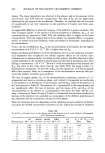
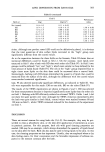
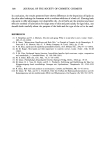
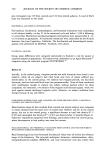
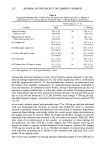
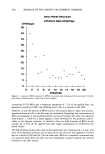
296 JOURNAL OF THE SOCIETY OF COSMETIC CHEMISTS the Rp values of a solution of linoleic acid in 2-ethyl-l,3-hexanediol and of a micro- emulsion carrying linoleic acid were also estimated (Table X). The concentration of 2-ethyl-1,3-hexanediol in the linoleic acid solution was about seven times higher than that of the microemulsion, but the Rp value of the microemulsion is just half of that of the solution. The experiments showed that even if 2-ethyl-1,3-hexanediol had an an- tioxidant effect, the microemulsion had a quite large inhibitory effect. This effect could be ascribed to the structure of the droplet interface, which is more close-packed than that of emulsions. TIMES OF INHIBITION In the systems described herein many reactions showed a considerable decrease of rate of oxidation of linoleic acid in the presence of o•-T in the presence of microemulsions, the oxidation rates are particularly slow, and an inhibition period longer than two hours could not be determined for experimental reasons (see Methods section). On the other hand, in micellar solutions the rates of oxygen uptake were sufficiently high, and a sharp decrease of oxygen uptake in the presence of inhibitor was assessed. Therefore, the inhibition period, tinh, and the rate of chain initiation, Ri, by the conventional method of inhibitor kinetics, should be determined by applying equation 8. But no inhibition time could be observed. In a previous study, other authors (27) underlined the necessity of a sequestrant, in the presence of micelles of sodium lauryl sulfate, when o•-T was the inhibitor. The necessity of a sequestrant to synergize the antioxidant effect of o•-T was also underlined by Cillard and Cillard (21-23). Four different concentrations of o•-T, in the presence of EDTA (1.0 x 10⁻⁴ M) were used to determine the period of inhibition. The tin h and R i values, reported in Table XI, show that the inhibition periods can be related to the o•-T concentration. CONCLUSIONS The auto-oxidation of linoleic acid in micellar solutions, in emulsions, and in micro- emulsions showed different rates of reaction. The rates of oxidation of linoleic acid in emulsions and in micellar solutions were about the same, even when the amounts of Tween 20 in the two systems were very different. However, the rates of oxidation of linoleic acid in the microemulsions were notably lower than those obtained in emulsions and in micellar solutions, probably in consequence of the structure of the droplet interface. Table XI Values of Inhibition Period tin h and R i (M/s) for Micellar Solutions, in the Presence of Azo-Initiator Miceliar solution ot-T tin h (S) Rin h X 1010 (M/s) 1 3.15 x 10 -8 540 1.17 2 8.00 x 10 -8 780 2.05 3 1.50 x 10 -7 1440 2.08 4 3.15 x 10 -7 3000 2.10 [AIBN] = 9.47 x 10 -3 M chelant [EDTA] = 1.0 x 10 -4 M. Linoleic acid concentration was 7.35 x 10 --2 M.
Purchased for the exclusive use of nofirst nolast (unknown)
From: SCC Media Library & Resource Center (library.scconline.org)