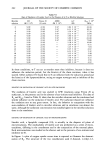
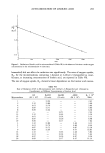
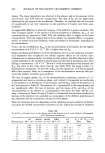
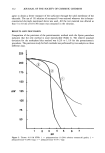
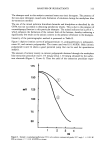
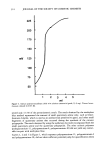
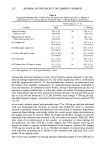
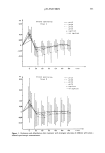
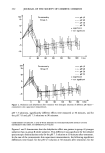
332 JOURNAL OF THE SOCIETY OF COSMETIC CHEMISTS Ski 15- 10- 5- O- -5- -101 Corneometry Group A • pH --- pH .... pH ?,0 ......... pH ?,5 significont not significont Skt • 15- 10- 5- . -5- Corneomety Group B ß •) 30 60 90 1•0 1•0 1•0 timin pH --- pH 5,9 .... pH 7,0 .......... pH ?,5 m significQnt o r,,ot significont Figure 2. Hydration and dehydration after treatment with detergent solutions of different pH values-- corneometric skin capacitance measurements. pH 7.5 solutions, significantly different effects were measured at 30 minutes, and for the pH 7.0 and pH 7.5 solutions at 90 m•nutes. COMPARISON OF GROUPS A AND B WITH REGARD TO THE DEHYDRATIVE EFFECT OF THE DETERGENT SOLUTION AT DIFFERENT pH VALUES Figures 1 and 2 demonstrate that the dehydrative effect was greater in group A (younger subjects) than in group B (older subjects). This difference was significant for the infrared spectroscopic determinations only for the pH 7.5 solution at 30 minutes after treatment. In the case of the corneometric skin capacitance measurements, the following significant differences were found: for the pH 4.5 solution at 30 minutes after treatment for the

pH AND SKIN 333 pH 5.9 solution at 60 and 90 minutes for the pH 7 solution at 30, 60, and 90 minutes and for the pH 7.5 solution at 180 minutes. DISCUSSION In our earlier studies, we were able to show that the water content of the horny layer is higher in older than in younger subjects, showing also higher variability for the former (2). In the present study, the infrared spectroscopic results confirmed the earlier find- ings. The corneometric skin capacitance measurements showed the same tendency, albeit outside the level of statistical significance. The present studies further show that the application of a specific detergent multicomponent emulsion leads to an initial, transient hydration effect. This hydration effect proved to be largely independent of the pH value of the solution nor was their any clear dependence on the age of the subjects. The dehydrative effect of detergent substances is well known. Blank and Shappirio (1) were able to demonstrate that the water-binding capacity of the stratum corneum decreases after the application of detergent substances. In earlier studies (3), we showed that both a soap solution and a surfactant solution caused a considerable dehydration of the stratum corneum. These studies involved infrared spectroscopy measurements as well as corneometric determinations of skin capacitance. These earlier findings appear to be corroborated by the present results. No exhaustive study on the dependence of the dehydrative effect of detergent solutions on their pH exists in the literature. In the older literature, it was often presumed that soaps had rather a moisturizing effect while synthetic surfactants had a dehydrative effect. Our earlier studies (3) have already disproved this concept. The present studies demonstrate that the dehydrative effect of this particular slightly alkaline detergent emulsion can be more pronounced than that of the same composition at neutral or slightly acid pH. If this result is generally applicable, slight acidification of detergent solutions would be a reasonable strategy to minimize dehydrative effects. This possi- bility should be explored in more depth. A notable aspect of the present study was the difference between the groups of older and younger subjects. Although the dehydrative effect was apparent as a tendency in both groups, it was more pronounced among the younger subjects than among the older subjects. REFERENCES (1) I. H. Blank and E. B. Shappirio, The water content of the stratum corneum. 3. Effects of previous contact with aqueous solutions of soaps and detergents. J. Invest. Dermatol., 25, 391-401, 1955. (2) M. Gloor, G. Hirsch, and W. Willebrandt, On the use of infrared spectroscopy for the in vivo measurement of the water content of the horny layer after application of dermatological ointments. Arch. Derre. Res., 272, 305-313, 1981. (3) M. Gloor, M. Gehse, and E. W/51fle, Beeinflussung der Hornschichtfeuchtigkeit durch waschaktive Substanzen. ,•rztl. Kosmetol., 15, 293-302, 1985. (4) K. Mosler, Hautfeuchtigkeitsmessung--kein Problem mir dem Corneometer 420. Pao c. Kosmet., 64, 375-379, 1983. (5) R. Osberghaus, D. Gloxhuber, H. G. Van Raay, and S. Braig, Hydragen F, ein neuer Hautfeuchtigkeitsregulator--Methoden und Ergebnisse des Wirkungsnachweises. J. Soc. Cosmet. Chem., 29, 133-146, 1978. (6) W. Schneider, Seifen und Syndets, •sth. Med., 10, 304-311, 1961. (7) H. Tronnier, Differenzierte Feuchtigkeitsmessung an der menschlichen Haut, •rtzl. Kosmetol., 10, 281-308, 1980.
Purchased for the exclusive use of nofirst nolast (unknown)
From: SCC Media Library & Resource Center (library.scconline.org)