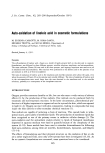
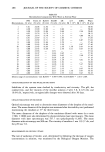
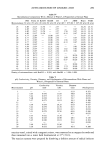
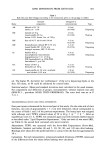
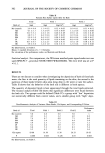
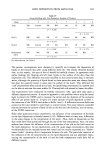
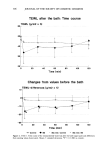
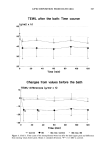
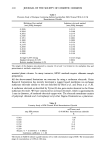
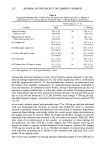
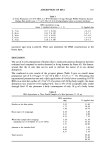
AUTO-OXIDATION OF LINOLEIC ACID 289 Table I¾ Microemulsion Compositions With a Mixture of Water/1,2-Propanediol as External Phase IPM Tween 20 ButOH HexOH LH ot-T AIBN Water PrOH Microemulsion (% w/w) (% w/w) (% w/w) (% w/w) (% w/w) (M x 10 4) (M x 10 3) (% w/w) (% w/w) 23 4.85 23.27 11.56 -- 2.57 -- -- 34.24 23.51 24 4.85 23.27 11.56 -- 2.57 -- 9.47 34.24 23.51 25 4.85 23.27 11.56 -- 2.57 1.56 9.47 34.24 23.51 26 4.85 23.27 11.56 -- 2.57 6.11 9.47 34.24 23.51 27 4.77 22.87 -- 13.08 2.53 -- -- 33.65 23.10 28 4.77 22.87 -- 13.08 2.53 -- 9.47 33.65 23.10 29 4.77 22.87 -- 13.08 2.53 1.56 9.47 33.65 23.10 30 4.77 22.87 -- 13.08 2.53 6.11 9.47 33.65 23.10 31 4.94 23.97 -- 12.21 2.62 -- -- 34.90 23.97 32 4.94 23.97 -- 12.21 2.62 -- 9.81 34.90 23.97 33 4.94 23.97 -- 12.21 2.62 1.62 9.81 34.90 23.97 34 4.94 23.97 -- 12.21 2.62 6.33 9.81 34.90 23.97 35 5.14 19.72 -- 11.27 2.72 -- -- 36.25 24.90 36 5.14 19.72 -- 11.27 2.72 -- 10.20 36.25 24.90 37 5.14 19.72 -- 11.27 2.72 1.68 10.20 36.25 24.90 38 5.14 19.72 -- 11.27 2.72 6.57 10.20 36.25 24.90 39 5.34 17.21 -- 10.27 2.84 -- -- 37.73 25.91 40 5.34 17.21 -- 10.27 2.84 -- 10.60 37.73 25.91 41 5.34 17.21 -- 10.27 2.84 1.74 10.60 37.73 25.91 42 5.34 17.21 -- 10.27 2.84 6.83 10.60 37.73 25.91 Density of microemulsions: with ButOH = 0.992 with HexOH = 1.004-1.008. Table V pH, Conductivity, Viscosity, Diameter, and Polydispersion of Microemulsions With Water and Water/1,2-Propanediol as External Phase Conductivity Viscosity Diameter Microemulsion pH (mS) (cSt) (nm) Polydispersion 1 -- -- 41.0 0.153 2 5.65 0.076 11.83 48.8 0.016 4 5.42 0.075 13.77 54.5 0.054 6 5.38 0.076 13.17 54.7 0.076 8 5.27 0.075 14.01 56.3 o. 188 12 -- -- -- 48.3 0.442 13 5.59 o. 079 20.25 63.8 0.437 15 5.42 0.079 22.76 62.5 o. 132 17 5.31 0.077 25.61 63.5 0.033 19 5.23 o. 079 29.56 64.6 o. 366 23 -- -- -- 40.1 0.032 24 5.55 0.032 15.76 -- -- 27 5.62 0.025 24.98 48.5 0.136 31 5.45 0. 030 22.01 57.1 0. 194 35 -- -- -- 59.8 0.028 36 5.40 0.031 21.96 -- 39 5.30 0.031 21.05 56.4 0.108 reaction vessel, stirred with a magnetic stirrer, was connected to an oxygen electrode and then immersed into a water bath thermostated at 37 ø (-0.1). The reaction systems were prepared by dissolving a definite amount of radical initiator

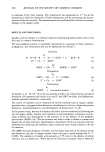
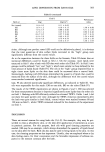
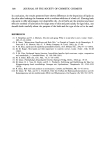
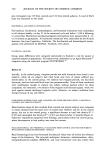
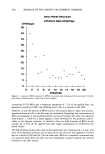
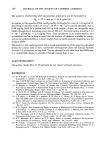
290 JOURNAL OF THE SOCIETY OF COSMETIC CHEMISTS in solutions of the three systems. The temperature was maintained at 37 ø for all the formulations, both for simulation of body temperature and for promoting the decom- position of the azo-initiator. The measurements were performed for two hours to prevent damage to the oxygen probe. RESULTS AND DISCUSSION Linoleic acid was chosen as a reference molecule representing lipids present both in the skin and in cosmetic formulations. The auto-oxidative process is commonly represented as consisting of chain initiation, propagation, and termination and can be represented by Scheme 1: Initiation kd '--' N2 + 2 [3 R ø + (1 - [3) R-R (1) ---) ROO ø (2) R-N=N-R R ø + 02 02 ROO ø + LH -- Propagation kp ROOH + LOO ø (3) LOO ø + LH -- L ø + LOOH (4) L ø + 02 -- LOO ø (5) Termination kt 2LOO ø --• non-radical product (6) In Scheme 1, R- N = N- R is the azo-initiator and [3 is the radical fraction produced therefrom LH represents the linoleic acid and L ø and LOO ø are alkyl- and alkylperoxy- radicals generated therefrom, respectively. The extent of oxidation can be measured by several methods such as oxygen uptake, peroxide value, conjugated diene formation, thiobarbituric acid test, ethane and pentane formation, chemiluminescence, and development of fluorescence (17, 18). In the present study, the rate of oxidation of linoleic acid was measured by following the rate of oxygen uptake. Linoleic acid oxidation in microemulsions, emulsions, and mi- celiar solutions was investigated in the presence or in the absence of the lipophilic azo-initiator (AIBN) (19). The azo-initiator was used in order to obtain a constant and known rate of chain initiation. Experiments in the absence of the azo-initiator were also performed for observing the oxidation under conditions more closely related to the use of cosmetics. The AIBN-initiated oxidation of linoleic acid was faster than that in the absence of any azo-derivative the plot of oxygen uptake versus time gave a good straight line (r 2 = 0.990). The oxidation of linoleic acid proceeds at 37øC even in the absence of radical initiator, but at a slower rate. When the rate of initiation is constant, that is, when the
Purchased for the exclusive use of nofirst nolast (unknown)
From: SCC Media Library & Resource Center (library.scconline.org)