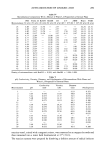
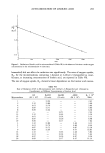
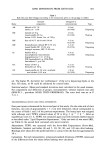
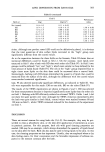
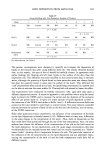
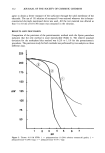
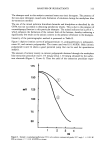
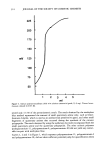
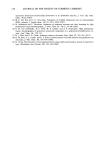
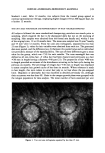
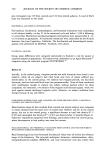
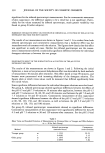
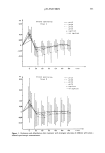
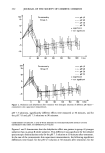
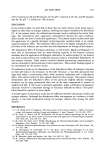
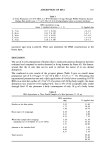
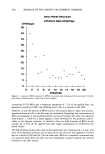
DIFFUSE ANDROGEN-DEPENDENT ALOPECIA 323 300 250 200 150 100 50 Total Hair Density 0 12 0 12 Treated (n=6) Controls (n=6) 0'0.05) 250 200 150 100 50 Meaningful Hair Density ß 0,0.00 0 12 0 12 Treated (n=6) Controls (n=6) Time Months Figure 2. Changes in total and meaningful hair densities (mean - SEM) in controls and subjects treated with spironolactone (75 or 100 mg per day). *Significance level (paired Student's t-test). predicting what effective regimen is required for a specific group or individual. Circu- lating hormonal levels do not provide any reliable information about the rate of change occurring in scalp hair or the dosage required to treat it (2). This is of considerable importance since the treatment time required may be several years. Moderate dosages of spironolactone (75 or 100 mg per day) appear capable of stabilizing the course of androgen-dependent alopecia, at least in these women, without any significant side effects. Initially, higher dosages may be necessary to improve hair quality and achieve increases in hair density. However, further long-term studies are required to confirm these findings. Our data for spironolactone supports the role of androgens as a mediating factor in genetic hair loss in women.

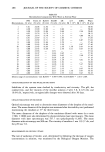
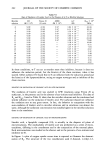
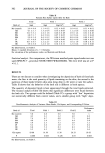
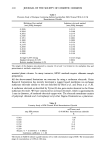
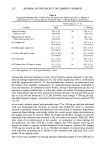
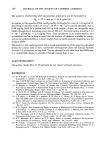
324 JOURNAL OF THE SOCIETY OF COSMETIC CHEMISTS Table HI Comparisons Between Basal Hair Variables and Those Obtained After 12 and 24 Months of Spironolactone Treatment Subject One Subject Two Spironolactone (mg per day) l---100---I---200---I I---75---I---150---I Time (months) 0 12 24 0 12 24 Hair variable Total hair density per cm 2 310 303 349 162 145 173 Meaningful hair density per cm 2 258 267 293 130 131 147 (%) Anagen hair 72.9 76.6 86.6 79.4 84.0 77.6 (%) Meaningful anagen hair 79.5 78.6 86.5 85.6 84.7 80.2 (%) Veilus hair 16.5 16.5 11.9 19.6 9.6 15.0 (%) Telogen hair --30 mm 13.2 6.2 2.6 11.2 6.4 7.5 ACKNOWLEDGMENTS The authors would like to thank the Philip Kingsley Trichological Clinics in New York and London for their financial support and sponsorship of this study. REFERENCES (1) (2) (3) (4) (5) (6) (7) (8) (9) (10) (11) (12) (13) (14) (15) A. Rook and R. P. R. Dawber, In Diseases of the Hair and Scalp (Blackwell Scientific Publications, Oxford, 1982), pp. 95-98. D. H. Rushton, I. D. Ramsay, K. C. James, M. J. Norris, and J. J. H. Gilkes, Biochemical and trichological characterisation of diffuse alopecia in women, Br. J. Dermatol., 123, 187-197 (1990). E. Ludwig, Classification of the types of androgenetic alopecia (common baldness) occurring in the female sex, Br. J. Dermatol., 97, 249-254 (1977). J. A. Miller, C. R. Darley, K. Karkavitsas, J. D. Kirby, and D. D. Munro, Low sex hormone binding globulin levels in young women with diffuse hair loss, Br. J. Dermatol., 106, 331-336 (1982). J. M. Kasick, W. F. Bergfeld, W. D. Steck, and M. K. Gupta, Adrenal androgenic female-pattern alopecia: Sex hormones and the balding woman, Clev. Clin. Q., 50, 111-122 (1983). W. Futterweit, A. Dunaif, H. C. Yeh, and P. Kingsley, The prevalence of hyper-androgenism in 109 consecutive female patients with diffuse alopecia, J. Am. Acad. Dermatol., 19, 831-836 (1988). L. Moltz, Hormonale diagnostik der sogenannten androenetischen alopezie der frau, Geburtsh in Frauenheilk, 48, 203-214 (1988). R. F. Spark and J. C. Melby, Aldosteronism in hypertension, Ann. Intern. Med., 69, 685-691 (1968). S. L. Steelman, J. R. Brooks, E. R. Morgan, and D. J. Patanelli, Anti-androgenic activity of spi- ronolactone, Steroids, 14, 449-450 (1969). H. C. Erbler, Suppression by the spironolactone metabolite canrenone of plasma testosterone in man, Arch. Pharmacol., 285, 403-406 (1974). K. P. Ober and J. F. Hennessy, Spironolactone therapy for hirsutism in a hyperandrogenic woman, Ann. Intern. Med., 89, 643-644 (1978). G. Shapiro and S. Evron, A novel use of spironolactone: Treatment of hirsutism, J. Clin. Endocrinol. Metab., 51, 429-432 (1980). D.C. Cumming, J. L. Yang, R. W. Rebar, and S.S. C. Yen, Treatment of hirsutism with spi- ronolactone, JAMA, 247, 1295-1298 (1982). P. YliSstalo, J. Heikkinen, A. Kanppila, A. Pakarinen, and P. A. Jiirvinen, Low-dose spironolactone in the treatment of female hirsutism, lnt. J. Fertil., 32, 41-45 (1987). E. L. Heifer, J. L. Miller, and L. I. Rose, Side-effets of spironolactone therapy in the hirsute woman, J. Clin. Endoerinol. Metab., 66, 208-211 (1988).
Purchased for the exclusive use of nofirst nolast (unknown)
From: SCC Media Library & Resource Center (library.scconline.org)