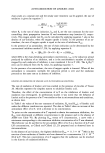
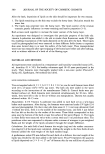
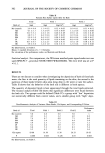
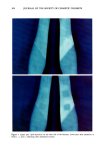
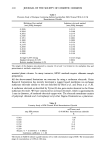
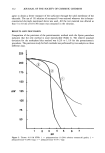
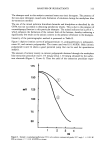
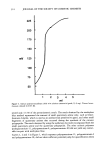
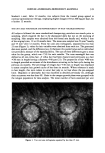
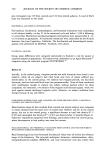
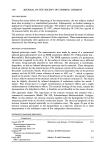
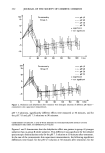
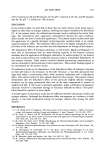
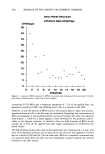
DIFFUSE ANDROGEN-DEPENDENT ALOPECIA 319 Student's t-test). After 12 months, two subjects from the treated group agreed to continue spironolactone therapy, employing higher dosages (150 or 200 mg per day), for a further 12 months. THE UNIT AREA TRICHOGRAM AND REPRODUCIBILITY OF HAIR VARIABLES EMPLOYED All subjects followed the same standardized shampooing procedure one month prior to sampling, which required the hair to be shampooed daily but not on the morning of sampling. Hair samples were obtained from the frontal area basally and, within 5 mm of the original sites, 12 or 24 months later. The mean area sampled was 56 mm 2 basally and 55 mm 2 after 12 months. From two unit area trichograms, separated by less than 25 mm (Figure 1), values for hair variables were obtained from each site. The generated data were pooled, and the difference (as a %) between this pooled value and an individual site provided a measure of the reproducibility. The sum of these differences gave a mean value for the group, which was (5% for each variable. The term meaningful hair was defined as all non-vellus hair. A vellus hair had been characterized previously as a hair 430 mm in length having a diameter 440 I•m (23). The proportion of hair 480 mm in length provided an estimate of the disturbance occurring to the hair cycle during the previous six months. The percentage of telogen hair 430 mm in length was employed to assess complete hair growth cycles of less than six months. Where reference is made to hair length, this term relates to uncut hair only or cut hair above the pre-assigned limit. Dysplastic or dystrophic hair was classified as detailed previously (2), although their occurrence was less than 4%. Hairs in the catagen growth phase were grouped with the telogen population for data analysis. The mean number of hairs examined per unit Figure I. Two unit area trichograms separated by less than 25 mm.

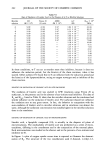
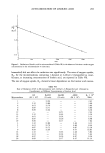
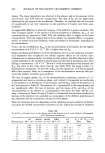
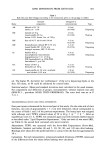
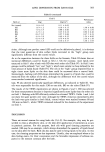
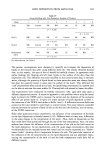
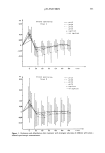
320 JOURNAL OF THE SOCIETY OF COSMETIC CHEMISTS area trichogram was 135 from controls and 141 from treated subjects. A total of 6624 hairs was examined in this study. BIOCHEMICAL AND MEDICAL INVESTIGATIONS Full medical, biochemical, haematological, and hormonal evaluations were undertaken in all subjects basally, on day 21 of the menstrual cycle and before 11.00 h following a 12-hour fast. Biochemical and haematological investigations were repeated after 6, 12, or 24 months as appropriate. All hormonal evaluations were undertaken by the Nichols Institute, San Juan Capistrano, California. The biochemical and hematological investi- gations were performed by MetPath, Teterboro, New Jersey. STATISTICAL ANALYSIS Group mean differences were compared statistically by Student's t-test for paired or unpaired samples as appropriate. All analyses were undertaken on an Apple Macintosh TM computer using the statistical program STATWORKS. TM RESULTS Initially, in the treated group, irregular periods and mild hirsutism were noted in two subjects, while all six subjects had mild facial acne (two of whom suffered pre- menstrually). In the control group, two subjects had irregular periods, one had mild hirsutism, and two had mild facial acne (one premenstrually). None of these conditions were troublesome enough to warrant any subject seeking medical advice for these complaints. On treatment, two subjects with irregular cycles became regular, while two with regular menses developed irregular cycles. However, no subject withdrew from therapy because of any side effects. COMPARISON BETWEEN BASAL HAIR VARIABLES AND THOSE OBTAINED AFTER 12 MONTHS IN CONTROL AND TREATED SUBJECTS Mean baseline values for hair variables from controls and treated subjects were compared to values obtained from the same sites 12 months later (Tables I and II). In the control group, but not in the treated group, a significant decrease in total hair density (P 0.05) and meaningful hair density (P 0.01) was observed after 12 months (Figure 2). Subjective impressions supported these findings, particularly within the control group, where deterioration in hair quality was cause for concern. BASAL BIOCHEMICAL AND HORMONAL EVALUATIONS FROM CONTROL AND TREATED SUBJECTS WITH DIFFUSE ANDROGEN-DEPENDENT ALOPECIA Basal hematological and non-hormonal biochemical values were all within the reference range of the laboratory. The principle androgenic hormones, androstenedione, dehy- droepiandrosterone-sulphate (DHEA-S), and total testosterone were also within their
Purchased for the exclusive use of nofirst nolast (unknown)
From: SCC Media Library & Resource Center (library.scconline.org)