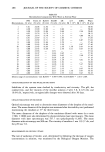
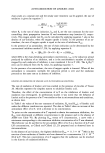
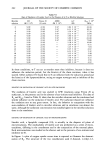
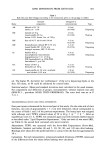
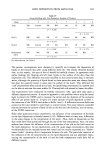
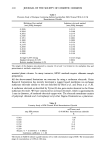
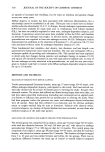
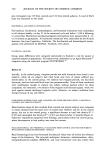
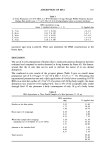
AUTO-OXIDATION OF LINOLEIC ACID 291 chain starts at a constant rate and the steady state treatment can be applied, the rate of oxidation is given by equation 7: -- d[O2] kp[LH] R? dt - Rp -- (kt)V2 (7) where R• is the rate of chain initiation, kp and k t are the rate constants for the rate- controlling chain propagation (reaction 4) and termination step (reaction 6), respec- tively. The oxygen uptake rate Rp can be calculated by applying equation 7 also in the absence of azo-initiator, when the oxygen uptake is linear. In the presence of an an- tioxidant, the rate of oxygen uptake is equal to the rate of inhibition R•n h. In the presence of an antioxidant, the rate of chain initiation can be determined by the conventional inhibitor method (7,20), by applying equation 8: R i = 213k d [R - N = N - R] = n [IH]/tin h (8) where [IH] is the chain-breaking antioxidant concentration, tin h is the induction period produced by addition of an inhibitor, and n is the stoichiometric number of radicals trapped by each molecule of inhibitor n was considered 2 for ot-T (20). The kp/(kt) I/2 ratio can be deduced from the R i value, by applying equation 7. In the presence of an antioxidant, the rate of oxygen uptake is lowered. When all the antioxidant is consumed, normally the induction period is over and the oxidation proceeds at the same rate as in absence of inhibitor. KINETICS OF OXIDATION OF LINOLEIC ACID IN THE MICELLAR SOLUTIONS The rate of oxidation of linoleic acid was studied in the presence of micelles of Tween 20. Micelles represent the simplest system to solubilize linoleic acid. Therefore, the effect of the concentration of ot-T on the inhibition of linoleic acid oxidation was investigated. In preliminary studies it was noted that the behavior of linoleic acid in the presence of ot-T was similar to that in microemulsions and emulsions, as shown later. In Table I the values of the rate constants of oxidation, Rp (and Rinh) , of linoleic acid under the different conditions are reported. The data in Table I show an increase of the antioxidant effect of or-T, with a decrease in its concentration. To point out the concentration of ot-T required to obtain the maximum inhibition, the Ri• h were determined at different concentrations in the presence and in the absence of AIBN (see Table VI). By plotting R•h versus ot-T concentration, a curve with a minimum corresponding to the maximum inhibitor concentration of ot-T was obtained. This behavior can be ascribed to the pro-oxidant effect of oe-T as a function of ot-T and LH concentrations, as Cillard and Cillard (21,23) proposed and as observed later in microemulsions. In the absence ofazo-initiator, the highest inhibition (Rin h = 11.3 X 10 -9 M/s) in the reaction of auto-oxidation of linoleic acid was observed at a concentration 3.9 x 10⁻⁶ M of ot-T. This low concentration of ot-T suggests that the surfactant can be involved in the kinetics of oxidation/inhibition.

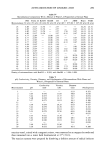
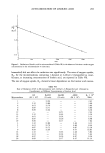
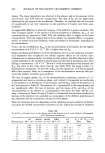
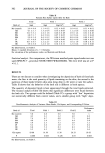
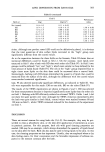
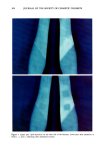
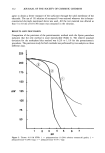
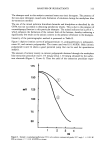
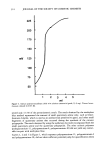
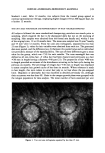
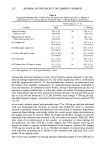
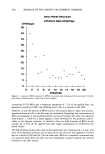
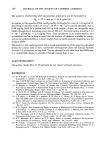
292 JOURNAL OF THE SOCIETY OF COSMETIC CHEMISTS Table ¾I Rate of Oxidation of Linoleic Acid in the Presence of ot-T in MiceIlar Solutions Miceliar LH Tween 20 AIBN ot-T Rin h X 109 solution (M X 10 2) (% w/w) (M X 10 3) (M) (M/s) 6 9.09 22.62 9.47 1.84 x 10 -3 43.44 7 9.09 22.62 9.47 6.11 X 10 -4 20.22 8 9.09 22.62 9.47 1.56 x 10 -4 17.30 9 9.09 22.62 9.47 3.12 x 10 -5 12.84 10 9.09 22.62 9.47 3.90 x 10 -6 11.30 11 9.09 22.62 9.47 3.90 X 10 --7 61.00 12 9.09 22.62 9.47 3.90 x 10 -8 75.80 13 9.09 22.62 2.18 X 10 -4 10.80 14 9.09 22.62 1.56 X 10 -4 9.72 15 9.09 22.62 -- 1.25 X 10 -4 7.64 16 9.09 22.62 -- 9.35 x 10 -5 6.92 17 9.09 22.62 6.23 x 10 -5 5.42 18 9.09 22.62 -- 3.12 x 10 -5 5.28 19 9.09 22.62 -- 1.56 x 10 -5 4.64 20 9.09 22.62 7.79 x 10 -6 4.72 21 9.09 22.62 -- 3.90 X 10 -6 3.56 22 9.09 22.62 1.95 x 10 -6 4.92 In these conditions, ot-T can act as retarder more than inhibitor, because it does not influence the induction period, but the kinetics of the chain reactions, when it has started. Other authors (15) found that ot-T can influence both the induction period and the kinetics of the lipoperoxidation, acting as oxygen scavenger and as inhibitor of the chain reaction. KINETICS OF OXIDATION OF LINOLEIC ACID IN O/W EMULSIONS The oxidation of linoleic acid was studied in O/W emulsions using Tween 20 as surfactant, in the presence and in the absence of azo-initiator and inhibitor. The data of Rp and Rinh, listed in Table II, show that the micellar solutions and the emulsions had similar influence on the oxidation of linoleic acid. The surfactant should not influence the oxidation rate to any great extent. In fact, the behavior in comparison with the auto-oxidation of linoleic acid in micellar solutions and in emulsions was almost the same, although the surfactant concentration was notably higher in the micellar solutions than in the emulsions. KINETICS OF OXIDATION OF LINOLEIC ACID IN MICROEMULSIONS Linoleic acid, a lipophilic compound (24), is actually in the disperse oil phase of microemulsions. The oxidizability of linoleic acid was performed on a series of micro- emulsions, differing in the cosurfactant and in the composition of the external phase. Each microemulsion was studied in the absence and in the presence of azo-initiator and inhibitor (or-T). In Figure 1 a plot of oxygen uptake versus time is reported to illustrate the determi- nation of Rp. The structure of the two cosurfactants used (1-butanol, 2-ethyl-l,3-
Purchased for the exclusive use of nofirst nolast (unknown)
From: SCC Media Library & Resource Center (library.scconline.org)