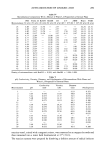
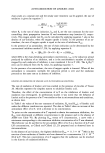
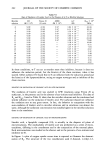
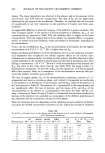
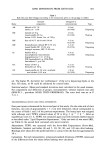
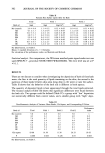
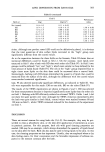
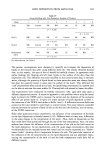
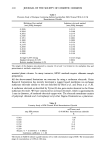
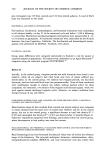
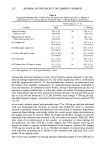
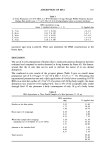
ABSORPTION OF BHA 337 Table I In Vitro Permeation of 0.07% BHA in a W/O Ointment (10 mg) Through Whole-Thickness Excised Human Skin (surface area 1.77 cm 2) After 16 h (6 ml physiological saline as acceptor medium) BHA equivalents in Ftg, (mean -+ standard deviation, n = 3) % Applied dose d, 75 yr 0.17 -+ 0.044 2.2-3.0 d', 90 yr 0.33 ñ 0.120 3.2-7.1 •?, 58 yr 0.1! ñ 0.055 0.7-2.0 9, 81 yr 0.11 ñ 0.012 1.5-1.8 9, 24 yr O. 18 ñ O. 140 1.6-5.3 successive tape strip is plotted. Their sum represents the BHA concentration in the horny layer. DISCUSSION The use of in vitro preparations of human skin to study percutaneous absorption has been evaluated and compared to results obtained in living humans by Franz (6). He demon- strated that the in vitro data can be used to indicate the extent of in vivo dermal absorption. The combined in vitro results of the acceptor phases (Table I) give an overall mean permeation rate of 0. 179 Ftg/1.77 cm2/16 h (SD - 0.125 n -- 15). Presuming this experimental permeation rate and a daily application of a body lotion containing 0.07% BHA on a total skin surface of 1.8 m 2 (7) of a person with 60 kg body weight, the mean absorption rate would be 0.03 mg/kg bw/d, that is 6% of the acceptable daily intake through food. If one presumes a daily consumption of only 10 g of a body lotion Table II BHA Equivalents in Three Parallel Samples of a Skin Specimen (•?, 24 yr) BHA equivalents (Ftg) % Applied dose Residue on the skin surface Horny layer (10 strippings) Whole-skin sample after stripping (solubilized in 10 N KOH, 4 h at 5540øC) Amount in the chamber fluid Total recovery 2.O2 31.60 1.75 29.3O 1.96 3O.7O O.38 5.89 0.41 6.89 0.53 7.52 3.28 3.23 3.27 O. 10 0.06 0.37 51.30 54.2O 46.9O 1.56 1.02 5.34 9O.4O 91.40 9O.5O

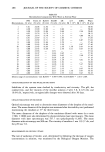
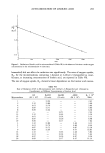
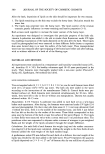
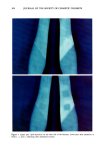
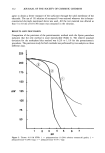
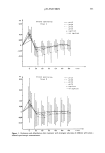
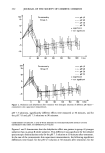
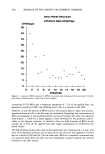
338 JOURNAL OF THE SOCIETY OF COSMETIC CHEMISTS BHA PENETRATION adhesive tape strippings DPM/tape 50-- 46 40 26 16 10 mm mm mmm mmm m•m mmm mmm mmm I I I I I I I I I I 2 4 8 8 10 12 14 18 18 20 strippings Figure 1. Amounts of BHA (measured in DPM) in successive tape strippings of the horny layer 16 hr after percutaneous administration--mean rate of three samples. containing 0.07% BHA and a maximum absorption of 7.1% of the applied dose, the resorption would be 0.0083 mg BHA/kg bw/d, that is a sixtieth of the ADI. However, if only the amount of BHA found in the acceptor phase is taken into account, important material still in the skin may be overlooked. Regarding the concentration of BHA accumulated in the epidermis/dermis sections of human skin after this exposure time (Figure 1, Table II), a depot appears to have developed in the epidermis, partic- ularly in the stratum corneum. In addition, there are high amounts of BHA in the corium (up to 50% of the applied dose) that might subsequently be resorbed by the blood vessels. The full-thickness human skin used in this experiment has a thickness of 3-4 mm, and most of an absorbed chemical can be taken up by the blood in the capillaries of intact skin at a depth of 200 •m (8). On the other side, BHA as a lipophilic compound may not partition freely from the skin into the hydrophilic acceptor medium but will be enriched in the skin tissues.
Purchased for the exclusive use of nofirst nolast (unknown)
From: SCC Media Library & Resource Center (library.scconline.org)