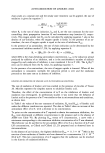
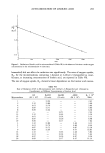
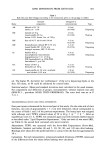
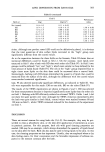
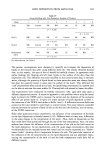
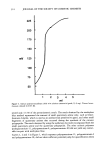
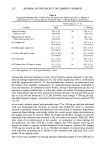
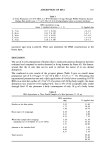
DIFFUSE ANDROGEN-DEPENDENT ALOPECIA 321 Table I Comparisons Between Hair Variables From the Frontal Area of Untreated Controls Basally and After 12 Months: Mean --- $D and Range (in parentheses) Control group (n = 6) Variable Basal 12 Months Total hair density (Hair per cm 2) Meaningful hair density (Non-vellus hair per cm 2) (%) Anagen hair (%) Meaningful anagen hair (%) Hair --80 mm in length (%) Veilus hair (%) Telogen hair --30 mm in length 231 --- 57 * 206 --- 72 (157-317) (120-303) 191 --- 67 ** 169 --- 74 (116-278) (80-268) 79.4--- 9.3 ns 75.3 --- 12.4 (61.0-84.7) (56.9-93.8) 85.9 --- 4.5 ns 79.0 --- 10.7 (81.5-94.2) (65.5-93.6) 68.4 --- 24.0 ns 74.5 --- 14.9 (25.9-89.0) (50.0-89.1) 17.9 --- 16.4 ns 19.2 --- 16.8 (2.0-46.3) (2.0-50.8) 11.7 --- 11.1 ns 11.2 + 9.1 (2.0-32.9) (0.0-27.7) ns = Not significant: P 0.05 *P 0.05 **P 0.01 (paired Student's t-test). respective reference ranges. The peripheral markers for hyper-androgenism were raised in six (50.0%) for free testosterone, in two (16.7%) for 3tx-androstanediol-glucuronide (3tx-A-diol-G), and in one (8.3%) for dihydrotestosterone (DHT). However, no corre- lation between individual or grouped hormonal values with any hair value could be established. TRICHOLOGICAL AND HORMONAL CHANGES IN TWO SUBJECTS WHO CONTINUED WITH SPIRONOLACTONE THERAPY FOR A FURTHER 12 MONTHS One subject who initially received 75 mg of spironolactone per day was increased to 150 mg per day, and one initially receiving 100 mg per day was increased to 200 mg per day. After 12 months of treatment with these higher dosages, both had increases in total hair density and meaningful hair density and a corresponding decrease in the percentage of veilus hair and telogen hair •30 mm in length (Table III). Comparisons between basal hormonal levels and those observed after 24 months showed a substantial reduction in the androgenic hormones. However, both DHT and 3tx-A-diol-G levels were inex- plicably elevated. DISCUSSION The major initiating feature of androgen-dependent alopecia in men and women is the action of androgens upon the pilo-sebaceous unit (2,7,24,25), the associated dermal/ sub-dermal tissue (26), and the receptor-binding phenomenon within the hair cell (27).

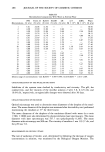
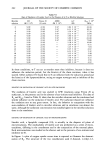
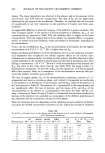
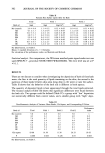
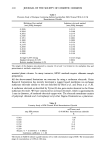
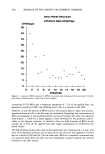
322 JOURNAL OF THE SOCIETY OF COSMETIC CHEMISTS Table II Comparisons Between Hair Variables From the Frontal Area Basally and After 12 Months of Spironolactone (75 or 100 mg per day) Treatment: Mean + SD and Range (in parentheses) Treated group (n = 6) Variable Basal 12 Months Total hair density (Hair per cm 2) Meaningful hair density (Non-vellus hair per cm 2) (%) Anagen hair (%) Meaningful anagen hair (%) Hair --80 mm in length (%) Veilus hair (%) Telogen hair -30 mm in length 256 + 78 ns 239 + 72 (162-336) (145-313) 197 + 67 ns 189 + 51 (123-276) (131-256) 78.5 + 5.1 ns 79.8 + 4.3 (72.9-84.8) (74.8-84.7) 81.2 + 6.0 ns 79.5 + 9.9 (70.2-86.2) (63.7-91.2) 56.9 + 16.6 ns 56.1 + 18.8 (37.6-80.8) (33.0-82.9) 23.2 + 6.0 ns 19.6 + 8.5 (16.5-30.3) (9.6-33.3) 10.3 -+ 2.9 ns 10.9 + 5.6 (6.8-13.9) (6.4-21.4) ns = Not significant: P 0.05 (paired Student's t-test). Compounds with anti-androgen activity would therefore appear essential in the treat- ment of androgen-dependent alopecia (25), and studies employing CPA in combination with EE 2 support this view (21,23). For spironolactone, however, no quantitative data for alopecia were available consequently, we employed dosing regimens established in acne and hirsutism. In moderately hirsute women, 50 mg of spironolactone per day was reported to regress terminal hair to vellus hair within six months of starting treatment (14). Good results had also been reported for dosages between 150 mg and 200 mg per day in acne (16) and hirsutism (13,17,28). However, with dosages 100 mg per day, side effects began to appear, and several studies reported drop-out rates in excess of 25 % (12,15). In our study, subjects treated with spironolactone (75 or 100 mg per day) had stabilized total and meaningful hair densities 12 months later (Table II), while in untreated controls a significant decrease was observed at this time (Table I). Subjective impressions supported these findings, particularly within the control group, where deterioration in hair quality was cause for concern. When the dosage was doubled, increases in total and meaningful hair densities were recorded in the two subjects so treated (Table III). Both were aware of an improvement in hair quality. In comparison to these findings for spironolactone, low-dose CPA-EE 2 studies suggest that CPA dosages •50 mg per month are unable to prevent further expression of the alopecia, whereas CPA dosages •500 mg per month are able to do so. Whether the degree of improvement achieved with high-dose spironolactone is similar to that obtained with high-dose CPA is the subject of an ongoing study. One of the major problems in treating androgen-dependent alopecia is the difficulty in
Purchased for the exclusive use of nofirst nolast (unknown)
From: SCC Media Library & Resource Center (library.scconline.org)