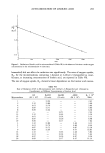
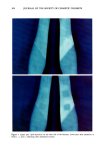
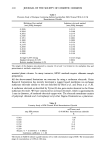
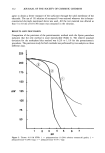
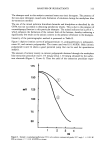
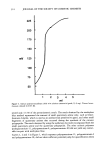
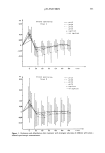
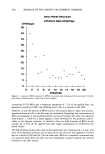
ABSORPTION OF BHA 339 DPM/0.28 100 BHA PENETRATION In vitro lO o,1 j- 0 I 2 3 4 6 8 7 8 g 10 11 12 14 18 18 20 22 24 28 28 30 32 34 38 Skin depth [•rn x 100] Figure 2. Amounts of BHA (measured in DPM) in the skin 16 hr after percutaneous administration-- mean rate of three punched sections (0.28 ½m 2) cut into 100-p•m slices. Another biological factor that can affect the penetration rate is metabolism in the skin coincident with BHA's diffusive passage through the skin. Bronaugh (9) investigated the metabolism of butylated hydroxytoluene (BHT) after application to fuzzy rat skin. Of the absorbed radioisotope only 6.6% was isolated in biotransformed products found mainly in the receptor fluid. It seems likely that for BHA, too, metabolism during skin absorption will be small. So, it should be possible to approximate the percutaneous absorption of BHA by determining the amount of absorbed material in the skin at the end of the experiment and adding this value to the receptor fluid values (9). That amount of BHA that has not yet passed the horny layer or that has remained on the skin surface, however, should not be included in permeability calculations. Schalla (10) proposes an equation that allows a rough estimation of the quantities absorbed in a given time under steady-state conditions. According to Schaefer (3), the measurepoint of 16 h for in vitro measurements represents this steady state. The flux density or the specific influx is defined as Qvs + QAP mol wt X t where • is the specific influx into the skin (mol/cm2/h) and Q is the quantity (g) in the compartments indicated by the subscripts: VS = viable skin layers AP = acceptor phase. Using this equation, the overall mean specific influx of BHA measured in this study was 1.9 x 10 -6 g 180.238 g/tool x 1.77 cm 2 x 16 h = 3.7 X 10-•ø mol/cm2/h (S.D. + 2.07, n = 15).

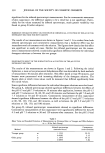
340 JOURNAL OF THE SOCIETY OF COSMETIC CHEMISTS The quantity resorbed (Q) after epicutaneous application can be estimated by Q• = • x mol wt x 24 h (g/cm2/d) According to this equation BHA could possibly be absorbed at a rate of 1.61 !xg/cm2/d. Assuming a total skin surface of 1.8 m 2, 28.98 X 10 -3 g/d could be absorbed, that is 0.48 mg/kg bw/d for a person with 60 kg body weight, almost the acceptable daily intake through food. Assuming a face area of 100 cm 2, the body burden would be 1.61 X 10 -4 g/d/60 kg = 2.6 !xg/kg bw/d. This calculation is an overestimation, but nevertheless one has to keep in mind that the amount of substance available for resorp- tion in the epidermis/dermis is much higher than the small quantity migrating into the acceptor phase. The results in this study represent only a rough approximation of the quantities absorbed within the contact time of 16 h, and further investigations about the kinetics between 4 h and 16 h of exposure are required. Yet the obtained in vitro data show that BHA may to a considerable degree be absorbed through human skin in vivo. ACKNOWLEDGMENT The author thanks Mrs. P. Hirschwald for her expert technical assistance. REFERENCES (8) (9) (10) (1) H. P. Fiedler, in Lexikon der HilJ3stoffe fiir Pharmazie, Kosmetik und angrenzende Gebiete (Editio Cantor Aulendorf), 3., fiberarb. u. erg. Aufl., 1989, pp. 237-239. (2) Joint FAO/WHO Expert Committee on Food Additives, Evaluation of certain food additives and contaminants, Technical Reports Series 776, 33rd Report of the JECFA, WHO Genf, 1989, pp. 14-15. (3) H. Schaefer, G. Stfittgen, A. Zesch, W. Schalla, and J. Gazith, "Quantitative Determination of Percutaneous Absorption of Radiolabeled Drugs In Vitro and In Vivo by Human Skin," in Current Problems in Dermatology (Karger, Basel, 1978), Vol. 7, pp. 80-94. (4) A. Zesch, W.-D. Hoffman, and H. Schaefer, Verteilung eines radioaktiv markierten Pharmakons in der menschlichen Hornschicht aus vier Salbengrundlagen, Pharmazie, 29, 198-203, 1974. (5) J. P. Skelly, V. P. Shah, H. I. Maibach, R. H. Guy, R. C. Wester, G. F. Flynn, and A. Yacobi, FDA and AAPS report of the workshop on principles and practices of in vitro percutaneous penetration studies: Relevance to bioavailability and bioequivalence, Pharm. Res., 4, 265-267, 1987. (6) Th. P. Franz, Percutaneous absorption. On the relevance of in vitro data, J Invest. Dermatol, 64, 190-195, 1975. (7) P. H. Dugard, "Skin Permeability Theory in Relation to Measurements of Percutaneous Absorption in Toxicology," in Advances in Modern Toxicology, F. N. Marzulli and H. I. Maibach, Eds. (John Wiley & Sons, New York, 1977), Vol. 4, pp. 525-550. R. L. Bronaugh, and R. F. Stewart, Methods for in vitro percutaneous absorption studies. VI: Preparation of the barrier layer, J. Pharm. Sciences, 75, 487-491, 1986. R. L. Bronaugh, R. F. Stewart, and J. E. Storm, Extent of cutaneous metabolism during percuta- neous absorption of xenobiotics, Toxicol. Appl. Pharmacol., 99, 534-543, 1989. W. Schalla, "Localization of Compounds in Different Skin Layers and Its Use as an Indicator of Percutaneous Absorption," in Percutaneous Absorption: Mechanism-Methodology-Drug Delivery, R.L. Bronaugh and H. I. Maibach, Eds. (Marcel Dekker, New York, 1985), pp. 281-303.
Purchased for the exclusive use of nofirst nolast (unknown)
From: SCC Media Library & Resource Center (library.scconline.org)