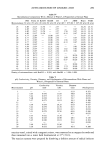
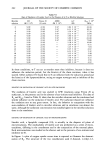
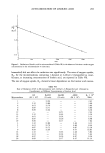
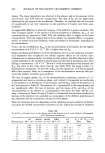
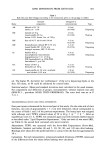
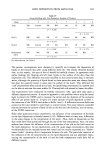
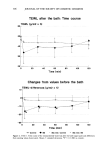
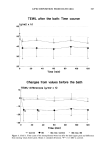
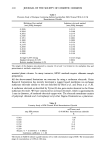
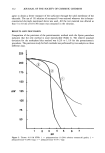
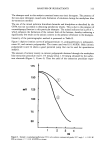
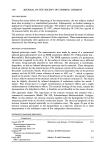
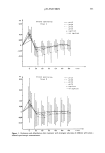
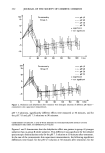
LIPID DEPOSITION FROM BATH OILS 303 Table II (continued) Field 3 Performance Bath oil (mg) (mg/cm 2) index No (control) 1.0 --- 0.2 0.11 --- 0.03 AK 1.6 --- 1.2 0.18 --- 0.13 1.48 --- 0.60 BD 7.9 --- 5.4 0.88 --- 0.60 4.71 --- 1.81 BN 2.2 + 1.4 0.25 --- 0.16 0.90 --- 0.40 EM 0.6 --- 0.5 0.07 --- 0.06 0.47 --- 0.23 LF 4.4 --- 2.9 0.49 --- 0.32 1.24 --- 0.82 OC 6.9 --- 4.9 0.76 --- 0.54 2.54 --- 1.59 OE 1.4 --- 1.5 0.16 --- 0.17 1.36 --- 1.05 sition. Although one product tested (LF) could not be definitively placed, it is obvious that the total quantities of skin surface lipids recovered in the "high" group were significantly different from the control values. As to the repartition between the three fields on the forearm, Table III shows that no statistical differences could be found in field 2. On the contrary, more lipids were extracted in field 1 after a bath with BD than with other oils (Table IV). In field 3 two groups could be defined ("low" and "high"), which were similar to those defined for the total amount of lipids found (Table IV). The oils in the "high" group deposited four to eight times more lipids on the skin than could be recovered after a control bath. Interestingly, bathing with EM always diminished the quantity of lipids that could be extracted from the surface of the skin, although the differences with the control values never reached statistical significance. Last, PI also showed statistically significant differences, as indicated in Table III. Two oils were responsible for this result: EM on one side, BD on the other (Table IV). The results of the TEWL experiments are shown in Figures 2 and 3. BD was selected for these measurements because it deposited significantly more lipids than the other oils on field 1. Bathing with BD efficiently reduced an elevated TEWL. Fields 1 and 3 did not show the same pattern over time: although the TEWL reduction immediately after the bath was quite similar in both fields, control values were reached between 60 and 120 min on field 1, whilst TEWL remained reduced for the duration of the experiment on field 3. DISCUSSION There are several reasons for using bath oils (2,6-9). For example, they may be pre- scribed to clean a seborrhoeic skin, or the skin after application of ointments as occurs in psoriatic patients. For this purpose, bath oils with good cleaning properties are needed. EM may be an example, which always diminished the quantity of lipids found on the skin after the bath. Bath oils also may be used to bring lipids to the skin. In this case, the cleaning properties are less important. Usually, they are employed where a dry skin feeling exists, for their convenience and the favorable impression of softness im- parted to the stratum corneum after the bath.

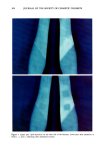
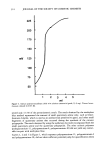
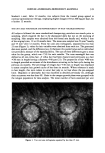
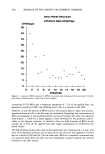
304 JOURNAL OF THE SOCIETY OF COSMETIC CHEMISTS Figure 1. Upper part: lipid deposition on the volar side of the forearms. Lower part: after extraction in fields 1, 2, and 3, indicating their anatomical location.
Purchased for the exclusive use of nofirst nolast (unknown)
From: SCC Media Library & Resource Center (library.scconline.org)