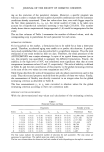
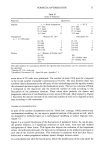
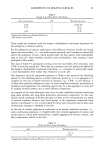
SENSORY QUALITY 103 considerations for implementation. The key considerations in establishing a functional Sensory QC program are 1) identifying the key sensory attributes that drive consumer appeal and 2) what limits of variability consumers will tolerate. Product sensory spec- ifications can then be set accordingly. The amount of variability that occurs within a product will determine the scope of the sensory program. It will provide the basis for 1) selection of attributes to be controlled, 2) the type of specifications required, and 3) the most appropriate methods of evaluation to be used. In addition to the amount of product variability to be anticipated, manufacturing conditions must be considered in establishing a plant sensory quality control program. The specific manufacturing circumstances influence 1) the key sensory attributes to be monitored, 2) the product sampling program, 3) the process points to be included, 4) the manufacturing sites involved, and 5) the methodology to be implemented (5). Monitoring product sensory quality requires resources in terms of time, manpower, and money. A program requires qualified subjects, an administrator, a location or facility, and a test method. Subjects must be screened and trained, standards developed, and action criteria established. All of these steps require commitment and approval from manufacturing, marketing, and R&D management. METHODS Many different sensory testing methods are currently employed in QC environments. These include difference tests, attribute or descriptive tests, qualitative assessments of "typical" character, and quality ratings. Table III displays various sensory test methods that have been applied to quality control. A discussion of these method alternatives follows. In general, the choice of methods for application to quality control should be based on Table III Sensory Methodologies* Rating methods Descriptive analysis Difference rating vs control Quality ratings Attribute ratings Designation methods Typical In/out of spec Acceptable/unacceptable Overall difference tests Triangle Duo-trio A/Not/A Consumer preference Measure amount of variability from standard Provide a yes/no evaluation vs product concept Very sensitive to small differences No data on qualitative or quantitative differences from a standard Sample may be equally preferred yet significantly different from standard Data on differences are not obtained Plant employees are NOT consumers * Sensory methods applicable to quality control.

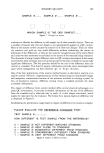
104 JOURNAL OF THE SOCIETY OF COSMETIC CHEMISTS the following, which also generally qualify instrumental methods as well. They should be simple, expedient, provide fast data turnaround, have precision, and be accurate, reproducible, cost-effective and compatible with other methods (4). Minimally, they must satisfy three basic technical requirements: 1) well-defined sensory characteristics that all technical staff understand, 2) standard measuring scales, and 3) standard and reproducible testing conditions (5). The most suitable methods for general sensory quality applications provide decision- oriented information and are practical in terms of the kinds of quality differences they detect. However, some of these methods are so sensitive that they allow no room for deviation from the control regardless of whether or not the differences would be per- ceived by consumers. Others are so general and inconclusive that they cannot be used for decision-making purposes. Ideally, the most useful sensory information in these cir- cumstances indicates how different the samples are from a standard and in what regard they differ. Preference tests or other consumer tests are the least appropriate methods for several reasons. First, to do a real consumer test with product users on every production batch is impractical from both a time and budget viewpoint. Holding up production to wait for the results of a consumer test is not realistic. Second, and this is usually the case, if a small group of company employees is used, they do not represent true consumers. Third, these kinds of tests provide no diagnostic information on the nature of the differences. Further, two very different samples could be equally preferred, each for different reasons. Therefore, from a quality standpoint, preference tests have absolutely no application to the task of insuring product consistency and reproducibility. In certain instances, based on the circumstances and the cost of scrapping a large batch, once a significant sensory difference has been established based on a sound testing scheme, a preference test may indicate whether the difference is critical to consumer acceptability. However, such practice is not recommended because it does not address the issue of product consistency as a critical dimension of quality. Furthermore, such practice may result in gradual quality drifts that will eventually erode consumer con- fidence and loyalty. To further address the place of consumer preference tests in the QC environment, such tests are very helpful in the early stages of product development, to aid in establishing standards and specifications. And they should, in fact, be built into the early stages of program development because they help relate sensory responses to actual consumer levels of tolerance for variability. But they should not be used for routine monitoring of product sensory quality and reproducibility, for the reasons already discussed. The problems inherent in using "typical" assessment for determining product quality have been briefly covered. However, this seems to be one of the most prevalent methods practiced in QC programs, probably because of its apparently simplistic approach. As simple as it may appear, it actually provides the evaluator with very little structure and allows a very large area for interpretive error. What is "atypical" to one assessor may be "typical" to another. And under "typical" circumstances, the assessors have minimal or no formal training regarding what is "typical" and what is not. Another type of difference test that is frequently used in the manufacturing environment is the triangle test. Figure 7 depicts the format for a triangle test that requires the
Purchased for the exclusive use of nofirst nolast (unknown)
From: SCC Media Library & Resource Center (library.scconline.org)