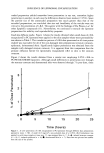
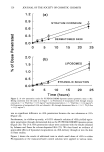
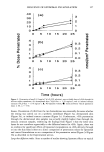
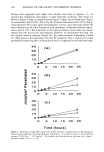
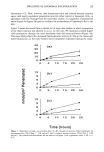
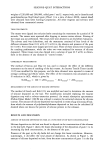
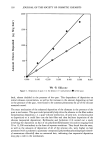
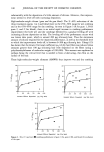
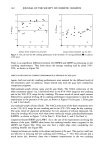
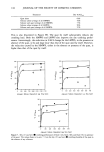
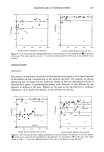
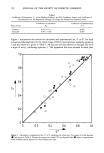
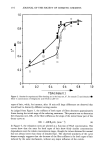
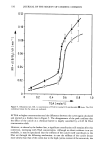
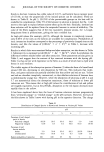
INFLUENCE OF LIPOSOMAL ENCAPSULATION 129 laboratories (31). Note, however, that dermatomed skin and isolated stratum corneum again yield nearly equivalent penetration rates for either control or liposomal t-RA, in agreement with the findings from the small-dose studies. A comparison of penetration ratios (Figure 4c/Figure 4b) gave no evidence for accumulation of liposomal t-RA in the skin. Figure 5 shows the results from a similar set of large-dose studies in which evaporation of the donor solution was allowed to occur. In this case, PC liposomes yielded higher t-RA penetration through the inert membrane than did transcutol/water (Figure 5a). This most likely reflects the decreased thermodynamic activity of t-RA in the transcutol/ water formulation, as the more volatile water component evaporated during the study. 40 I (a) T 30 10 0 • ' 0 5 I 0 I 5 20 25 m 12 ß _ 9 • 3 13= o E 12 3 0 (b) - 0 5 I 0 I 5 20 25 (c) __ 0 5 I 0 I 5 20 25 Time (hours) Figure 5. Penetration of high, non-occluded doses of t-RA through (a) silicone rubber membrane (b) dermatomed skin (3H20 flux = ].08 mg/cm2) and (c) isolated stratum corneum (3H20 flux = 0.98 mg/cm2). The symbols and formulations are the same as in Figures 3 and 4 (geometric mean --- SE, n =

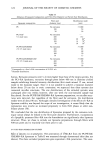
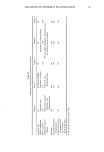
130 JOURNAL OF THE SOCIETY OF COSMETIC CHEMISTS Note that the opposite pattern was seen on dermatomed skin (Figure 5b) and isolated stratum corneum (Figure 5c), providing further evidence for an enhancing effect of transcutol. Relative to the occluded-dose experiments in Figure 4, t-RA penetration from the transcutol/water solution was depressed in approximately the same proportion as seen with the inert membrane. However, t-RA penetration from the PC liposomes was depressed to an even greater extent, resulting in substantially lower t-RA delivery from the liposomes than from the transcutol/water. There was a suggestion in these experi- ments that t-RA penetration from PC liposomes was higher through stratum corneum (Figure 5c) than through dermatomed skin (Figure 5b). The penetration ratios (Figure 5c/Figure 5b) at 7 and 24 h for the PC liposome formulation were significantly greater than those for the transcutol/water formulation. The results of this analysis, as well as comparable ratios for Figures 3 and 4, are shown in Table III. A summary of the experimental conditions and penetration results is presented in Table IV. DISCUSSION In this paper we have investigated two delivery phenomena attributed to topical lipo- somes: increased delivery of compounds through the stratum corneum and localization of these compounds in the lower skin layers, with an associated decrease in systemic absorption. The first of these phenomena was studied directly, by comparing the pen- etration rate of liposomally encapsulated t-RA with that of solvent-deposited t-RA and with that of a saturated solution of t-RA in a simple solvent system. The second phenomenon was studied indirectly, by comparing the penetration rates of liposomal t-RA through skin preparations of varying thickness. We found no evidence for en- hanced penetration of t-RA through the stratum corneum by these liposome systems vs encapsulated control formulations. This was shown for PC liposomes under both small- dose (Figure 3) and large-dose (Figures 4, 5) conditions and for PC/PE/OA/CHEMS liposomes in the small-dose case (Figure 2). The latter system was chosen due to its reported ability to deliver large-molecular-weight enzyme across the stratum corneum (21,22). While one cannot rule out the possibility that there may be liposome compo- sitions that would enhance the delivery of t-RA, we could not find such an effect with two quite different systems. Moreover, our results are in agreement with the majority of recent studies employing other penetrants, liposome compositions, and dose condi- Table III Penetration Ratio Analysis of Liposome-Induced Accumulation of t-RA in the Skin Penetration ratio a Liposomes Control b Figure 3 t = 24 h 0.42 --- 0.15 0.60 + 0.21 Figure 4 t = 24 h 0.84 + 0.48 0.68 + 0.20 Figure 5 t = 7 h 1.72 + 0.17' 0.86 --- 0.06 t = 24 h 1.75 --- 0.14' 0.88 --- 0.07 a Ratio of the cumulative amount of t-RA penetrated through stratum comeurn to that through der- matomed skin at time t (mean + S.E., n = 5-7). b Transcutol/water 68:32 v:v. * Significant difference from control, p 0.01.
Purchased for the exclusive use of nofirst nolast (unknown)
From: SCC Media Library & Resource Center (library.scconline.org)