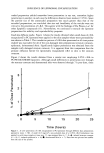
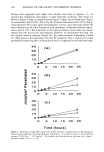
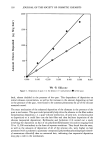
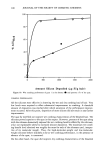
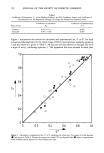
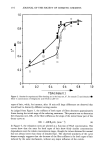
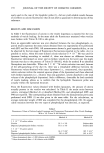
SILICONE-QUAT INTERACTIONS 137 weights of 220,000 and 280,000, called gums 1 and 2, respectively and a dimethiconol gum/dimethicone fluid blend (gum 2/fluid 1) in a ratio of about 40/60, named blend} were obtained from Dow Corning Corporation. All other reagents and solvents were obtained from commercial sources. TRESS TREATMENTS The tresses were dipped into solution baths containing the treatments for a period of 30 seconds. The tresses were squeezed after dipping to remove excess solvent. Rinsing of the tresses was not performed. The tresses were next allowed to air dry before evaluation. The solvent used was chloroform, and the treatments consisted of four levels of the different siloxanes (from 0.03 wt%-0.5 wt%) in the absence and presence of the quat (0.5 wt%). Five tresses were dipped per level used. Three of these tresses were evaluated for combing performance, while the other two were analyzed for amount of silicone deposited. Three tresses were also dipped into a solution of quat (0.5 wt%) in chloro- form in the absence of any siloxane as "control tresses." COMBABILITY MEASUREMENTS The method of Garcia and Diaz (2) was used to measure the effect of the different treatments on the ease of combing of the hair tresses. An Instron Tensile Tester (model 1122) was modified for this purpose, and the data obtained were reported in terms of average combing load (ACL) values. The effect of the treatments was calculated as the % reduction in ACL, which is given by %ACLv•ed = 100 X (ACLuntreate d - ACLtreated) q- ACLuntreate d MEASUREMENT OF THE AMOUNT OF SILICONE DEPOSITED The method of Gooch and Kohl (13) was modified and used to determine the amount of silicone deposited on the hair. The modification included replacing the enzyme digestion step with a solvent extraction protocol. An atomic absorption spectrometer (Perkin Elmer Model 1100 B) was utilized to analyze the extracted solution for silicone content. The amount of silicone deposited was reported in terms of •g silicone/g of hair, from which the amount of polydimethylsiloxane deposited on hair can be calculated (if desired) when one knows the percent of silicone present in the siloxane. RESULTS AND DISCUSSION AMOUNT OF SILICONE DEPOSITED ON HAIR AS A FUNCTION OF DIP BATH CONCENTRATION Silicone deposition on the hair was found to depend on the concentration of the siloxane in the dip bath. Figure 1 shows the linear relationship of the deposition of gum 1 to its increasing dip bath concentration, in the absence of the quat. Presence of the quat in the dip baths did not change this linear correlation. However, surprisingly, it did affect the total amount of deposition. As shown in Figure 1, the amount of silicone deposited on hair, from the same concentration of gum 1 in the dip

138 JOURNAL OF THE SOCIETY OF COSMETIC CHEMISTS 2000 1500 1000 500 0 I I I I I 0.000 0.100 0.200 0.300 0.400 0.500 0.600 Wt % Silicone Figure 1. Deposition of gum 1 in the absence (0) and presence (i•) of the quar. bath, almost doubled in the presence of the quat. This dependence of deposition on initial siloxane concentration, as well as the increase in the amount depositing on hair in the presence of the quat, were found to be common phenomena for all of the silicone materials tested. The exact mechanism of the enhanced deposition of the siloxanes in the presence of the quat is not known. The quat could potentially help drive the siloxane to the fiber surface (simultaneous deposition i.e. a quat-silicone interaction, of some sort, in solution prior to deposition) or it could first coat the hair fiber and then facilitate deposition of the silicone (sequential deposition). Berthiaume and Jachowicz (14) carried out a study involving the deposition on hair of six polydimethylsiloxanes (viscosities ranging from 50 to 12,500 centistokes) in the form of aqueous emulsions. They found that the rates, as well as the amounts of deposition of all of the silicone oils, were higher on hair pretreated with a polymeric quaternary compound {poly(methacrylamidopropyltrimeth- yl ammonium chloride)} than on untreated hair, indicating that sequential deposition may play a role in the mechanism.
Purchased for the exclusive use of nofirst nolast (unknown)
From: SCC Media Library & Resource Center (library.scconline.org)