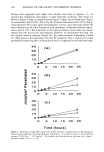
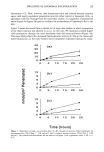
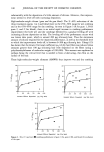
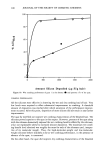
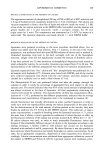
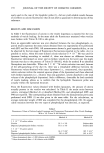
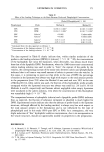
THE CUTICLE AND PERMANENT WAVE SET 151 described by Scott and Robbins (10). This method essentially consists of measuring the distance between the ends of a single fiber bent over a thin hook under appropriate loads attached to the fiber ends. The procedure for the measurements is described in detail in reference 7. After equilibration in distilled water for 20 min in the undeformed state, the fiber was draped over the hook of the bending device and placed in a beaker filled with distilled water. The change of the distance between the fiber ends with time was followed during the above-described treatment sequence. The exchange of the treatment agents was carried out by sucking off the solution in the beaker in parallel with an inflow of new treatment solution (7). THEORY AND RESULTS On the basis of Denby's equation (11) for the interrelation of bending stiffness and a cohesive set of wool fibers, an analogous description was developed for permanent set (7): S c= 1 - Bre/Bro (2) where the calculated set is given by the ratio of the residual stiffness of the fiber after the treatment sequence, Bre, and the inherent stiffness, Bro , that is restored to the fiber through reoxidation. Since Bro is not determined in the balanced fiber test, a coefficient of restoration, C, is defined (7) that relates the stiffness of the reoxidized fiber to the initial stiffness B o of the untreated fiber, so that: S c --- 1 - Bre/(C B o) (3) Bre was obtained by determining the bending stiffness remaining at the end of the final rinsing process, and B o was estimated graphically by extrapolating the curve for the bending relaxation in water (Step 1) to t = 0 (see Figure 3). Rewriting equation 3 as: and accepting the equality (7): Bre/B o = C (1 -S c) (4) allows us to determine C by fitting a linear regression through the origin to pairs of experimentally obtained data for Bre/B o and 1 - S e for the paired halves of normal and descaled fibers, where C is the slope of the related regression line. Pairs of data with low values of Br/B o, and hence large values of set, were omitted, since in the balanced fiber test for these cases bending strains are imposed that are beyond 1%, which is the limit of linear viscoelasticity for wool and most likely also for hair fibers (12,13). The values of C thus obtained are summarized in Table I, together with their 95% confidence limits and with the coefficients of determination r 2 of the regression. The values of C are comparable for normal and descaled hairs and in good agreement with previous results on normal hairs for various treatment conditions (7). They show that on reoxidation (Step 4) the bending stiffness, which is drastically lowered during reduction, is restored within about 5 % of its original value. S c = S e (5)

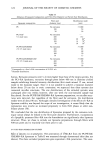
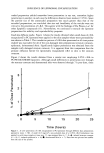
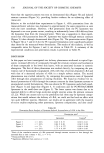
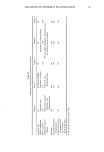
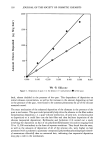
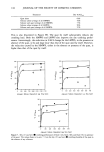
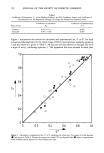
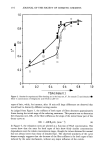
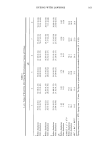
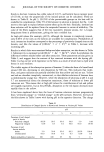
152 JOURNAL OF THE SOCIETY OF COSMETIC CHEMISTS Table I Coefficient of Restoration, C, of the Bending Stiffness, Its 95% Confidence Limits, and Coefficient of Determination for the Regression Through the Origin for Normal and Descaled Fibers Coefficient of restoration Coefficient of determination Type of hair (C) (r 2) Normal 0.94 -+ 0.11 0.959 Descaled 0.98 -+ 0.09 0.987 Figure 1 summarizes the results for calculated and experimental set, S c vs S e, for both normal and descaled hairs for the whole range of TGA concentrations, applying equation 3 and the values of C given in Table I. All data are well described by a straight line with a slope of unity, validating equation 5. The regression line even extends to those data 1.0 0.8 0.4 0.2 0 o o o I I I I I I I I l 0 0.2 0.4 0.6 0.8 1.0 Figure 1. Calculated vs experimental set, S' vs S e, applying the values for C for normal (O) and descaled (O) hair given in Table I. Further data points for normal ([•) and descaled hair (I) relate to experiments where bending strains beyond 1% were realized (see text).
Purchased for the exclusive use of nofirst nolast (unknown)
From: SCC Media Library & Resource Center (library.scconline.org)