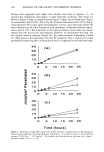
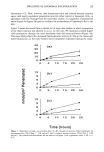
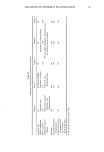
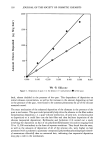
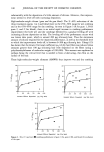
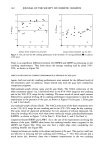
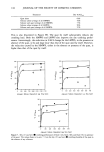
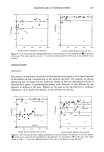
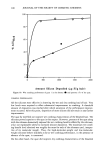
SILICONE-QUAT INTERACTIONS 147 hair. The silicones were also effective in this respect. However, presence of the quat had no efj•ct on the dry combing characteristics of the silicones. The low-molecular-weight silicones, in the presence or absence of the quat, were as good or slightly inferior to the quat by itself, whereas the high-molecular-weight silicones, in the presence or absence of the quat, were found to be superior to the quat in terms of dry combing load reduction. Thus the polydimethylsiloxanes tested (molecular weights ranging from 10,000- 280,000) were found to be very effective in substantially improving the wet and dry combing performance of bleached hair. They were shown to have superior wet combing performance and comparable dry combing performance to that of the quat used. How- ever, a synergistic effect was seen, as measured by wet combing improvement, when both the silicone and quat were used together. This combing improvement far outper- formed the effects of the quat or the siloxane alone, and this effect was not confined to a siloxane of a specific molecular weight. This synergistic effect was not observable for dry combing performance. The quat, the silicones, and the two together all performed equally well in lowering the dry combing load. TYPE OF SILICONE The dimethicone fluids and dimethiconol gums were essentially equivalent in their performance with regard to amount of deposition and to wet combing in the absence/ presence of the quat. The only difference seen was in dry combing performance, both in the presence and absence of the quat, where the dimethiconol gums (and the dimethi- conol gum/dimethicone fluid blend) outperformed the dimethicone fluids. The differ- ence in performance can be attributable to either the increased molecular weight or to the different endgroups present on the polymer chain going from dimethicone to di- methiconol. These results suggest that dimethiconol gums should be either equivalent to dimethicone gums in combing performance if the former hypothesis is true or outperform them if the latter holds true. ACKNOWLEDGMENTS The authors would like to thank Maria Nelson, William Inman, Jr., and Cassie Cuth- bert for their invaluable help in collecting the data for this study. REFERENCES (1) C. R. Robbins, C. Reich, and J. Clarke, Hair manageability, J. Soc. Cosmet. Chem., 37, 489-499 (1986). (2) M. L. Garcia and J. Diaz, Combability measurements on human hair, J. Soc. Cosmet. Chem., 27, 379-398 (1976). (3) J. Jachowicz and M.D. Berthiaume, Heterocoagulation of silicon emulsions on keratin fibers, J. (4) A. S. Weatherburn and C. H. Bayley, The sorption of synthetic surface-active compounds by textile fibers, Text. Res. J., 22, 797-804 (1952). (5) K. R. Loetzsch, A. K. Reng, D. Gantz, and J. M. Quack, "The Radiometric Technique. Explained by the Example of Adsorption and Desorption of i4C-Labelled Distearyl-Dimethylammonium Chlo-

148 JOURNAL OF THE SOCIETY OF COSMETIC CHEMISTS (6) (7) (8) (9) (10) (11) (12) (13) (14) (15) ride on Human Hair," in Hair Research: Proceedings of the International Congress, 1979, C. E. Orfanos, W. Montagna, and G. Stuttgen, Eds. (Springer-Verlag, Berlin, 1981), pp. 638-649. J. A. Faucher, E. D. Goddard, and R. B. Hannan, Sorption and desorption of a cationic polymer by human hair: Effects of salt solutions, Text. Res. J., 47, 616-620 (1977). C. R. Robbins, in Chemical and Physical Behaviour of Human Hair (Van Nostrand Reinhold, New York, 1979), Chapter 5. E. Spiess, The influence of chemical structure on performance in hair care preparations. Parfuem. Kosmet., 72, 370-376 (1991). M. F. Jurczyk, D. R. Berger, and G. R. Damaso, Quaternary ammonium salt--Applications in hair conditioners, Cosmet. Toiletr., 106, 63-68 (1991). D. J. Halloran, Silicones in shampoos, Happi, 60-64 (November 1991). D.J. Halloran, A silicone selection guide for developing conditioning shampoos, Soap/Cosmetics/ Chemical Spec., 22-26 (March 1992). R. Y. Lochhead, Conditioning shampoos, Soap/Cosmetics/Chemical Spec., 42-49 (October 1992). E. G. Gooch and G. S. Kohl, Method to determine silicones on human hair by atomic absorption spectroscopy, J. Soc. Cosmet. Chem., 39, 383-392 (1988). M. D. Berthiaume and J. Jachowicz, The effect of emulsifiers and oil viscosity on deposition of nonionic silicone oils from oil-in-water emulsions onto kertain fibers, J. Colloid Interface Sci., 14!, 299-315 (1991). K. Yahagi, Silicones as conditioning agents in shampoos, J. Soc. Cosmet. Chem., 43, 275-284 (1992).
Purchased for the exclusive use of nofirst nolast (unknown)
From: SCC Media Library & Resource Center (library.scconline.org)