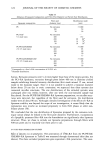
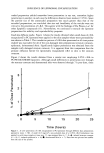
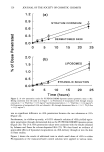
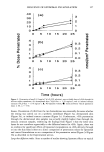
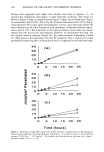
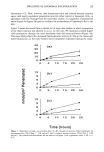
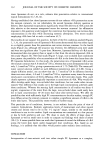
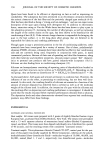
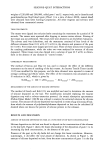
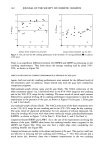
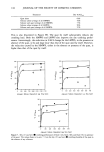
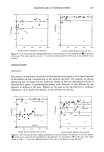
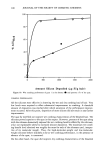
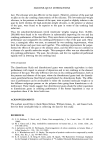
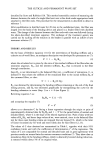
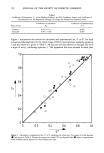
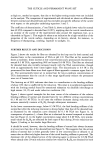
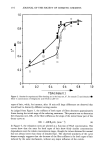
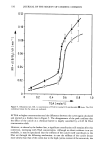
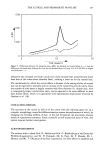
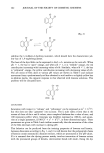
THE CUTICLE AND PERMANENT WAVE SET 155 0.8 0.6 0.2 o ß [] [] ß [] ß H20 I reduction I TSA © I I o i I i I o o o • o • o 0.3• o0.6H ß [] ß ß o ß o ß o ß ß ß rinse H20 ß I I reoxidotion H202 ß ß ß 30 SO 7• 95 Time [ min] rinse H•O Figure 3. The change of the relative bending stiffness during the five steps of the treatment sequence for normal hairs at 0.3 M (C)) and 0.6 M TGA ([•), and for descaled hairs under the same conditions (O, I). The relaxation rates show an intensive stepwise change between 0.5 M and 0.6 M TGA. Weigmann et al. (17) investigated the disulfide interchange-related relaxation of wool fibers and found an acceleration of the process with increasing degree of reduction and with temperature. In view of the assumption inherent to our theory, that the change of bending stiffness is due to the fission of disulfide bonds, the stepwise change in the relaxation rate can be interpreted as marking the TGA concentration where the transi- tion temperature for the disulfide interchange is lowered to the temperature of mea- surement (room temperature) and below. The results in Figure 4 indicate that the related concentration is higher for normal, compared to descaled, hair. The nature of the influence of the cuticle on the relaxation of the bending stiffness and hence on the set of the fiber may be estimated from the differences between the decay rates in both fiber types as given in Figure 5. A peak appearing at 0.55 M TGA indicates that the relaxation rates obtained for normal hair are systematically shifted to higher concentrations compared to those of the descaled fibers. This would suggest that a higher liquor concentration of TGA is required to reduce the cortex of normal hair in comparison with descaled fibers. From the half width of this peak, the amount of TGA in excess required to affect equal bending stiffness relaxation rates is roughly estimated to be 0.05 M. Since the only difference between both types of hair is the presence of the cuticle, the excess of TGA (0.05 M) can be assumed to be already reacting in the cuticle, and thus not reaching the cortex. The cuticle is hence effectively operative as a chemical barrier for TGA, as suggested by Wolfram et al. (5). Since the fibers are treated at an infinite liquor ratio, this effect will wear off with time, leading to the obvious time dependence of the set to be expected for 0.6 M TGA (see Figure 3). Consequently, the data points for the descaled hair (see Figure 4) were shifted by 0.05

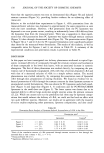
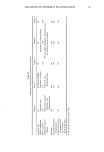
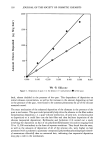
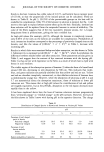
156 JOURNAL OF THE SOCIETY OF COSMETIC CHEMISTS 0.12 0.10 0.08 0.06 0.0/• 0.02 } I I I [ I I [ [ 0.2 0./, 0.6 0.8 1.0 TfiA [mole/l] Figure 4. Relaxation rate, RR, vs concentration of TGA for normal (C)) and descaled (O) hairs. The 95% confidence limits for the values are indicated. M TGA to higher concentrations and the differences between the curves again calculated and plotted as a broken line in Figure 5. The disappearance of the peak confirms that the effect of the cuticle as a chemical barrier is largely cancelled by a 0.05 M TGA concentration shift. However, as shown by the broken line, a significant contribution still remains after this correction, increasing with TGA concentration. Although no direct evidence is as yet available, it may be speculated that the stiffness of the cuticle itself contributes to the fiber set through the following mechanism: in case the stiffness of the cuticle decays more slowly than that of the cortex due to the high cystine content of the exocuticle, the
Purchased for the exclusive use of nofirst nolast (unknown)
From: SCC Media Library & Resource Center (library.scconline.org)