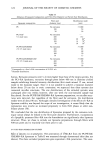
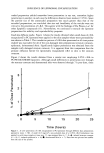
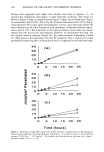
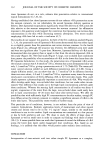
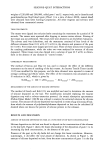
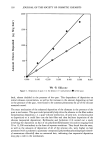
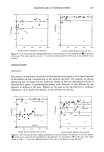
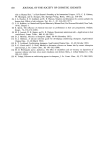
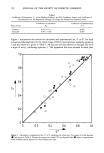
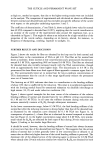
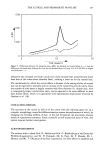
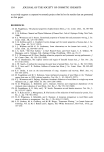
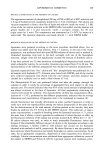
SILICONE-QUAT INTERACTIONS 139 AMOUNT OF SILICONE DEPOSITED ON HAIR AS A FUNCTION OF TYPE OF POLYDIMETHYLSILOXANE Viscosity of the materials tested was not expected to play a role in the deposition parameters because dilute solutions of the silicones were used in the dip baths. It was thought, however, that the different polymer chain lengths in the different materials tested may affect the deposition in some fashion. This was found not to be the case. For any given concentration of the dip bath, almost the same amount of silicone deposited, irrespective of which of the polydimethylsiloxanes was used. The trend of increased deposition in the presence of the quat, as compared in the absence of quat, for all of the materials, is shown in Figure 2. EFFECT OF SILICONE ON COMBING PERFORMANCE IN ABSENCE OF THE QUAT Both wet and dry combing performances were assessed for the different levels of the treatments used. In general, it was found that ease of wet and dry combing improved 2000 1500 lOOO 500 0 I I I I I 0.000 O. 100 0.200 0.300 0.400 0.500 0.600 Wt % Silicone Figure 2. Deposition of all silicones in the absence (O) and presence (O) of the quat.

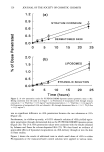
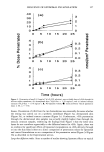
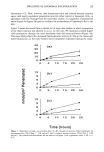
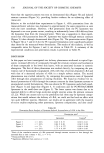
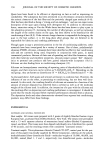
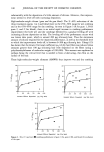
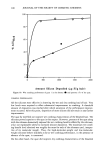
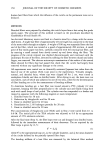
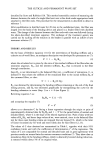
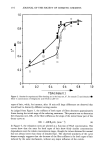
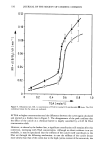
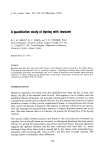
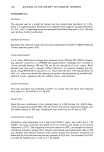
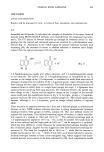
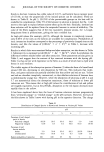
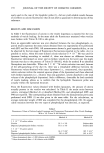
140 JOURNAL OF THE SOCIETY OF COSMETIC CHEMISTS substantially with the deposition of a little amount of silicone. However, this improve- ment seemed to level off with increasing deposition. High-molecular-weight silicones (gums and the gum blend). The % ACL reductions of the three treatments (gums 1 & 2 and blend) were in the 25%-50% range for wet combing and in the 65%-85% range for dry combing. As seen in Figure 3 (A for gum 1, B for gum 2, and C for blend), there is an initial rapid increase in combing performance improvement (for both wet and dry combing) followed by a gradual leveling off with increasing silicone deposition on hair. The leveling off of the performance occurs with our lowest data point, which is around 200 •xg silicone/g hair. Thus the minimum amount of silicone required for the improved performance, as well as the threshold level at which the improvement levels off, is between 0-200 •xg silicone/g hair. Yahagi (15) has shown that the kinetic frictional coefficient qXk) of dry hair fibers was reduced when amounts greater than 100 •xg silicone/g hair were deposited on the fibers (using a polydimethylsiloxane of molecular weight of 220,000). This amount was explained as perhaps being the critical level that is needed to form a lubricating, thin film on the surface of the hair. These high-molecular-weight siloxanes (HMWS) thus improve wet and dry combing 100' 80- 40- 20- A 250 500 750 1000 1250 Amount Silicon Deposited (gg Si/g hair) 100 80- 40 - 20- I i I i 250 500 750 1000 1250 Amount Silicon Deposited (gg Si/g hair) 100 20- /• • c 0q i I I I 250 500 750 1000 1250 Amount Silicon Deposited (gg Si/g hair) • 60- c..) 40- Figure 3. Dry (¸) and wet (O) combing performance of gum 1 (A), gum 2 (B), and blend (C) in absence of the quat.
Purchased for the exclusive use of nofirst nolast (unknown)
From: SCC Media Library & Resource Center (library.scconline.org)