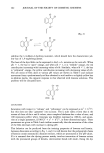
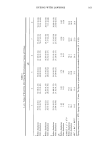
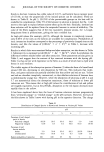
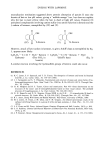
j. Soc. Cosmet. Chem., 45, 159-165 (May/June 1994) A quantitative study of dyeing with lawsone B. I. H. AMRO,* K. C. JAMES, and T. D. TURNER, Welsh School of Pharmacy, University of Wales College of Cardiff, P.O. Box 13, Cardiff CF1 3XF, United Kingdom. *Department of Pharmacy, University of Jordon, Amman, Jordan Received May 24, 1993. Synopsis Bleached wool felts have been dyed with lawsone, and reflectance spectra recorded in the visible region. These spectra were converted to L.a.b. values by computer. A dissolution technique that could be operated at prearranged pH values was developed, and L.a.b. values of dyed felts were recorded before and after extraction. A theory linking dyeing performance to electrolytic dissociation of lawsone and keratin pro- tonation was developed from the results. INTRODUCTION Hands-on experience over many years has established that when the hair is dyed with henna, the pH of the medium must be acid. This appears to be in conflict with the solubility behavior of lawsone, the principal coloring agent of henna. Lawsone is a weak acid and forms soluble salts in alkaline solution, but the undissociated form has a limited solubility in water, so that in acidic suspensions of henna, in concentrations used in hair dyes, not all the lawsone is dissolved. The lawsone in solution will be the active species, with the suspended excess providing a reservoir to replace dissolved lawsone lost to the hair. The more lawsone there is in solution, the greater the driving force of the dyeing reaction. The second conflict between practice and theory is that acid solutions of lawsone are colorless, but as the pH values are increased, an absorption maximum develops around 450 nm (1), giving the characteristic color of hair dyed with henna. Practical experience suggests the opposite behavior and has been confirmed with wool felts (1), which developed deep colors when dyed at around pH 4, but whose colors diminished pro- gressively with increasing pH, until at pH 7 the felts were virtually colorless. We attempt below to rationalize these differences. 159

160 JOURNAL OF THE SOCIETY OF COSMETIC CHEMISTS EXPERIMENTAL MATERIALS The material used as a model for human hair has already been described (1). 2-Hy- droxy-1,4-naphthoquinone (lawsone) and 2-naphthol were supplied by Sigma Chemical Co. Ltd., and 1,4-naphthoquinone was obtained from Fluka Chemical Co. Ltd. All were used without further purification. ABSORPTION SPECTRA Readings were obtained using a Kontron spectrophotometer (model UVIKON 860) and 10-mm matched quartz cells. COLOR MEASUREMENT L.a.b. values. Reflectance readings were obtained using a Phillips PU7908/24 integrat- ing spheroid connected to a PU8800 spectrophotometer. Readings were recorded at 10-nm intervals between 380 and 760 nm for the calculation of L.a.b. values. Black specular caps were used to measure diffuse reflectance. A computer program was pre- pared, using MINITAB to calculate L.a.b. values from the data. The reproducibility of the L. a.b. values was checked by carrying out replicate determinations on standard tiles. Identical results, agreeing with the standard values, were obtained. DYEING PROCEDURE The same procedure was employed as before (1), except that pH values were adjusted with either 0. ! M NaOH or 0.1 M HCI. DISSOLUTION Dyed felts were transferred to the rotating basket of a GB Calvena Ltd. ASCO disso- lution rate apparatus (model 6ST), 600 ml of water was used as dissolution medium, and the basket rotated at 100 rpm. Dissolution was carried out for 60 min at 50øC. SOLUBILITIES OF LAWSONE Solubilities were determined in 0.1 and 0.001 M HCI, water, and 0.001 and 0.1 M NaOH. An excess of lawsone was added to the test solution and shaken at an elevated temperature (55øC). The temperature was then reduced to 40øC, and samples of solution withdrawn through a syringe filter, diluted, and assayed spectrophotometrically at 290 nm. Samples were taken at intervals until constant results were obtained. Solubilities in water and the acid solutions were low and constant (0.02% w/v), but increased to 0.05% in 0.001 M NaOH and to 2.0% in 0.1 M NaOH.
Purchased for the exclusive use of nofirst nolast (unknown)
From: SCC Media Library & Resource Center (library.scconline.org)