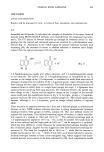
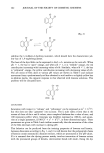
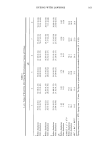
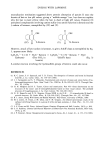
DYEING WITH LAWSONE 161 DISCUSSION UPTAKE AND DISSOLUTION Results will be discussed in turn, in terms of hue, saturation, and substantivity. HUE Savranskii and Pilipenko (2) calculated the energies of alternative w electronic forms of lawsone using MO-LCAO-SCF methods, and concluded that the compound was tauto- meric. The UV spectra of lawsone solutions go through an isosbestic point (1), sug- gesting that the ionized and unionized species are involved in a pH-dependent equi- librium (Eq. 1). Absorption in the visible region by lawsone solutions increases with increasing pH the tautomer in excess in alkaline solutions is therefore more deeply colored than the species associated with low pH values. O O OH f.• 0- / x, N + H+ O) 0 0 (Eq. 1) 1,4-Naphthoquinones usually give yellow solutions, and 1,2-naphthoquinones orange or red solutions. The yellow color of 1,4-naphthoquinones, as exemplified by (I), in contrast to the orange of the 1,2-compounds, is considered to result from restriction of resonance arising from the stability of the 1,4-quinone group, which demands that the bond joining the two rings is unsaturated (3). This bond fixation prevents formation of canonical forms in which there is a single bond joining the rings. 1,2-Quinones have canonical forms involving both ring junctions. The repulsion between the partial neg- ative charge on the 1-ketone and the negative charge on the 2-oxygen of the lawsone anion could push the equilibrium shown in Eq. 2 to the right, giving a 1,2-naphtho- quinone structure (II) with a characteristic reddish-orange hue. This would explain why lawsone, although it is a 1,4-quinone, gives an orange-colored solution in aqueous alkali. There would be no repulsion between the 1-keto and 2-hydroxy groups in undissociated lawsone in fact, NMR evidence indicates that there is strong intramolecular hydrogen bonding between these groups in CDCI 3 solution (4). Our own infrared results (5) support this conclusion. The carbonyl-stretching region of lawsone in carbon tetrachlo- ride consists of a doublet at 1662 and 1672 cm-•. The carbonyl-stretching peak of 1,4-naphthoquinone appears at 1675 cm- • (6), so that the smaller 1672 peak must be due to free carbonyl and the larger peak at 1662 cm-• can be assigned to 1-carbonyl, which has been shifted to a lower frequency by intramolecuIar hydrogen bonding with the 2-hydroxyl group. Support for this suggestion came from hydroxyl-stretching fre- quencies (5). The band for 2-naphthol lies at 3610 cm-•, while that for lawsone is smaller and located at 3411 cm- 1. Shifts of this order occur when hydroxyl is intramo- lecularly hydrogen bonded to form a non-conjugated ring, which suggests that undis- sociated lawsone occurs partly in the form indicated by (III). Such complexation would

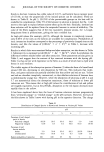
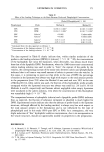
162 JOURNAL OF THE SOCIETY OF COSMETIC CHEMISTS O O O o (II) o- (Eq. 2) stabilize the 1,4-diketo-2-hydroxy tautomer, which should have the characteristic yel- low hue of 1,4-naphthoquinones. The hues of the dyed felts can be expressed in the L.a.b. notation as the ratio aJb. When aJb = 1, the hue is "pure" orange, and when aJb 1, it is "reddish" orange, the red contribution increasing with increasing values of aJb. Similarly, when aJb 1, the hue is "yellowish" orange, the yellow contribution increasing with decreasing values of aJb. The aJb ratios of felts dyed at various pH values are shown in Table I and indicate movement from a predominantly red hue obtained in acid media to a slightly yellow hue in alkaline media, the opposite response to that observed with lawsone solutions. This problem will be discussed later. SATURATION Saturation with respect to "redness" and "yellowness" can be expressed as (a 2 q- b2) TM, but this does not take "grayness" into account. The L scale takes a form tha• is the reverse of those of the a and b values, since complete blackness has a value of zero, and 100 represents perfect white. Grayness was therefore expressed as (100-L), and satura- tion as a single parameter, [(100-L) 2 q- a 2 q- b2] TM, in three-dimensional space. These parameters are given in Table I and confirm numerically that the saturation of the colors of the felts decreases with increase in dyeing pH. This behavior can be predicted from the ionizing properties of lawsone and keratin. Lawsone dissociates according to Eq. 1, and it is well known that the polypeptide chains of keratin contain monoacidic diamine residues, which are protonated at low pH values. If it is assumed that the dyeing process mainly involves interaction of lawsone anions with the protonated groups of keratin, electrovalent bonds will result, fixing the dye
Purchased for the exclusive use of nofirst nolast (unknown)
From: SCC Media Library & Resource Center (library.scconline.org)