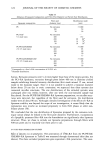
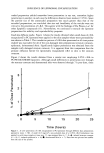
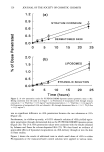
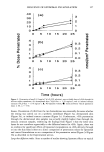
INFLUENCE OF LIPOSOMAL ENCAPSULATION 133 four-component liposome system did not increase its penetration rate across human stratum corneum relative to unencapsulated controls. Furthermore, under most (four of five) of the conditions studied, liposomes also failed to significantly reduce the delivery rate of t-RA across dermatomed human skin relative to that across stratum corneum hence, there was no evidence for liposome-induced accumulation of t-RA in the lower skin layers in these studies. Although there was evidence for accumulation of t-RA in the skin under one set of conditions (consisting of a large, non-occluded dose of t-RA in PC liposomes), these conditions do not correspond to a practical dose regimen for a topical skin care product. REFERENCES (1) (2) (3) (4) (5) (6) (7) (8) (9) (10) (11) (12) (13) (14) (15) (16) (17) (18) T. Nishihata, K. Kotera, Y. Nakano, and M. Yamazaki, Rat percutaneous transport of diclofenac and influence of hydrogenated soya phospholipids, Chem. Pharm. Bull., 35(9), 3807-3430 (1986). T. Kimura, N. Nagahara, K. Hirabayashi, Y. Kurosaki, and T. Nakayam, Enhanced percutaneous penetration of flufenamic acid using lipid disperse systems containing glycosylceramide, Chem. Pharm. Bull., 37(2), 454-457 (1989). M. Mahjour, B. Mauser, Z. Rashidbaigi, and M. B. Fawzi, Effect of egg yolk lecithins and com- mercial soybean lecithins on in vitro skin permeation of drugs, J. Contr. Release, 14, 243-252 (1990). A. Karo, Y. Ishibashi, and Y. Miyake, Effect of egg yolk lecithin on transdermal delivery of bunazosin hydrochloride, J. Pharm. Pharmacol., 39, 399-400 (1987). H. Williman, P. Walde, P. L. Luisi, A. Gazzaniga, and F. Stroppolo, Lecithin organogel as a matrix for transdermal transport of drugs, J. Pharm. Sci., 81(9), 871-874 (1992). V. Masini, F. Bonte, A. Meybeck, and J. Wepierre, Cutaneous bioavailability in hairless rats of tretinoin in liposomes or gel, J. Pharm. Sci., 82, 17-21 (1993). W. C. Foong, B. B. Harsanyi, and M. Mezei, "Biodisposition and Histological Evaluation of Top- ically Applied Retinoic Acid in Liposomal, Cream and Gel Dosage Forms," in Phospholipids, I. Hanin and G. Pepeu, Eds. (Plenum Press, New York, 1990), pp. 279-282. G. P. Martin and A. W. Lloyd, "Basic Principles of Liposomes for Drug Use," in Greisbach Conference Liposome Dermatics, 0. Braun, F. H. C. Korting, and H. I. Maibach, Eds. (Springer-Verlag, New York, Berlin, Heidelberg, 1992), pp. 20-26. S. J. Sveinsson and M. Mezei, In vitro oral mucosal absorption of liposomal triamcinolone acetonide, Pharm. Res., 9(10), 1359-1361 (1992). K. Egbaria, C. Ramachandran, and N. Weiner, Topical delivery of ciclosporin: Evaluation of various formulations using in vitro diffusion studies in hairless mouse skin, Skin Pharmacol., 3, 21-28 (1990). J. Du Piessis, K. Egbaria, and N. Weiner, Influence of formulations factors on the deposition of liposomal components into the different strata of the skin, J. Soc. Cosmet. Chem., 43, 93-100 (1992). K. Egbaria and N. Weiner, "Topical Delivery of Liposomally Encapsulated Ingredients Evaluated by In Vitro Diffusion Studies, "in Griesbach Conference Liposome Dermatics, O. Braun, F. H. C. Korting, and H. I. Maibach, Eds. (Springer-Verlag, New York, Berlin, Heidelberg, 1992), pp. 172-181. K. Egbaria and N. Weiner, "Liposomes as a Topical Drug Delivery System Evaluated by In Vitro Diffusion Studies," in Cosmetic and Pharmaceutical Applications of Polymers, C. G. Gebelein et al., Eds. (Plenum Press, New York, 1991), pp. 215-224. H. Komatsu, K. Higaki, H. Okamoto, K. Miyagawa, M. Hashida, and H. Sezaki, Preservative activity and in vivo percutaneous penetration of butylparaben entrapped in liposomes, Chem. Pharm. Bull., 34(8), 3415-3422 (1986). K. Egbaria and N. Weiner, Liposomes as a topical drug delivery system, Adv. Drug Delivery Review, 5, 287-300 (1990). A. Meybeck, P. Michelon, C. Montastier, and G. Redziniak (to LVMH Recherche), European Patent Appl. 0 472 225 A2 (February 26, 1992). S. W. Farnes and P. A. Sethess, Retinoid therapy for aging skin and acne, Postgrad. Med., 92(6), 191-200 (1992). M. G. Ganesan, N. D. Weiner, G. L. Flynn, and N. F. H. Ho, Influence of liposomal drug en- trapment on percutaneous absorption, Int. J. Pharm., 20, 139-154 (1984).

134 JOURNAL OF THE SOCIETY OF COSMETIC CHEMISTS (19) (20) (21) (22) (23) (24) (25) (26) (27) (28) (29) (30) (31) N. F. H. Ho, M. G. Ganesan, N. D. Weiner, and G. L. Flynn, Mechanisms of topical delivery of liposomally entrapped drugs, J. Contr. Release, 2, 61-65 (1985). J. Lash, R. Laub, and W. Wohlrab, How deep do intact liposomes penetrate into human skin?, J. Contr. Release, 18, 55-58 (1992). D. B. Yarosh, J. Tsimis, and V. Yee, Enhancement of DNA repair of UV damage in mouse and human skin by liposomes containing a DNA repair enzyme, J. Soc. Cosmet. Chem., 41, 85-92 (1990). D. B. Yarosh (to Applied Genetics, Inc.), Purification and administration of DNA repair enzymes, US Patent 5,077,211 (December 31, 1991). A. D. Bangham, M. M. Standish and J. C. Watkins, The action of steroids and streolysins on the permeability of phospholipid structures to cations, J. Mol. Biol., 13, 138-145 (1965). L. D. Mayer, M. J. Hope, and P. R. Cullis, Vesicles of variable sizes produced by a rapid extrusion technique, Blochim. Biophys. Acta, 858, 161-168 (1986). P. A. Lehman, J. T. John, and T. J. Franz, Percutaneous absorption ofretinoids: Influence of vehicle, light exposure, and dose, J. Invest. Dermatol., 91, 56-61 (1988). A.M. Kligman and E. Christophers, Preparation of isolated sheets of stratum corneum, Arch. Der- matol., 88, 702-705 (1963). T.J. Franz and P. A. Lehman, The use of water permeability as a means of validation for skin integrity in in vitro percutaneous absorption studies, J. Invest. Dermatol., 94, 525 (1990). E. W. Merritt and E. R. Cooper, Diffusion apparatus for skin penetration, J. Contr. Release, 1(2), 161-162 (1984). G. B. Kasting, T. G. Filloon, W. R. Francis, and M.P. Meredith, Improving the sensitivity of in vitro skin penetration experiments. Pharmaceut. Res., in Press. K. Boesze-Bartaglia, S. J. Fliesler, J. Li, J. E. Young, and P. L. Yeagle, Retinal and retinol promote membrane fusion, Blochim. Biophys. Acta, 1111(2), 256-262 (1992). R. Panchagnula and W. A. Ritschel, Development and evaluation of an intracutaneous depot for- mulation of corticosteroids using transcutol as a cosolvent: In-vitro, ex-vivo and in-vivo rat studies, J. Pharm. Pharmacol., 43, 609-614 (1991).
Purchased for the exclusive use of nofirst nolast (unknown)
From: SCC Media Library & Resource Center (library.scconline.org)