DYEING WITH LAWSONE 163

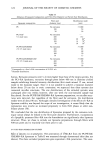
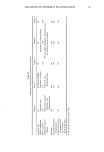
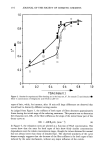
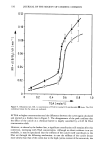
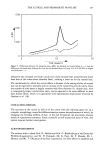
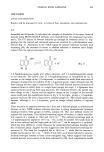
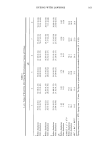
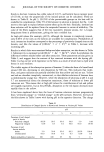
164 JOURNAL OF THE SOCIETY OF COSMETIC CHEMISTS firmly to the hair. Lawsone has a pKa value of 4.0 (7), and keratin has an isoionic point of 6.0 (8), so that the proportions of the ionized species can be calculated. These are shown in Table II. At pH 3, 99.95% of the protonizable groups on the hair will be available for complexation. Only 5% of the lawsone in solution is ionized, but Eq. 1 will move to the right to replace lawsone anions taken up by the hair. Similarly, lawsone lost from solution will be replaced from the suspended lawsone in excess of solubility. The color of the fibers suggests that of the two tautomeric lawsone anions, the 1,2-naph- thoquinone form is predominant, giving the hair a reddish hue. At high pH values (for example, pH 9), although the lawsone is completely ionized, only 0.05% of the sites on the keratin are available for complexation. Probabilities of ionic interaction therefore correspond to the percentage of positively charged sites on the keratin, and like the values of [(100-L) 2 + a 2 -{- b2] 1/2 in Table I, decrease with increasing pH. Results in which felts were examined before and after extraction, are also shown in Table I. Substantivity is expressed as [A(100-L) 2 + Aa 2 + Ab2)] ¾2, where A symbolizes the difference between results before and after extraction. These parameters are also given in Table I, and suggest that the amount of dye removed increases with the dyeing pH. Table I is thus in line with experience in the field, as a result of which hair is dyed with henna in acid medium. The visible region of the absorption spectra of lawsone (1) takes the form of a broad band around 450 nm, decreasing to zero absorption by 500 nm. This indicates that violet, blue, and green radiation are partially absorbed but that yellow and red are not. Yellow and red are therefore completely transmitted, so that alkaline solutions of lawsone have a predominantly orange hue. However, while the absorption of solutions at pH 4.2 and 5.7 are symmetrical about the absorption maximum, those of solutions at lower pH values are not. This means that at high pH values the contributions of red and yellow are roughly equivalent, but as the pH falls, absorption in the red region decreases more rapidly than in the yellow. It has been explained above how the hues of lawsone solutions increase progressively from "yellowish-orange" to "reddish-orange" as the pH increases. However, the hues of the felts shown in Table I move with dyeing pH in the opposite direction. The charge Table II Distribution of Charged Species in Keratin and Lawsone at Various pH Values pH 3 4 5 6 7 9 Percentage of total charged species in keratin Positively charged Negatively charged Percentage of total lawsone molecules Anion Undissociated Relative probability of interaction 99.95 99.5 95.0 50.0 5.0 0.05 0.5 5.0 50.0 95.0 5.0 50.0 95.0 99.5 99.95 95.0 50.0 5.0 0.5 0.05 100 100 95 50 5 0.05 99.95 100.0 0.0 0
Purchased for the exclusive use of nofirst nolast (unknown)
From: SCC Media Library & Resource Center (library.scconline.org)