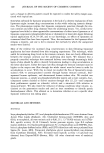
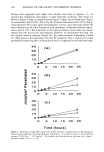
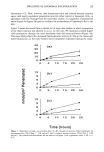
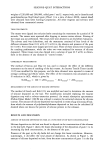
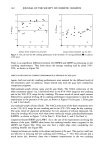
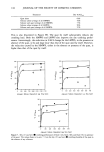
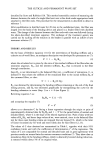
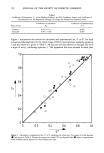
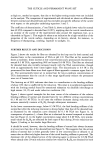
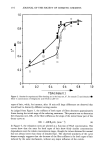
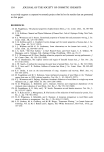
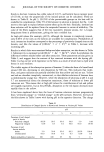
142 JOURNAL OF THE SOCIETY OF COSMETIC CHEMISTS lOO ß 60- O O 40 2O o,• ß O A I i i i 250 500 750 1000 12 0 80- 40- O ß ß 250 ß øøß O ß •, OO O B I I 500 750 1000 1250 Amount Silicon Deposited (gg Si/g hair) Amount Silicon Deposited (gg Si/g hair) Figure 5. Dry (A) and wet (B) combing performance of all the fluids ( 0 ) and gums/blend (O) in absence of the quat. There is no significant difference between the HMWS and LMWS as pertaining to wet combing improvement. They both reduce the average combing load by about 35%- 50%, as shown in Figure 5B. EFFECT OF SILICONE ON COMBING PERFORMANCE IN PRESENCE OF THE QUAT Again, both wet and dry combing performances were assessed for the different levels of the treatments used. In addition, tresses treated only with the quat were combed for comparison purposes. High-molecular-weight silicones (gums and the gum blend). The %ACL reductions of the three treatments (gums 1 & 2 and blend) were in the 87%-94% range for wet combing and in the 56%-87% range for dry combing. The same trends of initial rapid increase followed by a gradual leveling off in combing performance improvement is valid for the experiments in the presence of the quat, as shown in Figure 6 (A for gum 1, B for gum 2, and C for blend). Low-molecular-weight silicones (fluids). The %ACL reductions of the three treatments were in the 73%-91% range for wet combing and in the 47%-79% range for dry combing. The same trend (of improved performance for low amounts of silicone deposited, fol- lowed by leveling off) is seen with these lower molecular weight polydimethylsiloxanes (LMWS), as shown in Figure 7 (A for fluid 1, B for fluid 2, and C for fluid 3). Comparison between HMWS and LMWS. As in the case of the experiments involving the absence of the quat, HMWS show better dry combing benefits when compared to the LMWS (see Figure 8A). They may also have a slight edge when considering wet combing benefits (see Figure 8B). Comparison between wet combing in the absence andpresence of the quat. The quat by itself was not effective in reducing the wet combing load (%ACL•e d = 3%). The silicones did a much better job, however there was a dramatic improvement in the wet combing

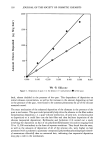
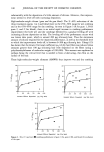
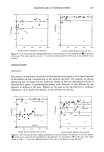
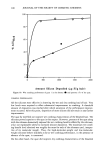
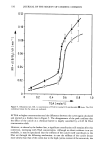
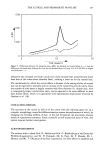
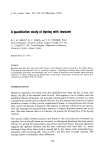
SILICONE-QUAT INTERACTIONS 143 100 100 80 80 • 60 • 60 200 20 O[ • • • • • • 0 250 500 750 1000 12•50 1 00 1750 0 250 500 750 1000 1250 1500 1750 2000 Amount Silicon Deposited (gg Si/g hair) Amount Silicon Deposited (gg Si/g hair) 100 80- 60 -• 40- 20- c I I I I 215 250 500 750 1000 1 0 1500 Amount Silicon Deposited ([tg Si/g hair) Figure 6. Dry ( 0 ) and wet (O) combing performance of gum 1 (A), gum 2 (B), and blend (C) in presence of the quat. The values shown at x-axis = 0 are the dry (•) and wet (O) combing benefits of the quat in the absence of any silicones. performance when both silicone and the quat were present together as shown in the table below: Treatment Wet %ACLre o Quat alone Silicone alone (average of all HMWS and LMWS) Silicone and quat (average of all HMWS and LMWS) 3% 43% 87% This is also illustrated in Figure 9A. The synergistic effect of the two simply cannot be explained by the improved deposition of the silicone in the presence of the quat. Similar amounts of silicone deposited on hair, in the absence and in the presence of the quat, display very different wet combing benefits. For example, in Figure 10, a level of 500 !xg silicone/g hair provides a 30% reduction of combing force in the absence of the quat but a 90% reduction in the presence of the quat. Comparison between dry combing in the absence and presence of the quat. There is no advantage in dry combing performance when both silicone and the quat are present together, as compared to the effect of the quat or the silicones alone as shown in the table below:
Purchased for the exclusive use of nofirst nolast (unknown)
From: SCC Media Library & Resource Center (library.scconline.org)