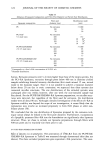
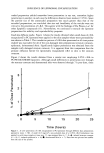
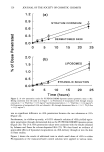
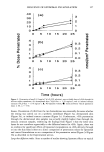
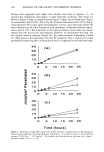
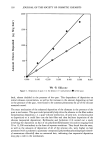
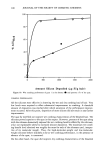
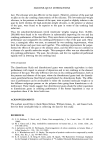
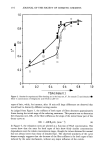
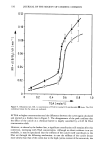
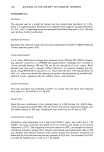
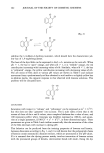
156 JOURNAL OF THE SOCIETY OF COSMETIC CHEMISTS 0.12 0.10 0.08 0.06 0.0/• 0.02 } I I I [ I I [ [ 0.2 0./, 0.6 0.8 1.0 TfiA [mole/l] Figure 4. Relaxation rate, RR, vs concentration of TGA for normal (C)) and descaled (O) hairs. The 95% confidence limits for the values are indicated. M TGA to higher concentrations and the differences between the curves again calculated and plotted as a broken line in Figure 5. The disappearance of the peak confirms that the effect of the cuticle as a chemical barrier is largely cancelled by a 0.05 M TGA concentration shift. However, as shown by the broken line, a significant contribution still remains after this correction, increasing with TGA concentration. Although no direct evidence is as yet available, it may be speculated that the stiffness of the cuticle itself contributes to the fiber set through the following mechanism: in case the stiffness of the cuticle decays more slowly than that of the cortex due to the high cystine content of the exocuticle, the

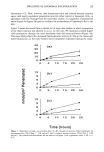
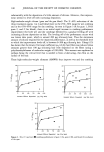
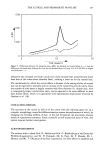
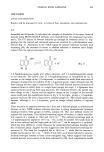
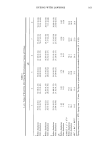
THE CUTICLE AND PERMANENT WAVE SET 157 0,06 0.04 0.02 0 O.S 1.0 TGA [ mole/I] Figure 5. Differences between the relaxation rates, ARR, for alescaled and normal fibers ( ), and the differences calculated after shifting the curve for the alescaled fibers in Figure 4 by 0.05 M TGA to higher concentrations (---). relaxation rate averaged over both cuticle and cortex (normal hair) would become lower than that of the cortex alone (descaled fiber), yielding a lower set for the normal hair. The mechanisms by which the cuticle affects a decrease of the setting ability of normal hair can be expected to intensify with an increase of the volume fraction of cuticle. Since the number of scale layers is largely invariate with fiber diameter (5), thinner hair, with a consequently larger cuticle/cortex ratio, can be expected to be more difficult to wave than thicker fibers, which is in agreement with experimental observations reviewed by Gershon et al. (18). CONCLUDING REMARK The reactions of the cuticle as well as of the cortex with the reducing agent set up a complex, morphology-controlled diffusion/reaction system the performance of which, by changing the bending stiffness of hair, in the end determines the practically relevant results of a permwave treatment. From a scientific as well as practical point of view, this system requires further investigation. ACKNOWLEDGMENTS The authors wish to thank Prof. H. HiScker and Prof. G. Blankenburg of the Deutsches Wollforschungsinstitut, and Dr. H. Fukusaki, Mr. K. Fujii, Dr. F. Masuda, Mr. I. Honma, and Mr. T. Okumura of the Kao Corporation, for their efforts to establish and
Purchased for the exclusive use of nofirst nolast (unknown)
From: SCC Media Library & Resource Center (library.scconline.org)