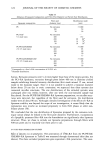
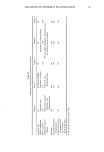
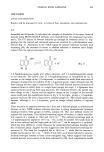
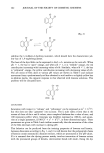
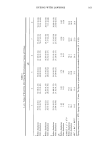
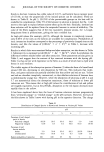
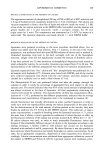
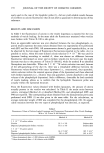
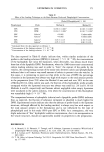
162 JOURNAL OF THE SOCIETY OF COSMETIC CHEMISTS O O O o (II) o- (Eq. 2) stabilize the 1,4-diketo-2-hydroxy tautomer, which should have the characteristic yel- low hue of 1,4-naphthoquinones. The hues of the dyed felts can be expressed in the L.a.b. notation as the ratio aJb. When aJb = 1, the hue is "pure" orange, and when aJb 1, it is "reddish" orange, the red contribution increasing with increasing values of aJb. Similarly, when aJb 1, the hue is "yellowish" orange, the yellow contribution increasing with decreasing values of aJb. The aJb ratios of felts dyed at various pH values are shown in Table I and indicate movement from a predominantly red hue obtained in acid media to a slightly yellow hue in alkaline media, the opposite response to that observed with lawsone solutions. This problem will be discussed later. SATURATION Saturation with respect to "redness" and "yellowness" can be expressed as (a 2 q- b2) TM, but this does not take "grayness" into account. The L scale takes a form tha• is the reverse of those of the a and b values, since complete blackness has a value of zero, and 100 represents perfect white. Grayness was therefore expressed as (100-L), and satura- tion as a single parameter, [(100-L) 2 q- a 2 q- b2] TM, in three-dimensional space. These parameters are given in Table I and confirm numerically that the saturation of the colors of the felts decreases with increase in dyeing pH. This behavior can be predicted from the ionizing properties of lawsone and keratin. Lawsone dissociates according to Eq. 1, and it is well known that the polypeptide chains of keratin contain monoacidic diamine residues, which are protonated at low pH values. If it is assumed that the dyeing process mainly involves interaction of lawsone anions with the protonated groups of keratin, electrovalent bonds will result, fixing the dye

DYEING WITH LAWSONE 163
Purchased for the exclusive use of nofirst nolast (unknown)
From: SCC Media Library & Resource Center (library.scconline.org)