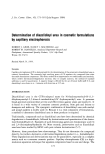
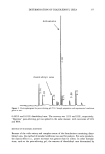
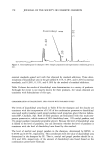
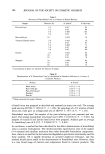
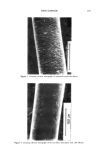
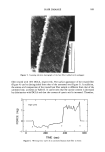
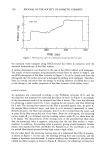
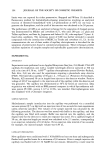
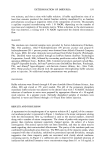
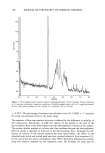
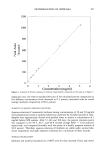
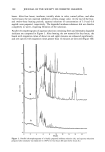
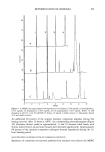
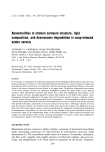
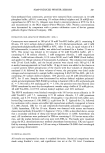
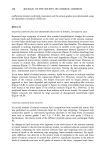
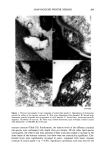
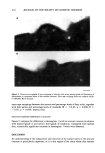
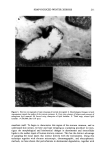
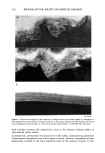
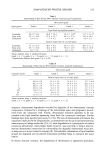
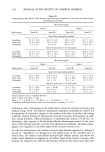
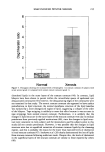
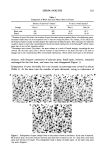
HAIR DAMAGE 189 Figure 5. Scanning electron micrograph of the hair fiber rubbed with sandpaper. fiber treated with 10% DCCA, respectively. The surface appearance of the treated fiber (Figure 4) can be distinguished from that of the untreated one (Figure 3). In addition, the amino acid composition of the treated hair fiber sample is different from that of the untreated one, as shown in Table II. It can be seen that the cystine content is decreased by chlorination with DCCA and that the content of cysteic acid is increased. Therefore, r'r- o -1 I I Hair-UT4 I I I I 0 200 400 600 TIME (sec) Figure 6. Wetting force curve of an untreated human hair fiber in water.

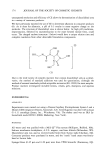
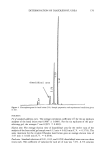
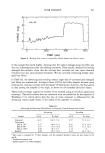
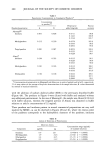
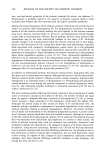
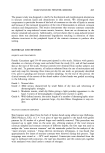
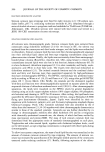
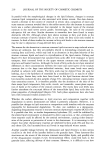
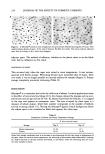
190 JOURNAL OF THE SOCIETY OF COSMETIC CHEMISTS 0 200 400 I 600 TIME (sec) Figure 7. Wetting force curve of a chlorinated human hair fiber in water. the increased water transport along DCCA-treated hair fibers is consistent with the increased hydrophilicity of the fiber surfaces. A similar phenomenon was observed in the case of hair fibers rubbed with sandpaper. The results of water transport along physically treated fibers are shown in Table I, and the SEM photograph of this fiber is shown in Figure 5. It can be clearly seen from the photograph that the surface structure is damaged by rubbing with sandpaper. Therefore, there is a strong indication that the change in wicking behavior of rubbed hair is due to the change in the surface properties of the fiber (removal of the surface layer). CONTACT ANGLE An apparatus was constructed according to the Wilhelmy principle (4,5), and the wetting force was measured for individual hair fibers in water. In Figure 6, an example of the experimental results of an untreated hair fiber is shown. This curve was obtained by advancing a liquid (water) for 5 mm, stopping for one minute, and then retreating for 5 mm. The wetting force exerted on the fiber is recorded against time. At point A, the sample fiber contacted water, and from A to B advanced (immersed) in water. Between B and C, the fiber was stationary, from C to D it receded from the water, and at point D the fiber was pulled out of the water. From the A-B region, the advancing contact angle (0 a) is obtained, and the receding contact angle (0 r) is taken from the C-D region. The characteristics of the wetting curve of the untreated hair fiber show that the advancing value is negative, indicating that the hair fiber surface is water- repellent. In addition, the receding value is positive, giving a high hysteresis. Similar results were reported by Penn and Miller (8), Kamath et al. (9), and Hsieh et al. (10) for several fiber/liquid systems having high contact angle values. On the other hand, the advancing wetting force of a chlorinated hair fiber is positive, as shown in Figure 7. In this case, the receding wetting force also increased, and the degree of hysteresis thus decreased. A similar tendency was observed for the physically rubbed hair fiber sample, as shown in Figure 8. However, the advancing wetting force
Purchased for the exclusive use of nofirst nolast (unknown)
From: SCC Media Library & Resource Center (library.scconline.org)