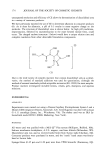
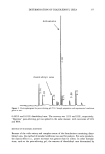
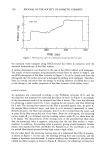
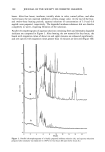
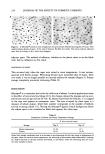
174 JOURNAL OF THE SOCIETY OF COSMETIC CHEMISTS unsurpassed resolution and efficiency of CE allow the determination of diazolidinyl urea in a variety of consumer products. We have previously reported the use of CE to determine allantoin in consumer products (8). As is done for allantoin, a pH of 9.3 results in some negative charge on the molecule. The structure of diazolidinyl urea is shown below. At high pH conditions, deprotonation, followed by tautomerization to the more favored enolate form, could occur. The charged enolate (structure 1 below) would have a unique elution time and complete resolution from other detectable formulation components. OH O HORN. N. ..ff OH o HO (1) Due to the wide variety of complex matrices that contain diazolidinyl urea as a preser- vative, the method of standard additions was used for quantitation, although the method of external standards yielded acceptable recoveries (80-120%) for most samples. Product matrices investigated included lotions, creams, gels, shampoos, and aqueous solutions. EXPERIMENTAL APPARATUS Experiments were carried out using a Dionex Capillary Electrophoresis System I and a Dionex 4400 integrator (Dionex, Sunnyvale, CA). Centrifugation was done with a Jouan G 4.11 centrifuge (Jouan, Inc., Winchester, VA). The shaker used was an IKA La- bortechnik model HS501 (DHK Marketing, New York). MATERIALS All water used was purified with a Milli-Q uv Plus system (Millipore, Bedford, MA). Sodium tetraborate decahydrate, A.C.S. reagent, was from Aldrich (Milwaukee, WI). Diazolidinyl urea was used as received (solid form) from Sutton Labs (Chatham, NJ). Consumer products were purchased in stores, and the "mock" hand cream was formu- lated at Sutton Labs. Syringe filters (0.45 I.tm and 0.20 I.tm) were from VWR Scientific (Piscataway, NJ).

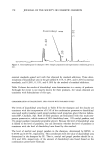
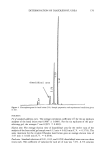
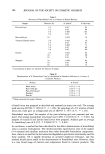
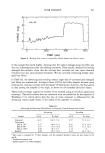
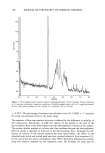
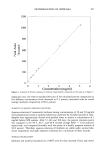
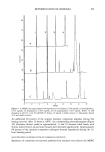
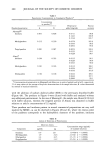
DETERMINATION OF DIAZOLIDINYL UREA 175 Ultrafiltration membrane cones (MW cutoff 25,000) were obtained from Amicon (Dan- vers, MA). Capillaries (Dionex) were of 50 •m i.d. and cut to 55 cm total length. The polyimide coating was burned off to create a detector window. The distance to the window was 50 cm. PROCEDURE The running buffer was vacuum filtered/degassed (0.45 •m) and further degassed by ultrasonication. The capillary was rinsed with 0.5 N NaOH by pressure injection for fifteen minutes, followed by pressure injection of water for fifteen minutes. The capillary was then rinsed with running buffer at least three times. The capillary was equilibrated at the run voltage for thirty minutes prior to any sample analysis. The operating buffer used was 20 mM borate (pH • 9.3). The following electrophoretic conditions were employed: Applied voltage: Temperature: Injection: Detection: 23 kV (i • 32 •tA) Ambient Gravity: 50 mm 30 s UV at 215 nm For HPLC determination of methyl and propyl parabens, a 70:30 water:isopropanol mobile phase acidified with phosphoric acid was used. The column was a Zorbax ODS (250 X 4.6 mm) C•g reversed-phase (Mac-Mod Analytical, Chadds Ford, PA), and detection was at 260 nm. Standard solutions of diazolidinyl urea were prepared from the solid. A 5% solution in water was prepared and diluted to 0.5% with water. The standards were then made by diluting the appropriate volume of the 0.5% stock solution with borate buffer. Samples were prepared by weighing the appropriate amount and diluting to 40 g with borate buffer (e.g., for a 5% sample solution, 2 g of sample was dissolved in 38 g of buffer). Mixing was achieved by vortexing for five minutes. The spiked sample solutions were prepared by pipetting the appropriate amount of 0.5% diazolidinyl urea into a glass vial and diluting to 10 mL with sample solution. Three spikes were prepared. The remainder of the sample solution was used as the unspiked sample. The vials were then shaken mechanically for one hour. After shaking, the samples were filtered through a 0.45-•m and a 0.20-•m disposable syringe filter. It was necessary to ultracentrifuge (cutoff 25,000 MW) shampoo samples to obtain an acceptable baseline. The unspiked and spiked sample solutions were in- jected in triplicate, and the amount of diazolidinyl urea was determined from the x-intercept of the fitted, standard additions curve (corrected for dilution). RESULTS AND DISCUSSION LINEARITY OF RESPONSE TO DIAZOLIDINYL UREA A calibration curve of peak area versus diazolidinyl urea content was linear (r 2 • 0.9900)
Purchased for the exclusive use of nofirst nolast (unknown)
From: SCC Media Library & Resource Center (library.scconline.org)