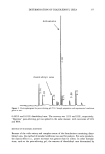
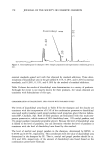
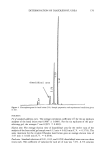
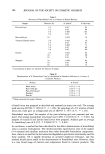
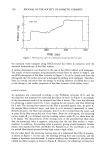
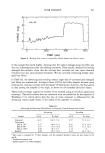
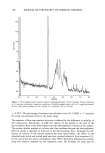
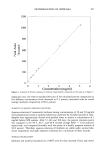
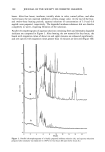
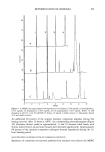
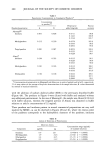
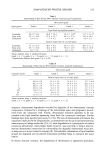
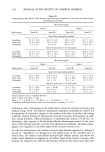
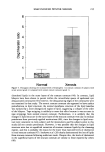
DETERMINATION OF IMIDUREA 201 elutes with the electroosmotic flow (to). Peak identification and peak purity of the parabens were confirmed by examination of PDA spectra. Neither imidurea nor the imidurea-related impurities are affected by the presence of micelles in the mobile phase due to highly hydrophilic character under these electrophoretic conditions. Buffer solutions of both commercial products were spiked at three different concentra- tion levels with the appropriate preservatives, and the percent recovered is shown in Table I along with the amount of preservatives found in each product. All recovery data are from duplicate determinations. The amount of preservative estimated from the spiked sample agrees well with the assay values, which are also reported in Table I. The detection limits appearing in Table II were determined using peak heights at a signal-to-noise ratio of six, with standard solutions encompassing the reported concen- tration ranges. A three-second injection period (5-in Hg) was used, which permitted an injection aliquot of 1.26 nL of sample. CONCLUSION The percent purity of imidurea in the commercial product was calculated to be 96.6%. Total analysis time by CZE was less than fifteen minutes with both minimal sample preparation and sample consumption. A minimum of twenty anionic species in addition to the major neutral component were detected and will be the subject of a CZE-MS investigation in the near future. With the addition of SDS to the electrophoretic buffer, imidurea and the parabens were separated. The determination of preservatives in two commercial products without any extensive sample preparation and method optimiza- tion illustrates the advantage of capillary electrophoresis with detection limits ranging from 25 to 125 picrograms at 190 nm. If an increase in sensitivity is desired, a capillary of wider inner diameter can be used without any significant loss in efficiency, since the current observed is less then 20 IxA. REFERENCES (1) P. A. Berke and W. E. Rosen, Germall, a new family of antimicrobial preservatives for cosmetics. Amer. Perfum. Cosmet., 85, 55-59 (1970). (2) W. E. Rosen and P. A. Berke, Modern concepts of cosmetic preservation, J. Soc. Cosmet. Chem., 24, 663-675 (1973). (3) D. S. Ryder, The thin layer chromatographic detection and determination of an imidazolidinyl antimicrobial preservative, J. Soc, Cosmet. Chem., 25, 535-544 (1974). (4) C. H. Wilson, Identification of preservatives in cosmetic products by thin-layer chromatography, J. Soc. Cosmet. Chem., 26, 75-81 (1975). (5) E. P. Sheppard and C. H. Wilson, Fluorometric determination of formaldehyde-releasing cosmetic preservatives, J. Soc. Cosmet. Chem., 25, 655-666 (1974). (6) F. E. P. Mikkers, F. M. Everaerts, and T. P. E. M. Verheggen, High-performance zone electropho- resis,.]. Chromatogr., 169, 1-10 (1979). (7) F. E. P. Mikkers, F. M. Everaerts, and T. P. E. M. Verheggen, Concentration distribution in free zone electrophoresis, J. Chromatogr., 169, 11-20 (1979). (8) J. W. Jorgenson and K. D. Lukacs, Zone electrophoresis in open-tubular glass capillaries, Anal. Chem., 53, 1298-1302 (1981).

202 JOURNAL OF THE SOCIETY OF COSMETIC CHEMISTS (9) J. W. Jorgenson and K. D. Lukacs, High-resolution separations based on electrophoresis and elec- troosmosis, J. Chromatogr., 218, 209-216 (1981). (10) J. W. Jorgenson and K. D. Lukacs, Capillary zone electrophoresis, Science, 222, 266-272 (1983). (11) S. Terabe, K. Otsuka, K. Ichikawa, A. Tsuchiya, and T. Ando, Electrokinetic separations with micellar solutions and open-tubular capillaries, Anal. Chem., 56, 111-113 (1984). (12) S. Terabe, K. Otsuka, and T. Ando, Electrokinetic chromatography with miceliar solution and open-tubular capillary, Anal. Chem., 57, 834-841 (1985). (13) R. J. Nelson, A. Paulus, A. S. Cohen, A. Guttman, and B. L. Karger, Use ofpeltier thermoelectric devices to control column temperature in high-performance capillary electrophoresis, J. Chromatogr., 480, 111-127 (1989).
Purchased for the exclusive use of nofirst nolast (unknown)
From: SCC Media Library & Resource Center (library.scconline.org)