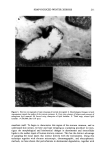
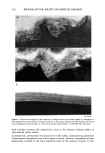
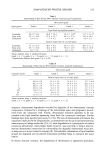
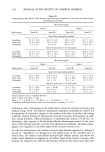
j. Soc. Cosmet. Chem., 45, 203-220 (July/August 1994) Abnormalities in stratum corneum structure, lipid composition, and desmosome degradation in soap-induced winter xerosis ANTHONY V. RAWLINGS, ALLAN WATKINSON, JULIA ROGERS, ANA-MARIA MAYO, JAMES HOPE, and IAN R. SCOTT, Unilever Research, Edgewater, NJ (A.V.R., I.R.S.), and Unilever Research, Sharnbrook, Bedford, UK (A.W., J.R. , A.-M.M. , J.H. ). Received April 20, 1994. Presented in part at the 17th IFSCC International Congress, October 1992, and at the the Society for Investigative Dermatology, April 1993. Synopsis In an attempt to understand the underlying biochemical and morphological abnormalities that lead to the physical appearance of xerosis, we have examined lipids and desmosomes in stratum corneum of normal and soap-induced winter xerotic skin. In normal skin, electron microscopy revealed lipid bilayers in the lower layers of the stratum comeurn that were absent in the upper layers. In addition, desmosomes were present in the lower stratum comeurn but underwent degradation towards the upper surface of the stratum corneum. These observations contrasted with xerotic skin, which had disorganized lipid bilayers in the upper stratum corneum, although apparently normal lipid bilayers in the deeper tissue regions. Also, desmosomes remained undegraded in the upper layers of the xerotic stratum corneum, a finding corrobo- rated by western blotting showing increased levels of desmoglein 1. Chromatographic analysis of stratum comeurn lipids showed decreased ceramide and increased fatty acid levels in subjects with xerosis compared with normal individuals, particularly in the outer stratum corneum layers. Although ceramides were lost from the stratum comeurn, the increased levels of fatty acids may be due in part to the deposition of soap fatty acids. Our results support previous studies demonstrating the importance of desmosomal degradation in desquamation. Furthermore, we have been able to show changes in the normal membrane structure of intracellular lipids in the desquamating layers of the stratum comeurn. These studies also provide new insights into soap-induced winter xerosis, revealing abnormalities in stratum comeurn lipid composition and organization together with reduced desmosomal degradation. INTRODUCTION Mammalian stratum corneum is highly complex, consisting of specialized intracellular lipids surrounding corneocytes (1) interconnected by proteinaceous structures called desmosomes (2). The intercellular lipids consist of a mixture of ceramides, cholesterol, and fatty acids, together with smaller amounts of cholesterol sulphate, glucosyl cera- mides, and phospholipids (3,4). These lipids are important for the barrier, desquama- 203

204 JOURNAL OF THE SOCIETY OF COSMETIC CHEMISTS tory, and mechanical properties of the stratum corneum (for review, see reference 5). Functionality is probably related to the capacity of stratum corneum lipids to form multiple lipid bilayers and their associated gel and liquid crystalline properties. During the normal maturation of the stratum corneum, individual cells are lost from its surface in a process called desquamation (6). For desquamation to proceed, the degra- dation of all the cohesive elements holding the cells together in the stratum corneum must occur. Stratum corneum lipids (1), lectins (7), and desmosomes (2,8) are thought to play roles in intercorneocyte cohesion. Recent findings, however, have indicated that desmosomes may be the main intercellular linkages in this tissue (2,8). Although initially thought to be non-functional within the stratum corneum due to their degra- dation in the lower layers (9, 10), studies have shown that some desmosomes, especially those associated with corneocyte interdigitations, persist intact up to the peripheral layers of the tissue (2, 11, 12). Supporting biochemical data has been provided by the persistence of desmoglein 1 (dsg 1) throughout the stratum corneum up to the peripheral layers where degradation appears to occur (11, 13). Thus, desmosomal degradation is believed to be an important part of the desquamatory process. Indeed, the enzymatic degradation of desmosomes has recently been shown to aid desquamation in palmoplan- tar and non-palmoplantar stratum corneum (12,14). Degradation of desmosomes is believed to be the result of the action of serine proteases (12,14-18), especially chy- tootrypsin-like (16) and possibly trypsin-like proteases (19). In addition to desmosomal proteins, the stratum corneum lectin, desquamin (20), may also play a role in intercorneocyte cohesion, although this has yet to be fully determined. Stratum corneum lipids, however, influence stratum corneum integrity, and hence their degradation is an important aspect of desquamation (1). Phospholipid and glucosylce- ramide hydrolysis occurs during the stratum compatum to stratum disjunctum transi- tion (3), and cholesterol sulphate hydrolysis is intimately associated with the loss of surface corneocytes (21,22). The most common problem affecting the stratum corneum is the accumulation of visible scales or corneocyte clumps on the surface of the skin, the severity of which can range from the genetic ichthyoses affecting a minority of the population (23,24), to xerosis, which concerns a large proportion of the population, particularly the elderly (25). Although the precise causes of skin xerosis are likely to be multifactorial (26), the resultant scaling is probably a consequence of perturbed degradation of the corneocyte adhesive elements, leading to aberrant desquamation. However, the relative contribu- tion of lipids and desmosomes to the disordered desquamatory process is poorly under- stood. Stratum corneum lipids have been well studied in xerosis, although no consensus in the role of lipids have been produced. Solvent (27) or surfactant (28) induced dry scaly skin was associated with intercellular lipid depletion. In contrast to these studies, the levels of stratum corneum fatty acids are increased, but ceramides, cholesterol, and cholesterol sulphate are reported not to be changed in subjects with winter xerosis (29). In addition, using electron microscopy, Fartasch et al. (30) did not find any abnormal- ities in stratum corneum lipid structure following surfactant use. An alternative view is that alterations in stratum corneum lipid composition, but not total lipid levels, result in skin scaling. In support of this, changes in lipid composition, especially ceramide subtypes, have been induced following surfactant treatment or tape stripping, and scaling has been elicited (31,32).
Purchased for the exclusive use of nofirst nolast (unknown)
From: SCC Media Library & Resource Center (library.scconline.org)