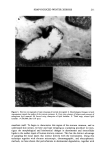
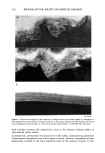
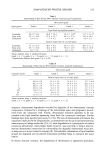
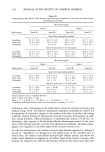
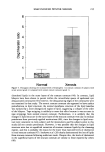
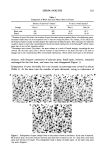
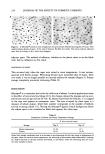
SEBUM ANALYSIS 225 For reasons of practicability the samples are often stored before being subjected to analysis. However, marked changes can occur during storage. These have been hitherto overlooked they relate to enlargement and whitening of spots along with increased translucency of the tape. These changes have dramatic effects on the number of spots and the percentage area covered. These changes may give rise to major errors in quantification. Fortunately, they can be prevented by freezer storage and by fastening the Sebutape © to a plastic sheet. We found that placing the Sebutape © on a plastic sheet and storing it in the freezer yields the most reliable results. Room temperature storage is acceptable only if samples are evaluated within 24 hours, preferably immediately after removal. In any given study the samples should be analyzed at a constant time after removal. REFERENCES (1) A.M. Kligman, D. L. Miller, and K. J. McGinley, Sebutape©: A device for visualizing and mea- suring human sebaceous secretion, J. $oc. Cosmet. Chem., 37, 369-374 (1986). (2) G. E. Pierard and C. Pierard-Franchimont, "Sebum Analysis Using a Hydrophobic Lipid-Absorbent Tape (Sebutape©)," in Noninvasive Methods for the Quantification of Skin Functions, 2nd ed., P. J. Frosch and A.M. Kligman, Eds. (Springer-Verlag, 1993) pp. 83-91. (3) K. M. Nordstrom, H. G. Schmus, K. J. McGinley, andJ. J. Leyden, Measurement ofsebum output using a lipid absorbent tape, J. Invest. Dermatol., 87, 260-263 (1986). (4) J. L. Leveque, C. Pierard-Franchimont, J. de Rigal, D. Saint-Leger, and G. E. Pierard, Effect of topical corticosteroids on human sebum production assessed by two different methods, Arch. Dermatol. Res., 283, 372-376 (1991). (5) G. E. Pierard and C. Pierard-Franchimont, Effect of a topical erythromycin-zinc formulation on sebum delivery. Evaluation by combined photometric-multi-step samplings with Sebutape ©. Clin. Exper. Dermatol. 18, 410-413 (1993). (6) C. Pierard-Franchimont, G. E. Pierard, and A.M. Kligman, Rhythm of sebum excretion during the menstrual cycle, Dermatologica, 182, 211-213 (1991). (7) C. Pierard-Franchimont, G. E. Pierard, and A.M. Kligman, Seasonal modulation of sebum excre- tion, Dermatologica, 181, 21-22 (1990). (8) G. E. Pierard, C. Pierard-Franchimont, T. Le, and C. Lapiere, Patterns of follicular sebum excretion rate during lifetime, Arch. Dermatol. Res., 279, S104-S107 (1987). (9) G. E. Pierard, C. Pierard-Franchimont, and T. Le, Seborrhoea in acne-prone and acne-free patients, Dermatologica 175, 5-9 (1987). (10) C. Pierard-Franchimont, G. E. Pierard, D. Saint-Leger, J. L. Leveque, and A.M. Kligman, Com- parison of the kinetics of sebum secretion in young women with and without acne, Dermatologica, 183, 120-122 (1991). (11) G. E. Pierard, Rate and topography of follicular sebum excretion, Dermatologica, 175, 280-283 (1987).

j. Soc. Cosmet. Chem., 45, 227 (July/August 1994) Book Review CHEMICAL AND PHYSICAL BE- HAVIOR OF HUMAN HAIR, Third Edition, by Clarence R. Robbins. Springer-Verlag, New York, 1994. 39! pages, 1!! figures. Price: $69.00. This is the third edition of Dr. Robbins' book on the chemistry and physics of hair and hair care products. The quality of the writing and the thorough coverage of hair care science in the first two editions made them required reading for anyone with a serious interest in hair research. This edi- tion easily lives up to, and even surpasses, the standard set by the previous editions. One might wonder if purchase of this book is justified since only about five years have elapsed since the second edition. I believe that it is. The book is completely updated to cover recent progress in hair science. The discussion of hair growth and androgenic alopecia has been greatly ex- panded, addressing one of the few weak- nesses in the earlier editions. The section on molecular structure of keratin and other intermediate filaments has been updated with recent information in this rapidly growing field. The other sections have also been updated and expanded to reflect the current literature. Forty nine figures have been added since the second edition, in- cluding many exceptional micrographs. For example, several outstanding SEM photos of damaged hair, illustrating vari- ous types of cuticle damage, have been added to the section on hair damage in Chapter 5. As the title implies, this is a book on hair chemistry and physics, not a formu- lary. The chemistry of each major type of hair care product is discussed quite thor- oughly, but relatively few example formu- lations are given. However, the examples given are well chosen representatives of the most important product categories. About the only thing I found missing was any discussion of hair straightening. On the other hand, reduction chemistry, which is similar, is covered very thoroughly. There is also good coverage of laboratory test methods for hair research, including vari- ous methods for determining the physical properties of hair. The physical quality of the book is out- standing. The binding and paper are of very high quality, and the micrographs are reproduced exceptionally well. It is re- markable that all this has been accom- plished at such a reasonable price ($69). Overall, this is an outstanding book. Its presentation of the chemistry of hair and hair care products is without peer in scope and clarity. ! plan to use it as a required text for my graduate class on hair, and I highly recommend it to anyone interested in this fascinating and complex area of cos- metic science.--R. RANDALL WICK- ETT, Ph.D., University of Cincinnati, College of Pharmacy. 227
Purchased for the exclusive use of nofirst nolast (unknown)
From: SCC Media Library & Resource Center (library.scconline.org)