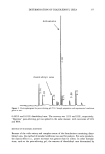
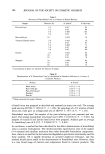
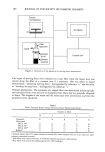
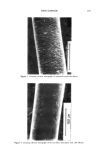
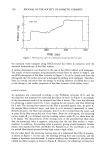
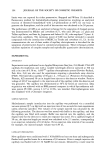
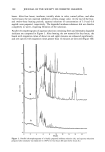
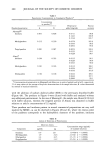
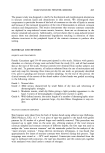
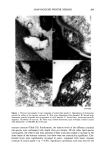
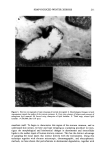
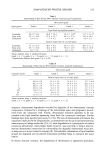
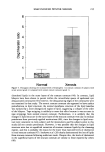
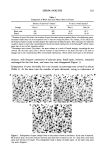
SEBUM ANALYSIS 223 Table I Comparison of Black Card and Plastic Sheet in Freezer Density of spots/cm 2 (mean) • % Area covered (mean) 2 Storage Day 0 Day 30 Day 0 Day 30 Black card 183 205 8.37 10.5 Plastic 198 168 10.91 14.43 • Number of spots: On plastic the number of spots decreases owing to gradual fusion of neighboring spots. Increased translucency can be disregarded since it does not change on plastic. By contrast, on the black card the density of spots actually increases despite the coalescence of adjacent spots. This is because the reduction caused by fusion is more than counterbalanced by the increased translucency of the Sebutape ©, which creates spots that do not in fact represent sebum. 2 Percentage area covered: On plastic, the spots enlarge as a result of lateral seepage, increasing the area covered. On the black card, there is also an increase in area however in the latter case this is due both to seepage and to the counteracting effect of increased translucency, which allows more spots to be detected. minutes, with frequent coalescence of adjacent spots. Small spots, however, remained unchanged for the first hour, and some tiny ones disappeared (Figure 1). Enlargement of spots inevitably led to an increase in percentage area covered by sebum (Table I). At the same time the number of spots decreased, owing to coalescence of Figure 1. Enlargement of spots. Sample from an oily subject stored in the freezer. A) At time of removal. B) 20 hours later the arrows indicate identical spots that have increased in size. C) 7 days later these same spots have become even larger. This enlargement leads to fusion of nearby spots. At the same time some tiny spots disappear.

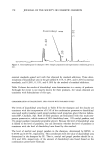
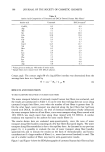
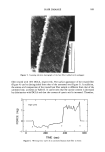
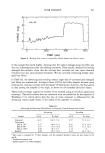
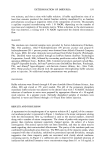
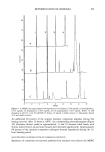
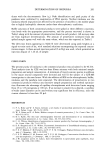
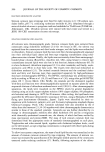
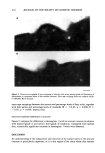
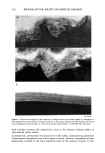
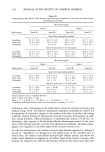
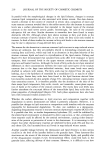
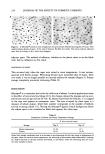
224 JOURNAL OF THE SOCIETY OF COSMETIC CHEMISTS Figure 2. In Sebutape © stored at room temperature the spots become bleached starting after 24 hours. This underestimates density of spots. A) At time of removal. B) After two weeks. The arrows indicate identical spots that are fading in fact, some may disappear. adjacent spots. The method of adhesion, whether on the plastic sheet or on the black card, had no influence on this result. WHITENING OF SPOTS This occurred only when the tapes were stored at room temperature. It was inconse- quential with freezer storage. Whitening became quite noticeable after 24 hours. After two weeks it was no longer possible to correctly analyze the samples (Figure 2). Freezer storage completely prevented whitening (Table II). DISCUSSION Sebutape © is a convenient device for the collection of sebum. Its main applications relate to the effect of topical and oral drugs (4, 5), the changes induced by diseases such as acne, and factors such as age and sex (6-10). As sebum issues from the follicles, it is trapped in the tape and appears as transparent spots. The area occupied by these spots is a measure of sebum output, while their number corresponds to the number of follicles actively secreting sebum (11). Placing the Sebutape © against a black background allows the sebum spots to be visualized as black dots against the white tape. Table II Comparison of Freezer and Room Temperature Storage % Area covered (mean) Storage Day 0 Day 14 Room temperature 12.42 13.5 Freezer 10.91 14.38 Under both storage conditions there is an increase in area beginning the first day owing to enlargement of the spots. After two weeks at room temperature, the whitening of spots makes them undetectable, resulting in a relative decrease in the area covered. Conversely, in the freezer, where the whitening does not occur, the value steadily increases.
Purchased for the exclusive use of nofirst nolast (unknown)
From: SCC Media Library & Resource Center (library.scconline.org)